Bath salts or bath bombs for evening relaxation
Bath salts and bath bombs are not interchangeable products. Their formulas, dissolution behavior, skin effects, and primary functions differ at the ingredient level.
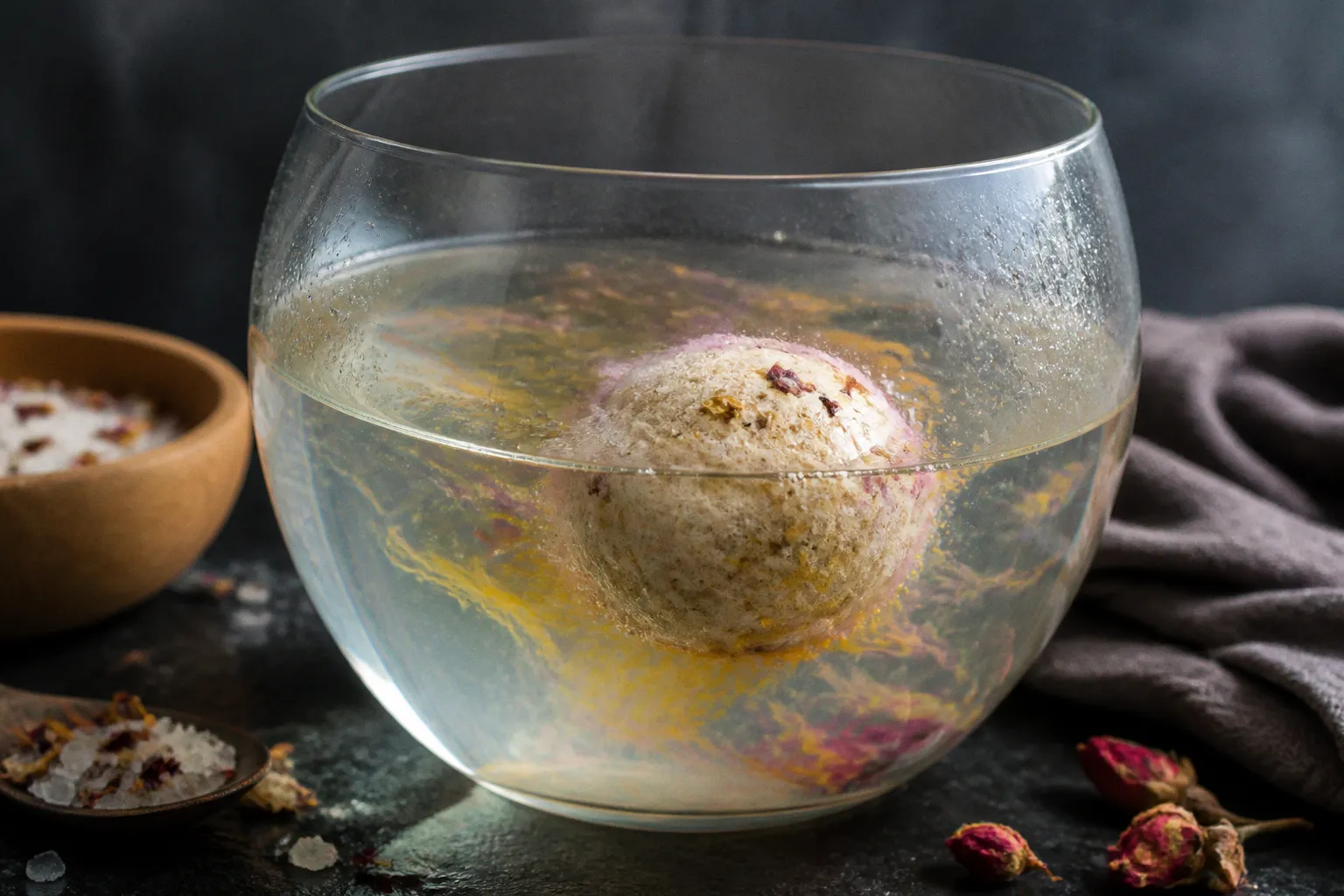
The central distinction is simple: bath salts deliver dissolved mineral compounds, while bath bombs create an effervescent reaction through sodium bicarbonate and citric acid.
Compare car rental deals in United Kingdom
See available offersPartner link — DiscoverCars comparisonThat difference matters when selecting a product for evening relaxation. If the goal is muscle comfort, a mineral soak is the more direct format. If the goal is sensory stimulation, fragrance dispersion, and a visually active bath, a bath bomb is designed for that use. Neither format should be treated as a universal solution for stress, pain, or sleep.
The relevant comparison is not which product is better in general. It is which formulation matches the intended bath ritual, skin condition, and tolerance for fragrance, residue, and post-bath dryness.
Bath salts vs bath bombs for relaxation: the functional difference
Bath salts are usually composed of mineral compounds such as magnesium sulfate, commonly called Epsom salt, Dead Sea salt, or Himalayan pink salt. The product dissolves in water and changes the composition of the bath without producing gas or foam.
Bath bombs use a different mechanism. Sodium bicarbonate reacts with citric acid when both ingredients contact water. The reaction releases carbon dioxide, creating the characteristic fizz. Fragrance, colorants, oils, butters, botanicals, and decorative materials are added around this base reaction.
The two formats therefore create different bath environments:
| Parameter | Bath salts | Bath bombs |
|---|---|---|
| Primary base | Magnesium sulfate, Dead Sea salt, Himalayan salt, or related minerals | Sodium bicarbonate and citric acid |
| Main action in water | Dissolution | Effervescent acid-base reaction |
| Carbon dioxide release | None | Yes |
| Primary use | Mineral soak and muscle-comfort routine | Sensory ritual, fragrance, color, and fizz |
| Skin-support ingredients | Sometimes oils or botanical extracts | Frequently shea butter, coconut oil, or other emollients |
| Common formulation concern | High salt concentration may feel drying on compromised skin | Fragrance, dyes, glitter, and tub residue |
| Best fit | A low-complexity soak focused on body comfort | A more active, scented bath experience |
The distinction between Epsom salt vs bath bomb is therefore a comparison between two product categories, not two competing versions of the same formula. Epsom salt is a mineral ingredient. A bath bomb is a finished, multi-component preparation.
Bath salts modify the soak. Bath bombs stage a reaction inside it.
For a practical evening routine, the choice can be made by identifying the dominant requirement:
- Muscle tension or general body aches: choose a mineral salt soak.
- Fragrance and sensory stimulation: choose a bath bomb with a controlled scent load.
- Sensitive or reactive skin: select the shorter ingredient list and avoid unnecessary fragrance, dyes, and glitter.
- Post-bath dryness: look for a product containing a compatible oil or butter, while recognizing that oils can increase tub slipperiness.
- Minimal cleanup: salts usually create less visible residue than heavily colored bath bombs, although botanicals and oils can change that result.
The science of effervescence: what a bath bomb actually does
The fizz in a bath bomb is not a sign of stronger cleansing or deeper relaxation. It is the visible result of a chemical reaction.
Sodium bicarbonate is a base. Citric acid is an acid. In the presence of water, they react and release carbon dioxide gas. The gas forms bubbles that break through the compacted product. The speed and intensity of the reaction depend on the ratio of ingredients, particle size, compression, moisture exposure during manufacturing, and water temperature.
A well-made bath bomb must remain sufficiently dry before use. If humidity enters the package, the reaction can begin prematurely. The product may expand, crack, soften, or lose much of its effervescence before it reaches the bath.
The formula usually contains more than the acid-base system. Common additions include:
- Fragrance oils or essential oils for odor and aromatherapy positioning.
- Colorants that disperse through the water.
- Oils and butters to reduce the stripped feeling associated with a high-bicarbonate formula.
- Solubilizers or dispersing agents to help oils distribute through the bath rather than remain in concentrated droplets.
- Botanicals such as dried petals, herbs, or powders.
- Glitter or mica for visual effect.
Each addition creates a technical trade-off. A high oil load can leave a film on the tub and increase slip risk. A high colorant load can stain porous surfaces or leave a ring. Dried plant material can obstruct drains. Fragrance can be tolerable for one user and irritating for another, particularly when the bath is hot and exposure occurs over a prolonged period.
Commercial bath bombs frequently rely on synthetic fragrances, artificial colorants, and glitter. These materials are not automatically unsuitable for every user, but they are relevant variables for anyone with reactive skin, eczema, psoriasis, or mucosal sensitivity. A product intended for relaxation should not create a second problem through avoidable exposure.
Effervescence is not a measure of product quality
A bath bomb that fizzes aggressively is not necessarily better formulated. Effervescence is controlled by the acid-base system and the physical structure of the tablet or sphere. It does not establish that the fragrance is well balanced, the colorant is appropriate for the intended use, or the emollient system will support the skin barrier.
The useful questions are more specific:
1. Does the product dissolve without leaving large particles?
2. Is the fragrance load disclosed clearly?
3. Does the formula include oils or butters if the base feels drying?
4. Are the colorants and decorative materials appropriate for the intended bath surface?
5. Does the product leave a persistent film or require immediate tub cleaning?
A bath bomb can perform its visual function correctly and still be a poor choice for sensitive skin. Conversely, a restrained formula with low visual drama may provide a more controlled experience.
Mineral therapy: why Epsom and other salts are used
Epsom salt is magnesium sulfate. Dead Sea salt contains a broader mineral profile, while Himalayan pink salt is primarily sodium chloride with trace minerals that contribute to its color. These materials are often marketed around muscle tension, body aches, and recovery-oriented bathing.
A salt bath can provide several practical effects:
- Warm water increases the perceived comfort of tense muscles.
- The soak creates a low-stimulation routine with no fizz, foam, or visual movement.
- Dissolved minerals alter the bathwater and can reduce the need for multiple fragrance or color additives.
- The format allows the user to control the concentration more directly.
The research fact that requires caution concerns topical magnesium absorption. The exact systemic absorption rate of magnesium through unbroken human skin during a standard 15–20 minute bath is not established in the provided evidence. A salt bath should therefore not be described as a reliable method for correcting magnesium deficiency or delivering a defined systemic dose.
The more defensible position is narrower: Epsom salt baths are commonly used as a body-comfort ritual, and warm immersion itself can support subjective relaxation. That does not make the product a medical treatment.
For a standard bathtub soak, the supplied formulation guidance uses 1 to 2 cups of Epsom salt or magnesium flakes. This is a practical bath concentration, not a prescription. More salt does not automatically produce greater benefit. Increasing concentration can intensify dryness or stinging on compromised skin.
Epsom salt, Dead Sea salt, and Himalayan pink salt
The name of the salt indicates a different mineral profile, but it does not determine the entire user experience. The finished product may also contain fragrance, starches, oils, colorants, or botanical powders.
Epsom salt is the most direct choice when the product is intended to provide a magnesium sulfate soak. It is usually visually plain and easy to dissolve.
Dead Sea salt is used in formulations positioned around mineral content and body care. Its composition differs from Epsom salt, so it should not be treated as a direct substitute in chemical terms.
Himalayan pink salt is primarily valued for appearance and its salt composition. The trace-mineral narrative should not be confused with a validated therapeutic effect.
A basic mineral soak is often easier to evaluate than a complex bath bomb because there are fewer functional variables. That advantage disappears if the salt blend contains a large fragrance load or abrasive particles.
Skin sensitivity: fragrance, dyes, and the barrier function
The skin barrier limits water loss from the stratum corneum. One useful measurement concept is transepidermal water loss, or TEWL. When the barrier is compromised, TEWL can increase, and the skin may respond with tightness, scaling, burning, or increased reactivity.
A hot bath can already challenge the barrier through prolonged water exposure and heat. A heavily fragranced or highly colored product adds another variable. The relevant issue is not whether a product is labeled natural, botanical, or clean. The relevant issue is the complete formula and the individual’s tolerance.
Why bath bombs can be difficult for reactive skin
Bath bombs often combine several potential irritants in one exposure:
- Fragrance compounds.
- Essential oils.
- Colorants.
- Citric acid.
- Sodium bicarbonate.
- Preservative systems in products containing water-based components.
- Botanical materials.
- Glitter or mineral particles.
The acid-base ingredients are necessary for the effervescent reaction, but the final bath pH and the user’s skin condition determine how comfortable the product feels. Stinging is not evidence that the product is working. It is a signal to stop exposure and rinse the skin.
Essential oils require particular caution. They are concentrated aromatic materials, not automatically mild materials. When used in bath products, they should be properly dispersed. Adding undiluted essential oil directly to bathwater is a poor formulation practice because the oil does not dissolve evenly. It can remain in concentrated droplets that contact the skin or mucous membranes.
A commonly used dilution reference is 1 ounce of carrier oil per 10 drops of essential oil. That ratio does not replace product-specific formulation work, but it illustrates the need for controlled dilution. Carrier oil alone is not always enough to disperse an essential oil evenly through a full bathtub. A properly designed bath product may require a solubilizer or another dispersing system.
Why salts are not automatically gentler
A simple salt formula may contain fewer potential irritants than a fragranced bath bomb. It can still feel drying or uncomfortable, particularly on skin with fissures, dermatitis, or an impaired barrier.
Salt is an electrolyte. At sufficient concentration, it changes the osmotic environment at the skin surface. The practical response varies by person and formula. A plain salt soak may be tolerated well, while a salt product containing fragrance and botanical extracts may not be.
For reactive skin, the most controlled route is usually:
- Use a short ingredient list.
- Avoid glitter and strong fragrance.
- Avoid products with a large number of essential oils.
- Start with a lower exposure time rather than increasing concentration.
- Rinse if burning or persistent itching occurs.
- Apply a body moisturizer after patting the skin dry.
The final step matters because water exposure can leave the skin feeling temporarily hydrated while increasing subsequent water loss if the barrier is not supported. A body butter or oil applied to damp skin can reduce the dry feel by forming an occlusive layer. The result depends on the formula, not simply on whether the product is marketed as botanical.
Balancing moisture: shea butter, coconut oil, and the bath surface
Bath bombs can contain shea butter, coconut oil, or other lipids to offset the drying feel associated with sodium bicarbonate and citric acid. These ingredients do not turn a bath bomb into a moisturizer in the same way as a leave-on body product. Much of the material is diluted in bathwater, dispersed across the tub, or rinsed away.
Their function is still relevant. Lipids can reduce the squeaky or tight sensation that some users experience after soaking. They may also leave a thin film on the skin. The film can be beneficial for dry skin, but it creates a maintenance issue: a tub with oil residue becomes slippery.
Shea butter contains a complex mixture of fatty acids and unsaponifiable components. Coconut oil is more saturated and has a different spread and solidification profile. Neither ingredient should be evaluated in isolation. The final sensory and barrier effect depends on concentration, particle distribution, emulsification, and the presence of dispersing agents.
Emulsification and dispersion are not optional details
Water and oil do not naturally form a stable, uniform mixture. In a leave-on cream, emulsification combines an aqueous phase and an oil phase through an emulsifier system. In a bath product, dispersion determines whether oils distribute through the bathwater or remain as separate droplets.
A bath bomb containing oil but no suitable dispersing strategy may deposit concentrated oil on the tub and skin. This increases slip risk and reduces predictability. A product can contain a high-quality butter and still be poorly designed for bath use.
The same principle applies to essential oils. An aromatic material may be botanically sourced and still require controlled dispersion. Natural origin does not resolve the physical chemistry.
Comedogenic scale ratings are also limited in this context. The comedogenic potential of an ingredient is not a fixed property that predicts every user’s response. Concentration, cleansing, exposure time, formulation, and individual skin biology all influence the outcome. A short bath exposure cannot be assessed in the same way as a leave-on facial product.
In bath chemistry, ingredient identity is only one variable. Concentration, dispersion, exposure time, and skin condition determine the result.
Residue is a formulation issue, not a category verdict
Bath bombs are more likely to leave visible residue because they commonly contain oils, colorants, clays, mica, glitter, and botanicals. Salts can also leave residue if they contain plant material, heavy fragrance oils, or insoluble additives.
A product that creates a thick film is not necessarily more moisturizing. It may simply be depositing excess oil that was not dispersed effectively. Likewise, a brightly colored bath is not evidence of a superior formula.
A low-residue product should have:
- Controlled colorant use.
- No loose glitter.
- Minimal insoluble botanical material.
- A reasonable oil load.
- Ingredients that dissolve or disperse predictably.
- Packaging that keeps the formula dry until use.
Choosing the product for the intended evening routine
The best bath product for stress relief depends on what “relief” means in the routine. That word can refer to lower sensory stimulation, reduced perception of muscle tension, fragrance exposure, or a transition away from work and screen use. The formula cannot determine every part of that experience.
Choose bath salts when the routine needs lower complexity
Bath salts are suitable when the user wants a mineral soak without fizz, color, or a long ingredient list. Epsom salt or magnesium flakes can be measured directly into the bath. The product is easy to adjust and usually produces less visual activity.
A salt soak is particularly practical when:
- The bath is intended to follow physical activity.
- The user prefers no strong fragrance.
- The tub surface is difficult to clean.
- The skin tolerates salt exposure.
- The objective is a quiet, mineral-focused routine.
Use the recommended amount rather than treating higher concentration as a shortcut. The supplied guidance is 1 to 2 cups per standard bathtub soak. A longer or hotter bath is not automatically more effective and may increase dryness.
Choose bath bombs when the sensory ritual is the point
Fizzy bath bombs are appropriate when the user wants a visible dissolution process, fragrance, color, and a product that feels more event-based. Their main function is sensory. They may provide light skin moisturization when formulated with oils or butters, but they should not be described as superior for muscle recovery.
A bath bomb is more suitable when:
- Effervescence is part of the desired ritual.
- The user tolerates fragrance and colorants.
- Tub cleanup is acceptable.
- The product does not contain loose glitter or excessive botanicals.
- The user wants a pre-portioned format.
A bath bomb with a strong scent is not necessarily a better aromatherapy bath soak option. Fragrance intensity depends on volatile compounds and concentration. Stronger odor can increase irritation risk without adding a measurable relaxation benefit.
Match the product to the surface and drainage system
The bathroom itself is part of the selection criteria. A bath bomb containing dark pigments, mica, oils, petals, or glitter can require more cleaning than a plain mineral salt. In an older or porous tub, residue may be more difficult to remove. Loose botanicals can also create a drain problem.
A product intended for frequent use should be evaluated for the routine after the bath, not only the moment of dissolution. If the formula requires repeated scrubbing, increases slip risk, or leaves residue on towels, it may not support a consistent evening ritual.
A controlled approach to aromatherapy bath products
Aromatherapy products often combine essential oils with a bath base. The term describes an aromatic use pattern, not a guarantee of therapeutic action. Essential oils can contribute odor and may influence perceived relaxation, but the response is individual and the safety profile depends on dose and dispersion.
Three formulation errors are common:
1. Adding undiluted essential oil directly to bathwater.
Oil does not dissolve in water. Concentrated droplets can contact the skin unevenly.
2. Assuming botanical origin means low irritation.
Essential oils are concentrated plant extracts. Some are sensitizing or irritating, especially with repeated exposure.
3. Ignoring total fragrance exposure.
A bath product may contain essential oils, fragrance oils, scented candles, diffuser exposure, and fragranced body care in the same room. The combined odor load can become excessive.
For a more controlled routine, use one primary aromatic source. If the bath product is fragranced, there is usually no need to add separate essential oil to the water. If a diffuser is used, lower the total fragrance intensity rather than layering multiple concentrated sources.
This is also where soy wax candles and essential oil diffusers differ from bath products. A candle primarily affects the room air. A bath product creates direct skin and mucosal exposure. The safety evaluation is not interchangeable.
How to build a lower-risk evening soak
A reliable routine does not require a complex product stack. The more ingredients introduced at once, the more difficult it becomes to identify the source of irritation or residue.
A controlled sequence can look like this:
1. Select one bath format.
Use salts or a bath bomb rather than combining several fragranced products in the same water.
2. Read the full ingredient list.
Look for the base, fragrance, colorants, oils, butters, botanicals, and any decorative materials.
3. Use the intended dose.
For Epsom salt or magnesium flakes, the supplied guideline is 1 to 2 cups per standard bathtub soak. For a bath bomb, use the manufacturer’s portion rather than adding extra product to intensify fragrance or color.
4. Control water temperature and exposure time.
Very hot water and prolonged immersion can increase dryness and may reduce comfort for users with reactive skin.
5. Keep the product away from mucous membranes.
Fizzing acids, fragrance materials, dyes, and concentrated oils can irritate sensitive tissue.
6. Rinse when residue or irritation is present.
A clear-water rinse removes remaining salts, colorants, fragrance materials, and oils from the skin surface.
7. Apply a leave-on moisturizer.
A body butter can provide occlusion. A body oil can reduce the dry feel through lipid deposition. Neither should be applied to a wet, slippery tub surface.
8. Clean the tub after an oil-rich or heavily colored formula.
This is a safety step, not a cosmetic preference.
A product should support repeatable use. If it creates irritation, heavy residue, or excessive fragrance, its performance should be judged accordingly, regardless of how attractive the packaging or ingredient story may be.
The practical verdict: salts or bombs?
For bath salts vs bath bombs for relaxation, the choice is best reduced to function:
- Bath salts are the more direct option for a mineral-centered soak and a routine focused on muscle comfort.
- Bath bombs are the more direct option for fizz, fragrance, color, and sensory engagement.
- Unscented or lightly scented salts generally provide fewer formulation variables.
- Bath bombs with shea butter or coconut oil may reduce the dry feel of the base but can increase tub residue and slip risk.
- Neither format should be used to make medical claims about pain treatment, magnesium correction, or recovery.
- Sensitive skin requires formula restraint, not a marketing label.
The strongest product is not the one with the longest ingredient list or the most visible reaction. It is the one whose chemistry matches the intended exposure.
Do
- Do choose Epsom salt or magnesium flakes when the objective is a mineral soak.
- Do use 1 to 2 cups of salt per standard bathtub soak when following the supplied dilution guidance.
- Do select a bath bomb with a transparent ingredient list and controlled fragrance.
- Do consider shea butter or coconut oil when a bath bomb tends to leave the skin feeling dry.
- Do account for emulsification, oil dispersion, tub residue, and slip risk.
- Do stop exposure if burning, itching, or persistent redness develops.
- Do apply a body moisturizer after bathing if the skin feels tight.
Don’t
- Don’t treat vigorous fizz as evidence of therapeutic performance.
- Don’t assume topical magnesium absorption through unbroken skin is established at a specific systemic dose.
- Don’t add undiluted essential oils directly to bathwater.
- Don’t assume synthetic fragrance, natural fragrance, or essential oils are universally suitable for eczema, psoriasis, or sensitive skin.
- Don’t use excess salt or multiple fragranced products to intensify relaxation.
- Don’t ignore glitter, loose botanicals, dark colorants, or oil residue.
- Don’t leave an oil-coated tub without cleaning it.
Bath salts and bath bombs solve different formulation problems. Mineral salts simplify the soak. Bath bombs add a controlled acid-base reaction and a larger sensory system. The correct choice is the one that delivers the intended routine without creating unnecessary exposure, residue, or barrier stress.