Soy candle scent throw: steps from first burn to maximum aroma
A soy candle can smell beautifully strong in the jar and still seem strangely quiet once lit.
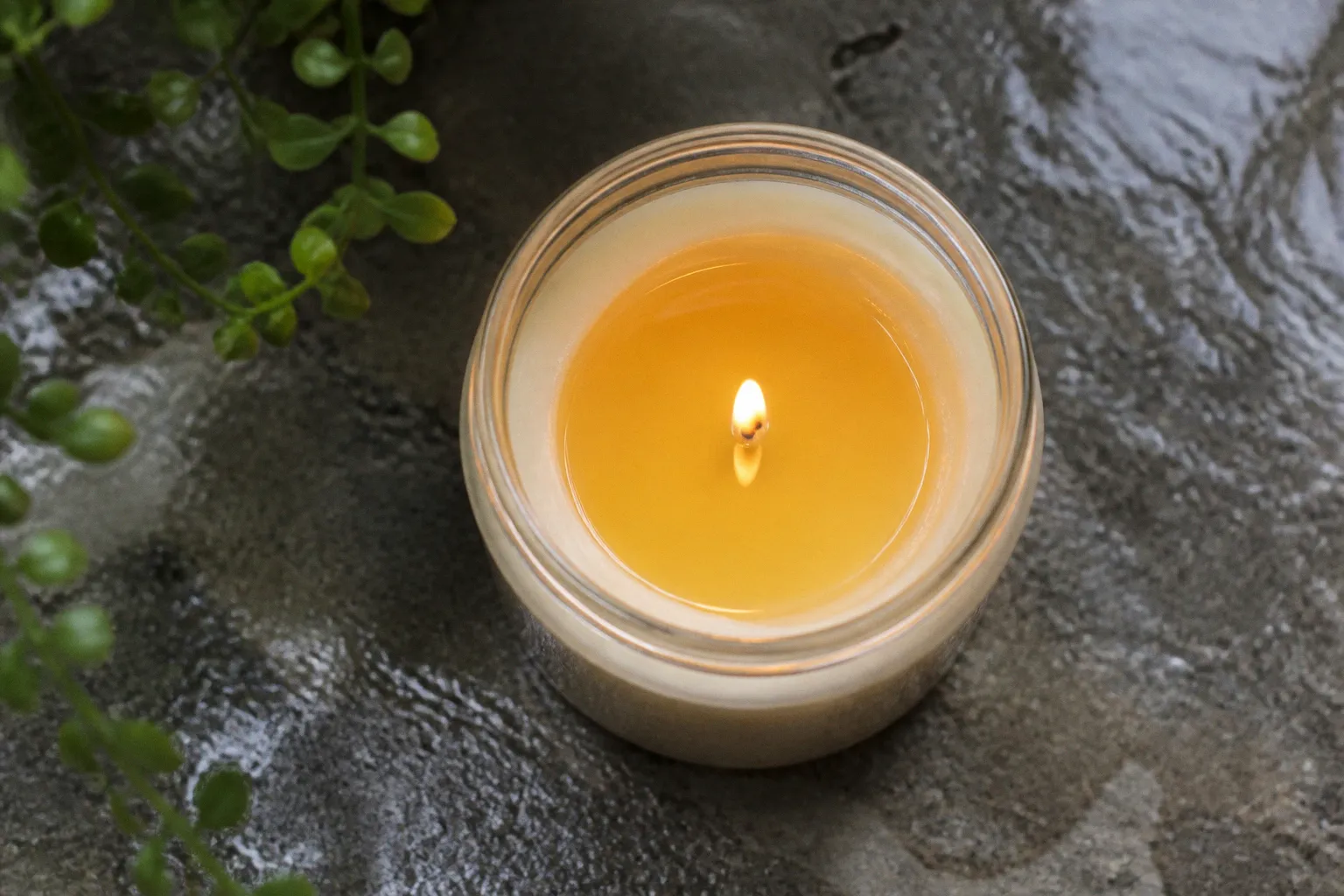
That mismatch usually comes from one of two things: the fragrance has not had enough time to settle into the wax, or the candle is not developing the right melt pool during its burn.
For reliable soy candle scent throw optimization, I look at the entire sequence rather than one dramatic fix. Fragrance load, incorporation temperature, cure time, wick performance, jar diameter, and burn duration all work together. A candle with a generous amount of fragrance oil can still produce a weak hot throw if the wax was poured too soon, the wick is poorly matched, or the first burn creates a narrow tunnel instead of a full melt pool.
The useful distinction is simple: cold throw is the scent you notice from an unlit candle, while hot throw is the aroma released as the candle burns. They are related, but they are not interchangeable. A compelling cold throw is encouraging; it is not proof that the candle will scent a room well.
The chemistry begins before the candle is lit
Soy wax has its own crystal structure, and fragrance oil needs time to settle into that structure. The way the fragrance is added and mixed affects how evenly it is distributed through the wax. This is why scent throw begins at the pouring stage, not at the moment you strike a match.
For 100% soy container wax, fragrance oil is commonly added when the wax is between 185°F and 190°F. The fragrance should then be stirred thoroughly for two minutes. That stirring is not decorative. It gives the oil time to disperse through the molten wax instead of remaining unevenly suspended.
In my formulation work, I think of the candle as a small aromatic system with three working parts:
- Primary component: the soy wax, which forms the structure and determines how fragrance is held and released.
- Secondary component: the fragrance oil, whose olfactory notes need to be distributed evenly throughout that structure.
- Trace components: the wick, vessel, dye, additives, ambient temperature, and airflow, each of which can change how heat travels through the candle.
The fragrance oil may carry the most noticeable scent, but the wax and wick determine whether that scent has a practical route into the room.
A typical fragrance load for soy container candles falls between 8% and 10% by weight. More is not automatically better. Once the wax is overloaded, the excess oil may interfere with the candle’s burn rather than creating a fuller aroma. A wick can struggle with a candle that contains too much unbound or poorly incorporated fragrance, producing an uneven flame, excess soot, or a melt pool that does not reach the vessel edge.
A strong fragrance formula still needs a controlled path from wax crystal to melt pool to air.
Temperature is a formulation decision, not a superstition
Candle makers often focus on the pouring temperature because it affects the surface finish, frosting, adhesion, and texture of soy wax. Those are important concerns, but fragrance incorporation deserves equal attention. If fragrance oil is added at the wrong stage or mixed too briefly, the candle may smell promising when cold while releasing less aroma when heated.
This does not mean there is one universal temperature that works for every wax blend and fragrance. Wax manufacturers may give their own recommendations, and fragrance oils vary in viscosity. A thick, resinous blend behaves differently from a light citrus or floral composition. Still, the supplied guidance for soy container wax places fragrance addition at 185°F to 190°F, followed by continuous stirring for two minutes.
That is the first scent throw milestone: not the first light, but the moment the fragrance is properly incorporated.
Why soy candles need a cure period
Freshly poured soy wax is not yet at its most settled state. The wax continues to form and stabilize its crystal structure as it cools and rests. During this curing period, fragrance oil has time to bond more fully with the wax crystals.
For 100% soy container wax, the minimum cure time is five days, while the more reliable target is fourteen days. In practical terms, this creates two useful points on the timeline:
| Cure stage | What it tells you | How to approach the candle |
|---|---|---|
| Under 5 days | The wax is still too fresh for a dependable performance judgment | Avoid treating the first light as a final scent test |
| 5–7 days | The candle may be usable, but the fragrance profile can continue developing | Evaluate cautiously, especially with heavier blends |
| 1–2 weeks | The wax has had time to settle and the fragrance to bond more completely | This is the preferred window for assessing hot throw |
| Around 14 days | A practical benchmark for mature soy wax performance | Use this point for consistent comparisons between candles |
The two-week cure period is not a marketing flourish. It is one of the clearest soy candle scent throw milestones because it separates early impressions from a more stable performance picture.
A candle lit within the first day or two may smell pleasant, but that does not tell you how it will perform after the wax has matured. The aroma can seem thinner, sharper, or less integrated than it will later. This is particularly noticeable in blends with deeper base notes, such as woods, resins, amber-style accords, vanilla, or dense florals. Lighter top notes may appear vivid early, while the full olfactory profile has not yet settled.
Store the candle quietly while it cures
During curing, keep the candle covered or protected from dust and strong surrounding odors. Store it at a relatively stable room temperature, away from direct sunlight and significant heat changes. You do not need to create a complicated ritual around this stage. The goal is simply to let the wax rest without unnecessary disturbance.
Do not move the candle from a warm room to a cold one and then judge its surface or scent immediately. Soy wax is sensitive to environmental shifts, and the vessel itself can feel cold even when the room is comfortable. A stable environment makes the eventual burn easier to interpret.
For personal use, five days may be enough to begin a gentle evaluation. For a serious scent comparison, I prefer the full 14-day cure. That gives the fragrance and wax a more consistent starting point and prevents you from rejecting a candle that was simply assessed too early.
The first burn establishes the candle’s memory
The first burn is the most consequential burn because it sets the pattern for future melting. If the wax melts only in a narrow circle around the wick, the candle can develop tunneling. Later burns may continue to follow that recessed path, leaving a thick ring of unmelted wax around the vessel wall.
A tunnel does more than waste wax. It reduces the surface area of the fragrance-bearing melt pool, which can weaken the hot throw. The candle has less warm liquid wax available to release fragrance into the surrounding air.
For the first burn, allow enough time for the melt pool to reach edge to edge across the container. A useful working guide is approximately one hour of burn time per inch of jar diameter. The exact result depends on the wick, vessel, wax blend, and room conditions, but the principle is consistent: the first burn should create a full, even melt pool rather than a small central well.
Do not extinguish the candle after a few minutes simply because the flame looks attractive. A short first burn may leave a ring of solid wax that becomes the boundary for every later session.
What to observe during the first burn
I pay attention to several physical cues before evaluating the fragrance itself:
1. Flame stability: The flame should burn steadily rather than shrinking, flaring, or repeatedly struggling.
2. Melt-pool width: The liquefied wax should gradually move toward the vessel edges.
3. Melt-pool depth: A shallow pool may not release fragrance as effectively as a properly developed pool, while excessive depth can suggest an overly aggressive wick.
4. Container heat: The jar should not become uncomfortably overheated during normal use.
5. Surface behavior: Excessive soot, mushrooming, or a visibly smoky flame suggests that the wick and fragrance system need attention.
6. Aroma development: Notice when the scent begins to fill the immediate area, and whether the profile remains balanced as the pool expands.
The scent may be modest at the beginning of the burn and become more noticeable once the melt pool is established. That is normal. Hot throw depends on warmed wax, and warmed wax needs time to form across the container.
A full melt pool should not be forced by burning the candle indefinitely. If the vessel becomes excessively hot or the flame grows unstable, extinguish it safely and reassess the wick selection. Scent throw is never improved by ignoring burn safety.
The Goldilocks zone of burn time
For most soy container candles, an ideal burn session lasts between two and four hours. That window gives the candle enough time to develop a useful melt pool and release fragrance without allowing the wax and vessel to overheat unnecessarily.
Burning for less than two hours often leaves too much solid wax around the edges. The result can be a reduced hot throw and progressive tunneling. Burning beyond four to six hours, however, can overheat the wax and degrade fragrance performance. The flame may become less controlled, the vessel may become excessively hot, and the fragrance may lose some of its balance.
This is where many weak scent throw complaints become difficult to diagnose. The candle may not have a formulation problem at all. It may be receiving short, interrupted burns that never let the aromatic system reach its working temperature.
A practical burn rhythm
For a new soy candle, I recommend this sequence:
- Let the candle cure for at least five days, with fourteen days as the preferred benchmark.
- Trim the wick before lighting so the flame is not asked to burn through an unnecessarily long wick tip.
- On the first burn, give the candle enough time to develop an edge-to-edge melt pool.
- Use the jar diameter as a guide, allowing roughly one hour per inch while still respecting the two-to-four-hour practical window.
- During later burns, keep sessions within two to four hours whenever possible.
- Extinguish the candle if the vessel becomes excessively hot, the flame becomes unstable, or soot begins accumulating.
- Allow the wax to cool and solidify before moving the candle or trimming the wick again.
The important point is consistency. A candle that is burned for twenty minutes one day, five hours the next, and then left untouched for a month is difficult to evaluate. A repeatable burn pattern gives you a clearer sense of the formula’s actual hot throw.
The first burn is not a quick preview; it is the foundation for every burn that follows.
Why cold throw can mislead you
Cold throw is the fragrance detected from an unlit candle. It is useful for judging the initial impression, the balance of olfactory notes, and whether the scent remains pleasant at room temperature. But it does not reproduce the heat-driven release of fragrance from the melt pool.
A candle can have an expressive cold throw because volatile aromatic materials are readily noticeable near the surface. Once lit, however, the candle depends on heat distribution, wick behavior, melt-pool size, and the ability of the wax to release fragrance at the correct rate.
The reverse can also happen. A candle may seem restrained when cold but become rounded and persuasive once warmed. Base notes often become more apparent through heat, while certain bright top notes may soften. This is why I avoid making a final judgment from the jar alone.
When assessing hot throw, give the candle time to develop. Move through the room rather than pressing your nose directly over the vessel. The immediate area above the flame is not the same as the way fragrance behaves at normal breathing height. Since room size, ventilation, ceiling height, furnishings, and drafts vary, there is no universal scent-throw distance that applies to every candle.
A smaller, still room may hold fragrance differently from a large open-plan space. An essential oil diffuser, open window, kitchen aroma, or strongly scented body product can also alter your perception. For a cleaner assessment, evaluate the candle in a familiar room with other competing fragrances reduced.
Fixing weak hot throw in soy candles
If your candle smells weak while burning, resist the urge to add more fragrance immediately. Fragrance load is only one part of the system, and increasing it beyond the wax’s workable range can create new problems.
Start with the timeline and the burn pattern. These are the simplest variables to correct.
1. The candle was tested too soon
A soy candle lit before the minimum five-day cure may not show its mature scent profile. If it was tested within the first twenty-four hours, the result is especially difficult to interpret. Set it aside and reassess after a longer cure, ideally at the fourteen-day point.
2. The fragrance was not incorporated thoroughly
Adding fragrance within the recommended temperature range is only half the process. The oil also needs thorough mixing. In the supplied guidance, that means stirring continuously for two minutes at 185°F to 190°F.
Insufficient mixing can create uneven fragrance distribution. One candle may smell fuller than another from the same batch, or the cold throw may seem stronger than the hot throw suggests.
3. The first burn was too short
If the first burn ended before the melt pool reached the vessel edge, tunneling may already be limiting scent release. A narrow melt pool exposes less warmed wax, and less warmed wax generally means a quieter aroma.
For a jar with a wider diameter, the first burn can require patience. The one-hour-per-inch guide is useful, but it should be balanced with the two-to-four-hour session range and the candle’s safety behavior.
4. The wick is not distributing heat effectively
The wick has to create enough heat to melt the wax across the intended surface without overheating the container. A wick that is too small may leave unmelted edges and produce weak hot throw. A wick that is too large may generate excessive heat, soot, mushrooming, or a melt pool that becomes too deep too quickly.
This is a formulation issue rather than a fragrance-only issue. A higher fragrance load cannot compensate for poor heat distribution. The wax, vessel diameter, wick series, fragrance viscosity, and load percentage need to be considered together.
5. The fragrance load is outside the useful range
For soy container candles, an 8% to 10% fragrance load by weight is a common working range. The correct level still depends on the wax and fragrance oil, but treating the upper limit as an automatic performance guarantee is a mistake.
A candle overloaded with fragrance may burn poorly, release an oily surface, struggle to maintain a clean flame, or produce an aroma that feels dense rather than diffusive. The target is not the largest possible amount of oil. The target is a stable synergy between the carrier wax, the fragrance, and the wick.
6. The room is absorbing or dispersing the aroma
Soft furnishings, high ceilings, open doors, air conditioning, and active ventilation can all change how a scent is perceived. A candle may perform normally but feel weak in a large or drafty room.
This is also why I prefer describing scent throw in sensory terms rather than promising a fixed coverage area. Terms such as airy, close, diffusive, resinous, sheer, or enveloping communicate the character of the aroma without pretending that every home provides the same conditions.
Reading the fragrance profile, not just its volume
Maximum aroma does not necessarily mean maximum intensity. A well-made candle should express its olfactory notes with clarity. If the scent becomes harsh, overly sweet, smoky, or flat as it heats, the problem may be balance rather than strength.
Fragrance materials have different evaporation behavior. Bright citrus and green notes may appear quickly, while woods, balsams, vanilla-style notes, and musks tend to provide persistence and body. A blend with only delicate top notes can feel fleeting even when the candle is burning correctly. A blend dominated by heavy base notes may feel rich at close range but less diffusive across a room.
The carrier also matters. Soy wax offers a softer, creamier structure than many paraffin-heavy systems, and that affects both viscosity and release. The same fragrance oil can behave differently in different waxes because the wax holds and releases it through a different physical matrix.
When I evaluate a candle, I ask:
- Does the fragrance become more rounded as the melt pool expands?
- Are the top, middle, and base notes still distinguishable?
- Does the aroma remain pleasant after two hours, or does it become heavy?
- Is the scent present beyond the immediate area around the vessel?
- Does the fragrance remain consistent from one burn session to the next?
- Is the wick producing enough heat without creating smoke or excessive soot?
These questions reveal more than simply asking whether the candle is strong.
A clear route to better scent throw
If you are working with a soy candle that feels underwhelming, use this order rather than changing everything at once:
1. Confirm the cure period. Wait at least five days; use fourteen days as the stronger benchmark for evaluation.
2. Review fragrance incorporation. Add the fragrance at 185°F to 190°F and stir thoroughly for two minutes.
3. Check the fragrance load by weight. Keep the formula within the wax and fragrance supplier’s workable range; 8% to 10% is a typical soy container candle recommendation.
4. Reset the first burn. Aim for an edge-to-edge melt pool while keeping the session within a safe two-to-four-hour window.
5. Observe the wick. Look for tunneling, unstable flame behavior, excessive soot, or a melt pool that is too shallow or too aggressive.
6. Evaluate the room. Reduce drafts and competing scents before deciding that the candle itself is weak.
7. Assess the scent profile. Distinguish a genuinely weak hot throw from a deliberately soft, sheer, or base-note-led fragrance.
8. Change one variable at a time. Otherwise, you will not know whether the improvement came from curing, wick performance, burn duration, or formula adjustment.
This sequence keeps the diagnosis practical. It also prevents the most common overcorrection: adding more fragrance when the actual issue is an immature cure or an incomplete melt pool.
The final burn habit matters
A soy candle’s aroma is built through small, repeatable decisions. Let the wax cure. Incorporate the fragrance thoroughly. Give the first burn enough time to reach the container edges. Keep later sessions around two to four hours. Watch the wick and melt pool rather than judging only the scent in the jar.
For the most dependable result, mark the pour date on the candle and wait until the fourteen-day point before making a final hot-throw assessment. Then burn it in a stable room, trim the wick, and allow the melt pool to develop fully without pushing the session beyond a sensible duration.
That is the practical route to stronger, cleaner, more balanced soy candle scent throw: not simply more fragrance, but better timing, better heat distribution, and a wax system given enough time to mature.