Masculine body wash scent traps that waste money
If your shower gel smells rich, smoky, and impressively woody in the bottle but disappears before you have finished getting dressed, the problem is not necessarily your skin or your nose. It is the format.
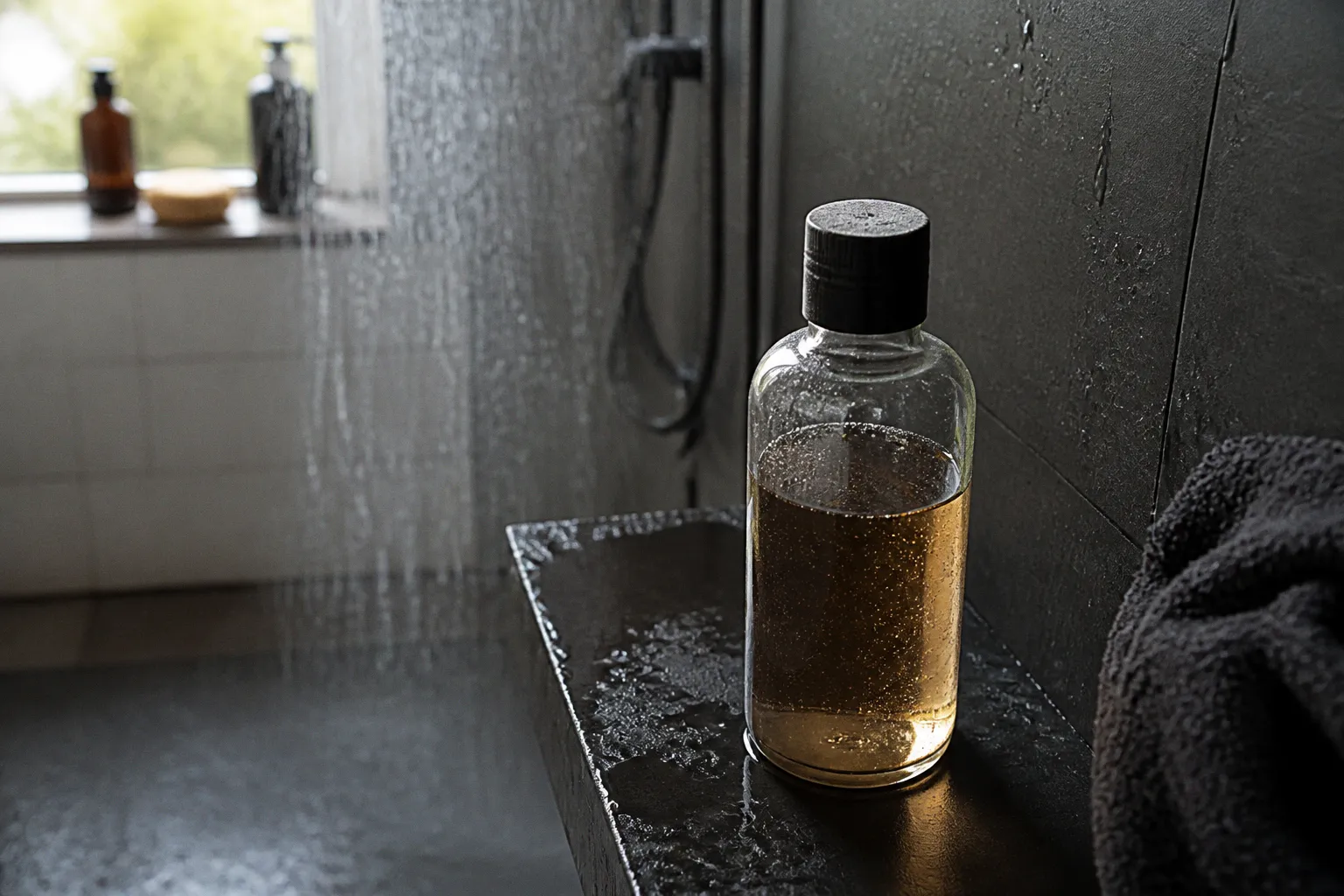
A body wash is designed to cleanse and rinse away, while fragrance is designed to remain on the skin. Those two jobs naturally work against each other.
This is the central misunderstanding behind masculine body wash scent longevity. A premium body wash can offer a beautiful olfactory opening, a refined lipid profile, and a more comfortable post-shower finish than a basic cleanser. What it cannot reliably do is behave like cologne after you rinse it down the drain. The route to a lasting scent begins with understanding what happens during cleansing, then building a sensible carrier system after the shower.
The science of the rinse: why surfactants take fragrance with them
A body wash is not simply scented water in a handsome bottle. Its cleansing system usually contains surfactants: molecules that help lift sweat, sebum, dirt, and product residue from the skin so they can be carried away with water.
That is precisely why the product works. Surfactants interact with both water and oil, gathering oily material into structures that can be rinsed away. Fragrance oils are also oil-based. Many of the aromatic materials that create a polished masculine profile—citrus fractions, herbs, woods, resins, and musks—are therefore exposed to a cleansing system designed to remove oily substances.
During the shower, several things happen at once:
- The body wash spreads across wet skin, where warmth increases the volatility of many aromatic molecules.
- Surfactants and emulsifiers surround or bind some fragrance components.
- Water dilutes the formula and carries much of the cleansing system away.
- Rinsing removes the majority of the scent-bearing product from the skin.
- The fragrance that remains is usually only a small, uneven film rather than a perfume-like deposit.
This is not a formulation failure. It is the expected behavior of a rinse-off product.
A luxurious body wash can still be worthwhile. Its value may sit in the quality of the cleansing experience, the feel of the skin afterward, the elegance of the fragrance during use, and the way it prepares the body for a lotion, oil, or cologne. But the fragrance performance has to be judged within those boundaries.
A body wash can make the shower smell exceptional without making your skin smell exceptional all day.
Why more fragrance is not a simple solution
It is tempting to assume that a stronger-smelling shower gel must contain more fragrance, and that more fragrance must produce longer wear. In practice, scent intensity in the bottle is a poor predictor of scent persistence on the body.
A formula can smell powerful in a closed container because volatile aromatic materials accumulate in the airspace above the product. Once the product is diluted over wet skin and rinsed, that impression changes quickly. A dense cedar or amber accord may feel substantial while you are lathering, but its performance after rinsing depends on what remains on the skin and how quickly those materials evaporate.
There is also a sensory trick at work. Fresh citrus, mint, eucalyptus, and other bright top notes create immediate impact. They announce themselves quickly, which makes a cleanser feel highly scented. Yet these materials are often among the first to disappear. A softer base built around sandalwood, cedar, amber, or musk may be less dramatic at the beginning but more noticeable later—provided enough of it remains after the rinse.
The formula must also balance fragrance with skin tolerance. Increasing aromatic load indiscriminately can make a product more irritating or uncomfortable, particularly on dry, freshly shaved, or sensitive areas. Good masculine grooming is not a competition for the loudest shower.
“Longevity-washing” and the language of the bottle
The beauty industry has a persuasive vocabulary for scent: enduring, intense, all-day, long-lasting, signature, amplified. Some of those words may describe the fragrance experience inside the shower. They do not automatically describe what happens several hours later.
The term “longevity-washing” is used for exaggerated claims about how long a personal-care product performs, especially when the wording suggests endurance without meaningful clinical or formulation evidence. The issue is not that a body wash smells good. The issue is that a rinse-off cleanser may be presented as though it offers the staying power of a leave-on fragrance.
When I assess a masculine body wash, I separate three different experiences that are often folded into one marketing promise:
1. In-bottle impact — how concentrated, vivid, or polished the fragrance smells before use.
2. In-shower diffusion — how the scent develops in warm steam while the product is being massaged over the body.
3. Post-rinse persistence — how much fragrance remains on the skin after drying and dressing.
These are related, but they are not interchangeable. A body wash may excel at the first two and offer only a quiet trace of the third.
What a premium price can reasonably buy
A higher price may reflect a more elegant carrier system, better surfactant selection, botanical extracts, a more refined fragrance composition, or a richer after-feel. It can also reflect packaging, small-batch production, and the work of an independent perfumer or formulator.
What the price should not lead you to assume is that the cleanser will replace a dedicated fragrance.
A premium masculine body wash may give you:
- A less stripped, more comfortable skin feel after cleansing.
- A more nuanced fragrance with distinct top, heart, and base notes.
- Better compatibility with a matching body lotion, butter, or oil.
- A denser lather or smoother slip during application.
- A more considered experience for post-workout, morning, or evening grooming.
Those are tangible benefits. They simply belong to the category of cleansing and ritual rather than eight-hour fragrance wear.
For context, dedicated men’s fine fragrances commonly occupy a much longer wear category, often around 8 to 12 hours depending on the composition, concentration, application, and individual skin. A wash-off product should not be evaluated by that same standard.
The thirty-minute fade: top notes, base notes, and the masculine scent arc
When someone asks me why body wash scent fades, I usually begin with the fragrance architecture. Every fragrance is a moving composition. It does not remain in the same shape from the first inhale to the final trace.
Top notes: the quick lift
Top notes create the first impression. Citrus, mint, aromatic herbs, and other lighter materials can feel clean, sharp, cool, or energetic. They are particularly effective in body wash because they make the shower feel fresh and immediately scented.
Their trade-off is volatility. Citrus and mint top notes can fade within roughly 15 to 30 minutes after application. In a rinse-off format, some of that evaporation occurs while you are still showering, and much of the remaining fragrance leaves with the water.
This is why a body wash that opens with bergamot, grapefruit, spearmint, or a cool herbal accord can smell almost silent once you have dried off. The fragrance has not necessarily failed; its quickest materials have simply completed their part of the composition.
Heart notes: the character of the blend
Heart notes give the fragrance its personality after the initial freshness settles. In masculine profiles, these may include lavender, aromatic greens, spices, geranium, tea, or softer woods. They create the bridge between the bright opening and the deeper base.
In a body wash, the heart can be muted by surfactants and emulsifiers, especially when the fragrance is surrounded by a cleansing matrix that affects how readily its components volatilize. What you smell on wet skin may therefore be less linear than what you imagined from the bottle.
Base notes: the slower, deeper residue
Base notes such as sandalwood, cedar, amber, and certain musks tend to linger longer than citrus or mint. They have a lower volatility and can remain perceptible after the brighter materials have faded.
But “longer” does not mean “all day,” particularly after rinsing. The amount left on the skin matters more than the mere presence of a base note in the formula. A cedar accord can have excellent staying power in a leave-on oil or cologne while leaving only a faint woody impression after a shower.
| Fragrance layer | Common masculine examples | What you notice | Likely behavior in body wash |
|---|---|---|---|
| Top | Citrus, mint, eucalyptus, bright herbs | Immediate freshness and lift | Often fades quickly, sometimes within 15 to 30 minutes |
| Heart | Lavender, aromatic greens, spices, softer woods | The recognizable personality of the blend | Can be softened by dilution, surfactants, and rinsing |
| Base | Sandalwood, cedar, amber, musk | Warmth, depth, and lingering character | More persistent, but only if enough remains after rinsing |
| Leave-on support | Body oil, butter, lotion, cologne | A continuous scent trail on hydrated skin | Best route to extending the fragrance beyond the shower |
A useful test is to stop judging the product while the bathroom is still full of steam. Notice the scent on your skin after drying, then again after you have dressed. The fragrance that matters is the one that remains when the shower environment is gone.
Skin chemistry and hydration: the quiet factors in scent retention
The same body wash can smell different from one person to another. Skin temperature, sebum levels, climate, recent shaving, and the condition of the skin barrier all influence scent behavior.
Dry or tight skin tends to let fragrance evaporate more quickly. Hydrated skin holds scent molecules more effectively because the surface offers a more comfortable, cohesive environment for aromatic materials. This is one reason a rich body butter or lightweight oil can make such a difference even when it contains only a modest amount of fragrance.
The sensation of tightness after a hot shower is especially relevant. Hot water can leave the skin feeling depleted, while an aggressive cleansing system may remove more surface oil than your body needs. When the skin is dry, the fragrance has less of a supportive lipid film. The result is often a sharp opening followed by a very fast disappearance.
Body butter or body oil?
Both can support scent layering, but they create different sensory finishes.
A body oil has a more fluid viscosity and usually spreads quickly over damp skin. Its carrier system may include jojoba, squalane, sunflower, grapeseed, or another plant-derived oil, depending on the formulation. The finish can range from dry and satin-like to more cushiony and occlusive.
A body butter has a higher viscosity and typically contains a blend of butters, oils, and structuring materials. Shea butter, mango butter, cocoa butter, and waxes can create a more substantial film. This may feel ideal on elbows, knees, shins, and other areas that become visibly dry, though it may be too rich for someone who dislikes residue.
For men who want a masculine body wash scent that lasts, the choice is less about whether oil or butter is universally superior and more about the carrier that suits the skin and the season.
| Your skin or preference | More suitable carrier | Why it helps |
|---|---|---|
| Tightness after a hot shower | Body butter or richer lotion | Builds a more protective lipid film and reduces the dry, stripped sensation |
| Normal skin with dislike of residue | Lightweight body oil or fluid lotion | Adds slip and hydration without a heavy finish |
| Dry shins, elbows, and knees | Butter applied selectively | Higher viscosity gives concentrated comfort where the skin needs it |
| Warm climate or humid weather | Dry-touch oil or light lotion | Supports scent without leaving a dense surface film |
| Fragrance-sensitive skin | Unfragranced carrier plus a separate cologne | Lets you control the amount and placement of aromatic material |
Apply the leave-on product while the skin is still slightly damp, not dripping wet. A small amount of water on the surface helps the product spread, while the carrier helps reduce rapid moisture loss. The result is a smoother finish and a better surface for fragrance.
This does not mean that hydration “locks” scent in permanently. It means the skin is less dry and more receptive to a thin, even film. Good grooming rarely depends on one dramatic product. It depends on compatible layers.
Beyond the shower: the practical route to lasting masculine scent
If you want the scent of a long-lasting men’s shower gel to stay present beyond the bathroom, build the fragrance in stages rather than asking the cleanser to perform a job it was never designed to do.
1. Start with a cleanser that leaves skin comfortable
The best body wash for scent layering is not necessarily the strongest-smelling one. Look for a formula that cleanses without leaving the body tight or squeaky. The post-rinse feel is important because dry, uncomfortable skin will shorten the life of whatever you apply next.
For daily use, a masculine body wash with a clean woody, aromatic, or softly ambered profile is often easier to layer than an extremely loud formula. A restrained cedar or sandalwood accord gives you room to add an oil or cologne without creating a crowded scent cloud.
2. Match the family, not necessarily the exact product
Layering works through olfactory notes and shared character. The products do not have to come from the same line, but they should speak a compatible scent language.
Examples include:
- Citrus body wash with a dry cedar oil and a restrained woody cologne.
- Mint or eucalyptus cleanser with a clean aromatic lotion and an herbal fragrance.
- Sandalwood body wash with an unscented body butter and an amber-wood cologne.
- Smoky body wash with a low-fragrance carrier and a dry, resinous fragrance applied only to pulse points.
The objective is synergy, not duplication. Three products all competing with strong mint, leather, smoke, and spice can become muddy. One product should usually lead while the others provide texture and support.
3. Use the carrier as the bridge
A body oil or lotion helps connect the rinse-off stage to the leave-on stage. If the body wash leaves a faint woody trace, a matching or compatible oil can give that trace a more substantial surface to rest on.
Apply the carrier to the torso, shoulders, arms, and legs according to your skin’s needs. You do not need to coat every square inch heavily. A thin, even layer is more comfortable and often more elegant than overapplication.
If you use a scented body product and cologne together, apply the body product first and allow it to settle. Then place cologne where you actually want the scent to be noticed—usually the neck, chest, or wrists rather than every area at once.
4. Keep beard oil separate from body fragrance when necessary
Beard oil can support a masculine grooming routine, but facial hair and facial skin have different needs from the body. A beard oil’s carrier viscosity, absorption profile, and fragrance load should be chosen with the face in mind.
A heavily scented body oil is not automatically a beard oil. Products formulated for the beard often use lighter carriers that soften the hair without leaving it greasy, while the fragrance must remain comfortable near the nose throughout the day. If the same scent family is available in both products, the result can feel coordinated without forcing one formula to do two jobs.
Also be cautious with strong aromatic materials after shaving. Freshly shaved skin may be more reactive, and an intense fragrance can feel sharp or hot even when it is comfortable elsewhere on the body.
5. Let the base notes carry the afternoon
If you need a scent that remains recognizable well after the shower, choose the leave-on fragrance for its base structure rather than its first thirty seconds. Cedar, sandalwood, amber, and other deeper notes generally have more staying power than a bright citrus or mint opening.
This does not mean avoiding fresh scents. It means giving them support. A citrus cologne over a hydrated, lightly scented body lotion may feel fresh while the underlying woody or musky structure remains after the citrus has softened.
For truly extended performance, rely on a dedicated fragrance rather than increasing the amount of shower gel. The rinse-off product prepares the skin and establishes the first layer; the cologne supplies the lasting architecture.
The most efficient scent routine is not the one with the strongest cleanser. It is the one that assigns each product the right job.
Common scent traps that make a body wash feel disappointing
Buying the loudest bottle
A dramatic fragrance in the bottle may be built around volatile top notes. It can produce an excellent shower experience and still fade rapidly after rinsing. Smell the product on the skin, not only from the cap, and notice the dry-down after the bathroom air has cleared.
Confusing clean skin with perfumed skin
A good cleanser may leave the body feeling fresh without leaving a pronounced fragrance. Those are separate outcomes. The absence of a strong scent does not mean the product failed to cleanse or condition the skin.
Treating “premium” as a promise of cologne-level wear
Premium describes positioning, formulation choices, ingredients, or craft. It does not change the physics of rinsing. A costly body wash can be beautifully made and still require a leave-on layer for meaningful fragrance longevity.
Applying fragrance to dry, tight skin
Dryness can make scent feel fleeting and uneven. If your skin feels tight after bathing, address that first with a compatible body butter, lotion, or oil. The improvement may be more noticeable than switching between two similarly fragranced shower gels.
Layering too many competing profiles
A fresh body wash, sweet body butter, spicy beard oil, and smoky cologne may each smell attractive alone. Together, they can obscure the olfactory notes you intended to wear. Choose a dominant profile and let the supporting layers stay quieter.
Ignoring the loofah
A shower tool that remains damp for too long can develop an unpleasant hygienic profile and produce less effective lather. If you use a shower loofah, replace it approximately every three to four weeks and allow it to dry fully between uses. This is not a fragrance issue in the narrow sense, but a stale shower accessory can compromise the entire grooming experience.
A more honest way to choose a masculine body wash
When comparing men’s body care products, I look at the fragrance as only one part of the formula. The cleanser should suit the skin, the scent should fit the time of day, and the finish should make the next step easier.
A practical selection process looks like this:
1. Decide whether you want a shower scent or an all-day scent.
If you only want the bathroom and immediate post-shower experience to smell polished, a scented body wash may be enough. If you want recognizable fragrance later, plan for a leave-on product.
2. Read the scent structure rather than the promise.
Citrus and mint suggest a quick, bright opening. Cedar, sandalwood, amber, and musk suggest a deeper dry-down. Neither is automatically better; they simply behave differently.
3. Consider your skin’s after-feel.
Tightness, roughness, or visible dryness indicate that the cleansing routine may need more support. A comfortable lipid film is useful for both skin condition and scent layering.
4. Choose one carrier layer.
Start with a lotion, oil, or butter rather than adding several products at once. Observe the viscosity, absorption, and finish before building a more complex routine.
5. Use cologne for the duration you actually need.
A shower gel cannot reliably replace a dedicated fragrance. If you need wear through a workday or evening, make the cologne or perfume the lasting layer.
The most successful men’s shower routine is usually quieter than the marketing suggests. Cleanse thoroughly, avoid stripping the skin, add hydration where it is needed, and place fragrance deliberately. You do not need a bathroom full of matching products. You need a compatible carrier, a scent profile with a stable base, and realistic expectations about what rinsing can leave behind.
A premium masculine body wash is worth choosing for its formulation quality, sensory balance, and ability to make daily grooming feel considered. Its fragrance can open the ritual, but it should not be asked to close the day. For masculine body wash scent longevity that genuinely lasts, let the shower gel cleanse, let the body oil or butter condition, and let the dedicated fragrance carry the final notes.