Post-shower body oil routine: what to check and prepare
You step out of the shower with water still clinging to your forearms and shins. That is the useful moment for body oil—not because a stopwatch is running, but because damp skin gives the product something to work with.
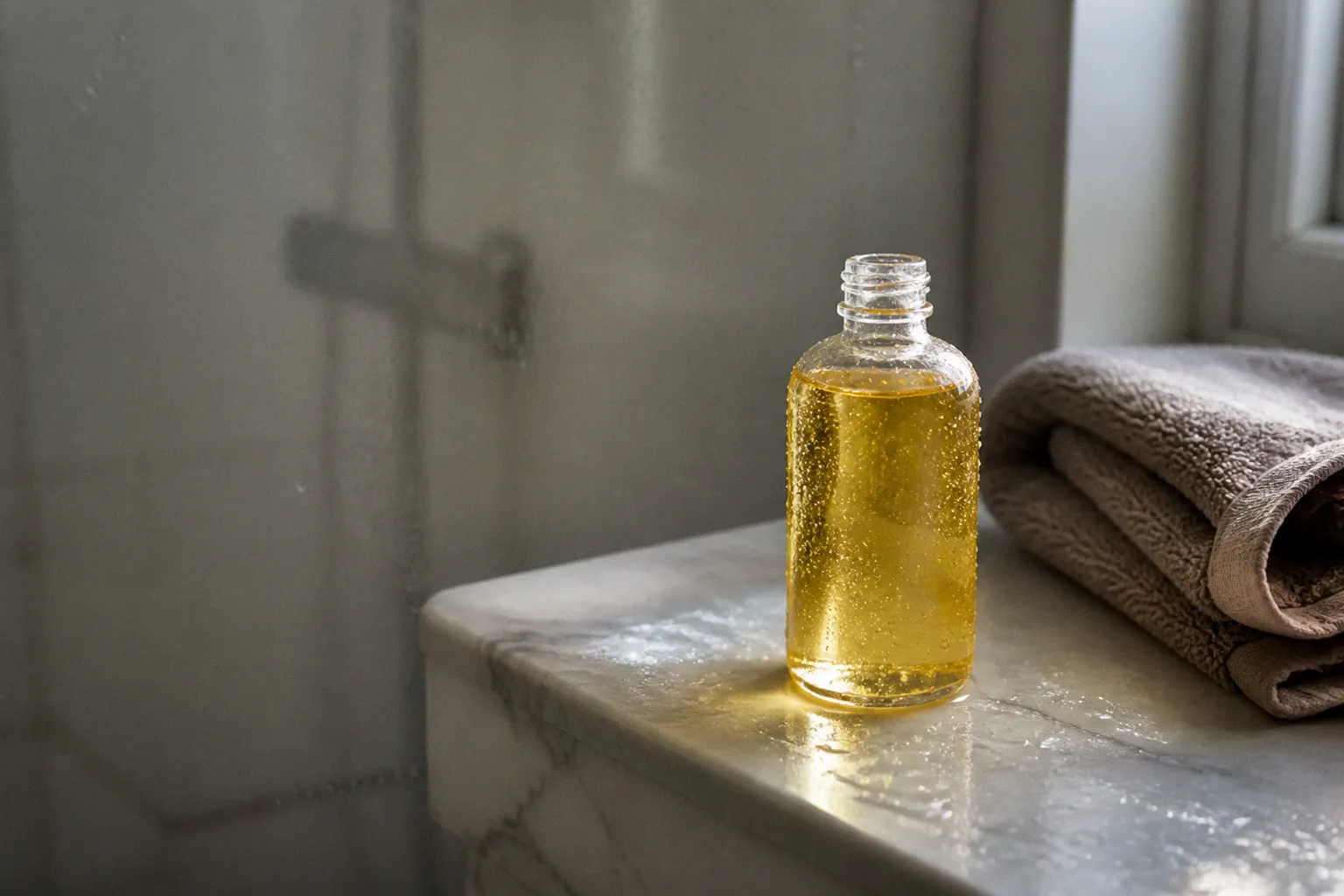
A few minutes later, the surface may feel tight and the oil will still make it smoother, but it will be working under less favourable conditions.
That distinction matters. A post-shower body oil application checklist is not a race to beat an exact deadline. It is a way to keep the routine in the right order: leave some moisture on the skin, choose whether you need lotion as well as oil, use enough product to cover without creating a transferable film, and apply it without irritating the surface.
Most people make the routine harder than it needs to be. They towel off completely, walk around while finishing their hair, pour too much oil into one hand, then blame the formula when their skin feels dry again by evening. The bottle is rarely the whole problem. Timing, layering, dose, and technique usually decide whether the routine feels nourishing or merely slippery.
The Science of the Three-Minute Rule: Why Timing Matters
Right after bathing, the outer layer of the skin contains residual surface water. Some of that water has been absorbed into the outermost cells; some remains on top of the skin. Applying a moisturizer or oil while the skin is still damp helps reduce the amount of water that evaporates into the air.
This is the reasoning behind the familiar three-minute rule. It is a useful habit, not a hard biological cut-off. Skin does not suddenly stop responding at three minutes, and an oil applied later is not automatically pointless. The practical message is simpler: the sooner you apply your leave-on product after gently patting off excess water, the more moisture there is available for the product to help retain.
The best time to apply body oil is therefore usually immediately after the shower, while the skin is damp but not dripping. You want enough water left on the surface to support the routine, but not so much that the oil slides away or becomes difficult to spread evenly.
If you wait longer, several things change:
- Surface water continues to evaporate, especially in a warm, dry room.
- Skin may begin to feel tight before you have applied anything.
- You may need more product to achieve the same sense of slip and comfort.
- The oil can still soften the surface and reduce water loss, but it will be less effective at sealing in post-shower moisture because less of that moisture remains.
That last point is the one worth keeping. Damp-skin application is optimal; delayed application is not useless.
Your preparation should happen before the water is turned off:
- Keep a clean, absorbent towel within reach. Pat rather than scrub, especially on areas that already feel dry or sensitive.
- Place your lotion and oil where you can reach them without walking through the house with wet skin.
- Decide whether you are using lotion and oil together or oil alone. There is no requirement to use both at every shower.
- Apply to the body before starting a long hair routine if retaining surface moisture is the priority.
- Keep the bottle closed and away from the shower stream. Water entering the container can affect the product and make a slippery bathroom floor even more likely.
The three-minute rule is best understood as a timing cue, not a cliff edge: apply while skin is still damp, but do not discard the oil routine if life gets in the way.
A delayed application can still be worthwhile. If your skin is already dry when you remember the oil, use a smaller amount and spread it over clean skin. The result may be more about surface comfort and softness than about sealing in fresh post-shower water, but emollient and occlusive effects still count.
Layering Logic: Why Water-Based Lotion Must Come First
When a body lotion and a body oil are used together, lotion generally comes first and oil follows. This is not because oil is inherently more powerful or because every product needs a complicated sequence. It is because the two formats do different jobs.
A conventional body lotion is an emulsion containing water along with oils, humectants, emulsifiers, and other supporting ingredients. It can add water to the skin and help make the surface feel more flexible. A traditional body oil is water-free or nearly water-free. Its main contribution comes from lipids that soften the skin and form a partial barrier against water loss.
The usual sequence looks like this:
| Step | Product | Main role | Best timing |
|---|---|---|---|
| 1 | Body lotion | Adds hydration and softens the surface | On clean, damp skin |
| 2 | Body oil | Adds emollience and slows moisture loss | After lotion, while skin is still comfortable and slightly damp |
The lotion does not need to disappear completely before oil goes on. Waiting a short moment is enough if the lotion has spread evenly and no longer feels wet or patchy. In a rushed routine, apply lotion to one section, then oil that section while moving to the next. The goal is an even, comfortable layer—not a formal absorption ceremony.
If you skip lotion and go straight to oil, the oil can still spread over damp skin and help seal residual surface water. It does not have to be placed over lotion to do anything at all. This one-step approach can be perfectly reasonable for balanced skin, warm weather, or anyone who dislikes layered products.
The limitation is that a water-free oil does not provide the same type of hydration as a lotion. If your skin is very dry, tight, or rough, lotion may offer a more complete routine because it supplies water and supportive ingredients before the oil reduces evaporation. If your skin feels comfortable with oil alone, there is no need to add lotion simply to follow a rule.
A useful way to choose between the two approaches:
- Oil alone on damp skin: simple, fast, and often comfortable for normal or mildly dry skin.
- Lotion followed by oil: better suited to persistent dryness, rough patches, cold weather, or indoor air that leaves skin tight.
- Lotion alone: sensible when you want hydration without a noticeable oily finish.
- Oil on completely dry skin: still capable of smoothing and softening, but less efficient at retaining fresh shower moisture.
Formula matters as much as the category name. Some products sold as body oils contain fragrance, botanical extracts, or lighter and heavier carrier oils that change how they feel. A lotion with a rich occlusive base may make an additional oil unnecessary. Conversely, a very light lotion may pair well with a small amount of oil on the driest areas.
Precision Dosing: Avoiding Greasy Residue with the Right Amount
The correct dose is not a universal teaspoon measurement. It depends on the oil's viscosity, the size of the area, whether the skin is damp, and whether you are applying lotion underneath. A thin, fast-spreading oil may need only a few drops for an arm. A dense blend may require more work but not necessarily a larger final layer.
Start smaller than you think you need. Place a few drops in one palm, spread them between both hands, and apply them to one section. If the skin still feels dry or catches under your palms, add a little more. This is more reliable than pouring a large amount at once and trying to distribute it before it runs down your wrists.
For a full-body routine, divide the application into sections:
1. Apply a small amount to one arm, including the outer elbow if it is dry.
2. Repeat on the other arm before adding more product.
3. Move to the chest and stomach, using less on areas that tend to feel warm or become congested.
4. Treat one leg at a time, giving extra attention to shins, knees, and ankles.
5. Finish with feet and heels, where a slightly richer layer may be useful.
These are starting points, not fixed quantities. The right amount is the smallest layer that leaves the skin flexible and comfortable without remaining wet or visibly oily after you dress.
Different oils also change the equation:
- Lighter oils, such as jojoba-based formulas, often spread quickly and leave less surface residue.
- Heavier oils, including some coconut-rich or dense botanical blends, may feel more noticeable and are easier to overapply.
- Blended oils can behave differently from any one ingredient listed on the label, particularly when fragrance or additional emollients are included.
- Oil applied over lotion usually requires less product than oil applied as the only leave-on step.
Use your clothes as a practical test, not as the only measure of success. If fabric clings immediately, the skin looks wet after several minutes, or the product transfers to bedding, reduce the amount next time. If tightness returns quickly and the surface feels rough, increase the amount slightly or consider adding lotion underneath.
Body oil should leave skin supple, not sealed under a glossy layer. Start with less, then build only where your skin asks for more.
Zone-based dosing is more useful than treating the entire body identically. Heels, elbows, knees, and shins often need more attention than the stomach or upper arms. The chest, back, and shoulders may need a lighter layer if they are prone to clogged pores or body breakouts. You can use the same bottle on all of these areas while applying it differently.
Technique Matters: Pressing vs. Rubbing for Optimal Absorption
The point of application is to distribute the oil evenly without creating unnecessary friction. Vigorous rubbing can irritate skin, especially immediately after hot water, shaving, exfoliation, or a wash that has already left the surface feeling stripped. It can also make the routine feel greasier because the product is moved around repeatedly instead of being spread in a thin layer.
There is no need to treat pressing as a rigid replacement for every form of massage. Gentle, short strokes are not automatically harmful. The problem is force: dragging dry palms over the skin, working one area for too long, or trying to make an oil disappear completely through friction.
A more controlled method:
1. Pat the body until it is damp rather than dripping.
2. Pour a small amount into one palm.
3. Rub your palms together briefly to distribute the oil.
4. Place your hands flat on the skin and spread the product over one section.
5. Use light strokes or gentle pressing until the area feels evenly coated.
6. Move on before the skin becomes warm, red, or irritated.
On the legs, work upward or downward according to comfort; the direction is less important than using light pressure and covering the skin consistently. On the arms, pay attention to the elbows and the backs of the hands, but avoid repeatedly passing over the same patch. On the torso, a thinner application usually feels more comfortable under clothing.
Pressing has a practical advantage on damp skin: it helps you keep contact with the surface without chasing a product that is sliding away. It also discourages the instinct to keep rubbing until the oil seems to vanish. Body oil is supposed to leave a fine emollient film. A completely dry finish is not proof of better absorption.
Be careful with the floor and your hands. Oil on wet tile is a fall risk, and oil left on the palms can make it difficult to turn a doorknob or handle a phone. Keep a towel available for the soles of your feet and wash your hands if you need to move around immediately. The routine is only useful if it does not create a second problem.
Barrier Support: Understanding Occlusives and Emollients
Body oils are often described as moisturizers, but that word covers several different actions. A useful distinction is between humectants, emollients, and occlusives.
- Humectants help attract and hold water in the outer layers of the skin. They are common in lotions and creams.
- Emollients fill gaps between rough skin cells, making the surface feel smoother and more flexible.
- Occlusives form a layer that slows the movement of water out of the skin.
Many body oils provide emollient benefits and some degree of occlusion. Their performance depends on the oil, the amount used, the condition of the skin, and what is underneath. They do not all create the same type of film, and “natural” does not mean that every skin type will find a product light or non-comedogenic.
This is why the following statements are all compatible:
- Oil on damp skin can help reduce water loss even without lotion.
- Lotion followed by oil can provide a more complete hydration-and-sealing routine for dry skin.
- Oil on dry skin can still smooth the surface and support the barrier through emollient and occlusive action.
- Oil is not a substitute for every moisturizer, particularly when skin needs humectants, richer barrier-supporting ingredients, or treatment for an underlying condition.
If the skin is cracked, inflamed, persistently itchy, or flaking heavily, a body oil may make it feel more comfortable but should not be treated as a complete solution. Fragrance and essential oils can also be irritating for some people, especially when the barrier is already compromised. Patch testing a new product on a small area is a sensible precaution when your skin reacts easily.
After shaving or waxing
Post-shave and post-wax care deserves its own adjustment rather than a blanket rule. Shaving can leave the surface temporarily more sensitive because the razor removes hair and may also disturb some of the outer skin. Waxing can produce redness and tenderness from the mechanical removal of hair. Neither process means that follicles have simply been “opened,” and an oil is not automatically inappropriate afterward.
Some people tolerate a light, fragrance-free oil after hair removal; others find that it stings, feels occlusive, or contributes to bumps. The response can depend on the formula, the treated area, the condition of the skin, and whether the method caused irritation. If the skin is hot, red, abraded, or sore, wait until it has settled and follow the aftercare guidance associated with the hair-removal service or product.
On areas prone to ingrown hairs, avoid using a heavy layer just because the skin feels dry. Keep the application light, observe how the skin responds, and do not combine freshly waxed or shaved skin with aggressive scrubs or strong exfoliating acids in the same routine. Product choice and individual response matter more than a universal prohibition.
Adjusting the routine over time
Daily use may suit dry winter skin, but not every body needs oil every day or in every area. Climate, shower temperature, cleanser, clothing, and activity level all influence how much support the barrier needs.
Signs that the routine may need more moisture or a richer layer include:
- Tightness returning soon after bathing
- Roughness or flaking on the shins, elbows, or knees
- Itchiness that worsens after hot showers
- Skin feeling comfortable immediately after application but dry again later
Signs that the product or dose may be too much include:
- Persistent greasiness beneath clothing
- Oil transferring to sheets or towels
- A heavy, warm feeling on the chest or back
- New bumps or congestion in areas that did not previously react
Adjust one variable at a time. Reduce the amount before abandoning the formula. Use lotion only on the driest zones if the whole-body combination feels heavy. Switch from a dense blend to a lighter oil for the upper body. If irritation appears, stop and assess the complete formula rather than assuming that every body oil will cause the same reaction.
Final Word
A reliable post-shower body oil routine is less about following a perfect ritual than about responding to the condition of your skin. Keep the product nearby, pat instead of scrubbing, and apply while the skin is still damp whenever possible. Use lotion first when your skin needs added hydration, but remember that lotion is optional: oil can still seal residual surface water on its own.
Start with a small amount, work in sections, and use light pressure. A delayed application can still soften dry skin and reduce water loss, even if it no longer captures as much post-shower moisture. After shaving or waxing, let the skin's response guide the routine rather than assuming that every oil behaves the same way.
Body oil performs a focused job. It can smooth the surface, add emollience, and slow moisture loss. It works best when timing, product order, amount, and technique match what your skin actually needs. Once those variables are under control, the bottle stops being a promise and becomes a useful, predictable part of body care.