Does body oil stain clothes after application?
Body oil can stain clothes after application, especially when a noticeable layer is still sitting on the skin.
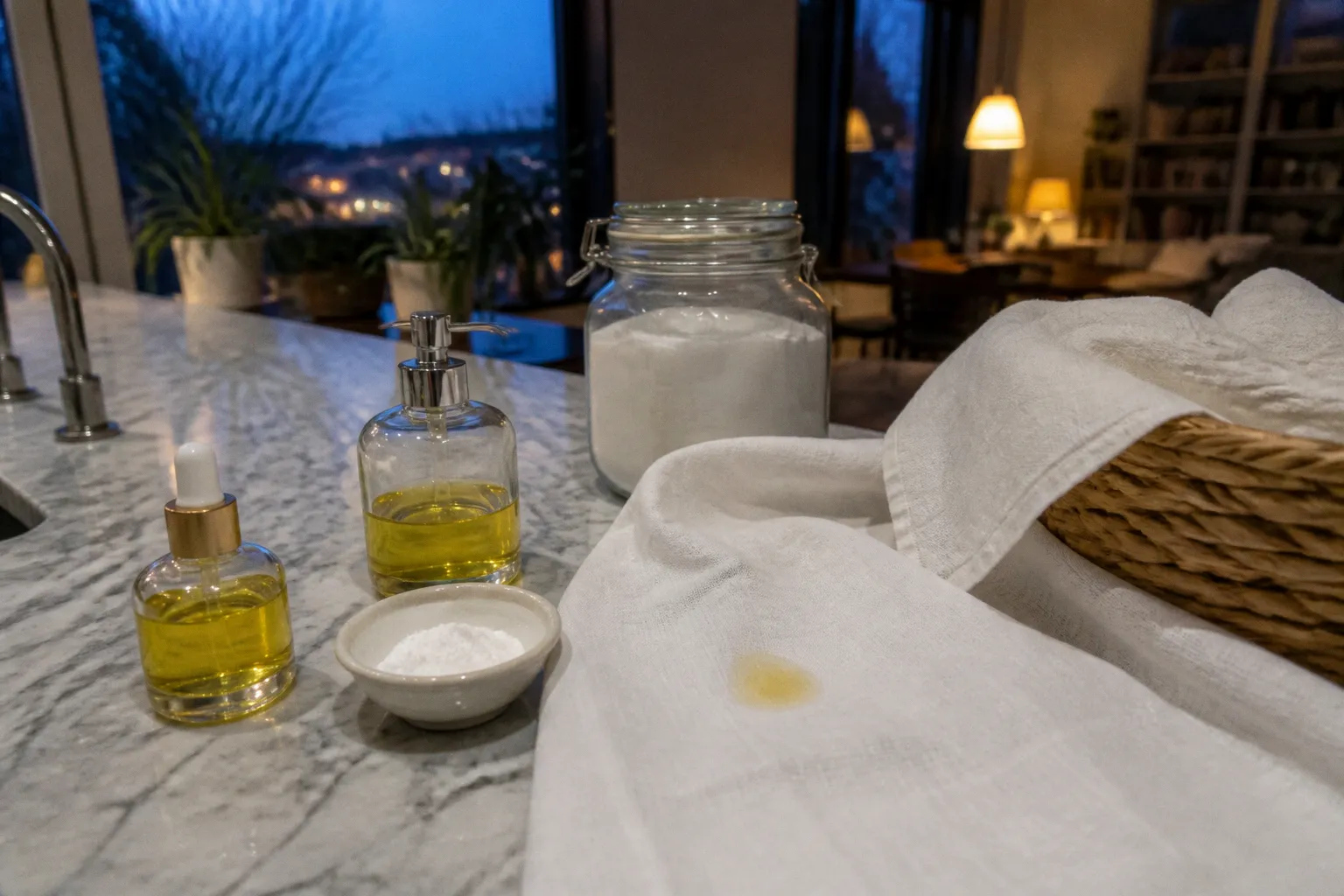
The result depends on the formula, the amount used, the fabric, the pressure and friction involved, and how quickly the garment is treated afterward.
The most common mistake is not choosing body oil in the first place. It is getting dressed while the product is still visibly wet. A lightweight dry oil may leave little residue after a short pause. A richer oil, coconut-based formula, or oil-and-butter blend can remain active on the surface for longer and transfer to waistbands, sleeves, collars, towels, bedding, and upholstery.
That does not mean body oil needs to be reserved for evenings spent in old sleepwear. A smaller application, a sensible wait before dressing, and prompt treatment when a mark appears will prevent many problems. The real question is not simply does body oil stain clothes? It is how much oil reaches the fabric, how absorbent that fabric is, and what happens before the item is washed and dried.
The Science of Oil Transfer: Why Fabrics Trap Moisture
Skin and fabric handle oil in very different ways. When you apply body oil, some of it spreads over the surface while some begins to settle into the outer layers of the skin. The amount that remains available for transfer depends on the product’s texture, the condition of your skin, and how generously you applied it.
Fabric has a network of fibers and spaces that can catch liquid product. Cotton and linen are absorbent, while synthetic blends may show oil as a darker or glossier patch even when they do not absorb it in quite the same way. A garment does not need to feel wet for transfer to occur. Friction from pulling on a shirt, sitting against a waistband, or bending an elbow can move a thin layer of oil into the weave.
Fresh marks often look translucent or slightly darker than the surrounding fabric. On some materials, the spot becomes less obvious as the oil spreads or is absorbed. On others, particularly pale garments, it can remain visible after the surface appears dry. A regular wash may remove a light, recent mark, but a concentrated spot can persist if it was not treated before laundering.
The key factor is surface residue. If your skin still feels distinctly slick, there is more product available to move onto clothing. If the finish is comfortable and lightly moisturized rather than wet or greasy, the likelihood of noticeable transfer is lower.
Does jojoba oil stain clothes?
Jojoba oil can stain clothes, although it may feel lighter and absorb more readily than some heavier plant oils. It is technically a liquid wax, and its smooth texture does not make it immune to transfer. If you apply a large amount or dress immediately, jojoba oil can still leave a darker patch on fabric.
The same principle applies to rosehip oil, almond oil, coconut oil, olive-derived oils, and blends marketed as nourishing or restorative. Their behavior differs from formula to formula. Viscosity, added esters, fragrance ingredients, and other emollients can affect how quickly a product stops feeling wet on the skin.
Dry oils deserve a qualification as well. They often contain lightweight esters or volatile ingredients that create a faster-drying finish, but “dry” describes the feel on the skin, not a promise that the product cannot mark fabric. A dry oil can still transfer if the application is heavy or if clothing presses against the skin straight away.
Body butter can create a similar issue, even though it may feel less fluid than an oil. Butters and waxes can leave a concentrated residue on cuffs, collars, and fitted areas. An oil-butter hybrid may spread easily at first and then remain on the surface as a richer film. The product label matters, but the finish on your skin is the most useful immediate clue.
Body oil is most likely to mark clothing while it is still sitting on the surface of the skin. The practical solution is to reduce that surface layer before fabric gets involved.
Fabric construction also changes the appearance of a mark. A loose cotton weave can absorb and spread the oil beyond the original contact point. A smooth synthetic fabric may show a sharply defined dark patch. A dark garment may conceal a small transfer while still retaining the residue, which can become more noticeable after repeated contact or laundering.
This is why the same body oil can seem harmless on one outfit and troublesome on another. The product has not necessarily changed; the amount of pressure, the surface area of contact, and the absorbency of the textile have.
Strategic Application: Timing Your Routine to Protect Textiles
Preventing body oil stains starts before the garment goes on. The routine does not need to become elaborate. It simply needs to give the product a chance to spread evenly and settle.
Apply less than you think you need
Body oil spreads efficiently over damp skin. After a shower, pat your body with a towel rather than drying it completely, then apply a small amount to one section at a time. Damp skin can make the product easier to distribute, which means you may need less oil to cover the same area.
A good application should leave the skin supple and comfortable, not visibly wet. If your legs or arms still look glossy several minutes later, you may have used more than your clothes can tolerate. This is particularly relevant with rich oils and products that combine oil with butter, waxes, or dense emollients.
The amount also depends on where you are applying it. Elbows, knees, and shins may need more product than the upper arms, but areas that will sit directly against clothing deserve a lighter hand. Ankles rubbing against trouser hems, the waist beneath a fitted shirt, and the backs of the knees are all high-contact areas.
If you have already applied a body butter, lotion, or shower oil, adjust the amount of leave-on oil accordingly. Layering is not automatically a problem, but each product adds to the surface film. A skin-care routine that feels comfortable in the bathroom can become too rich once it meets tight clothing.
Give the product time to settle
There is no universal absorption time for every body oil or every person. A lightweight formula may feel settled after a relatively short pause, while a thicker oil can remain slick for longer. Very dry skin may also hold onto the product differently from skin that already has a comfortable moisture barrier.
As a practical starting point, allow several minutes before dressing and extend the wait when the product feels rich or visibly wet. The often-used ten-to-twenty-minute range can be useful for heavier formulas, but it is not a guarantee. Your skin’s finish is a better guide than a timer.
Use a simple touch test on a discreet area, such as the inner forearm. Your finger does not need to feel completely powder-dry; body oil is supposed to leave some softness. The warning sign is a slippery film that moves under light pressure or leaves a clear oily trace on your finger.
Do not confuse fragrance longevity with oiliness. A scented body oil may continue to smell noticeable after the carrier oils have settled. The useful test is whether the skin feels wet or leaves residue, not whether the fragrance is still present.
Consider the garment, not only the product
Fabric choice changes how obvious a transfer will be and how difficult it may be to remove.
- Pale cotton, linen, and other absorbent fabrics tend to reveal oily marks quickly.
- Loose weaves can allow product to travel beyond the point of initial contact.
- Tight, dark fabrics may disguise a small mark, but they can still retain oil.
- Fitted clothing creates pressure and friction, which can push residue into the textile.
- Delicate fabrics such as silk require more caution because aggressive home treatment can damage the fibers or finish.
- Textured fabrics can hold product in valleys and seams, making a mark look uneven after washing.
- Stretch garments may press the oily area against the body over a larger surface, increasing transfer even when the original application was modest.
If you are wearing a white top, pale trousers, or a fitted dress, use less product on the areas that will be covered and allow extra time before dressing. If you are applying oil at night, older sleepwear can be more forgiving than a freshly laundered light-colored set, but it is still worth keeping the application moderate.
Repeated oil exposure can gradually leave towels, bedding, and clothing looking dull even when no single mark seems dramatic. Washing removes much of the residue, but regular contact gives the fabric more opportunities to retain small amounts of product.
Plan the order of the routine
Choose your clothes before applying body oil. Once the product is on your skin, you will be less tempted to rush through dressing or pull a garment over a still-wet application.
If you need to get dressed immediately, apply the oil to areas that will remain uncovered or use a smaller amount than usual. Another option is to apply body oil after changing into loose clothing, provided the fabric will not press tightly against the application area. The goal is to avoid creating a damp, oily contact zone between skin and textile.
For a morning routine, applying oil after a shower and before preparing breakfast or doing your hair can create a natural settling period. At night, applying it after changing into loose sleepwear may work better than putting oil on and then immediately getting into bed. The exact schedule is less important than giving the product time to stop feeling wet.
Emergency Tactics: Using Absorbents on Fresh Oil Spots
If you notice a mark soon after dressing, act before putting the garment through the dryer. Fresh oil is generally easier to manage than a spot that has been washed, dried, and exposed to repeated heat.
First, remove the garment if possible and place it on a flat surface with the mark facing upward. Do not rub the spot aggressively. Rubbing can spread the oil outward and work it farther into the weave.
A powder such as cornstarch or baking soda may help absorb some surface oil, particularly on sturdy, washable fabric. Cover the mark with enough powder to obscure it, then leave it in place for a while. The precise waiting time depends on the size of the spot and the fabric, but fifteen to thirty minutes is a reasonable starting point for a small, fresh transfer. Longer contact may be useful if the area still feels oily.
Brush or shake away the powder gently. Do not assume that a visible color change in the powder is proof that all the oil has been removed. The powder may look much the same, and the garment may still need a detergent-based treatment. Judge the result by the fabric: does the spot look lighter, and does the surface still feel greasy?
If a mark remains, repeat the absorbent step once or move to a liquid pre-treatment suited to the garment. Check the care label first, especially if the item is delicate, dark, textured, or likely to water-spot.
Blotting can help when the transfer is very fresh. Place a clean paper towel or absorbent cloth over the area and press lightly to lift surface residue. Replace the absorbent material as it picks up oil. Do not drag it across the fabric, because that turns a localized mark into a wider film.
What not to do with a fresh mark
Avoid adding water immediately and rubbing the fabric between your hands. Water alone does not dissolve most oils, and vigorous rubbing can turn a small mark into a larger one. Avoid ironing the area as well. Heat can make later removal more difficult.
Do not apply a strong cleaner to an expensive or delicate garment without testing it in an inconspicuous place. A stain is frustrating; a bleached patch or damaged finish is a different problem.
Do not pile the garment into a laundry basket while the oil is still fresh if you can treat it first. Pressure from other clothes can spread the residue, and a concealed mark is easier to miss when the load is eventually washed.
The Grease-Cutting Protocol: Pre-Treating Set-In Stains
When powder does not solve the problem, a detergent or degreasing product is usually more useful. The aim is to loosen the oil so it can be rinsed away and then carried out during laundering.
Liquid dish soap for washable, sturdy fabrics
A small amount of liquid dish soap can work as a pre-treatment for many washable garments. Choose a plain liquid formula rather than one containing bleach or aggressive additives, and test it on a hidden area if you are uncertain about colorfastness.
1. Place the garment flat and apply a small amount of dish soap to the mark.
2. Work it gently into the fibers with your fingers or a soft brush.
3. Leave it for several minutes so the detergent has time to interact with the oily residue.
4. Rinse from the reverse side of the fabric with cool or lukewarm water.
5. Wash according to the care label.
6. Inspect the garment while it is still damp and before it goes anywhere near a dryer.
The treatment should be gentle enough that you are loosening the mark rather than grinding it deeper into the fabric. A soft toothbrush can help with a durable cotton garment, but it is not appropriate for every textile.
Rinsing from the reverse side can help push loosened oil away from the visible surface rather than driving it farther into the garment. Use enough rinsing to remove the soap itself. Residual detergent can leave its own patch or alter the texture of some fabrics.
Baking soda paste for a stubborn mark
For a resistant spot on a washable, colorfast garment, you can combine a small amount of liquid dish soap with baking soda to make a soft paste. Apply it lightly rather than building a thick abrasive coating. Let it sit for a short period, then rinse thoroughly and launder.
Baking soda may provide mild mechanical assistance, but it is not the part doing all the grease removal. The liquid detergent is the more important component. Avoid this approach on silk, wool, cashmere, suede, or any fabric whose care instructions warn against wet treatment.
Do not leave a paste on a colored garment indefinitely or scrub until the surface becomes fuzzy. The purpose is to help lift the residue, not to wear down the textile while chasing a faint shadow.
Enzyme detergents and body oil
Some laundry detergents contain enzymes that help break down oily or protein-based residues. A product label may identify lipase or describe the detergent as suitable for grease and body soils. These formulas can be useful for an older mark, but they still need to be used according to the instructions on the package.
Apply detergent directly to the dampened stain only if the garment’s care instructions allow it. Give the product the recommended contact time, then wash in the warmest setting permitted for that fabric. Do not assume that hotter is always better. Excessive heat can set some stains and can damage fibers, finishes, or dyes.
If the item has already been washed once and the mark remains, treat it again before drying. One unsuccessful wash does not mean the garment is ruined, but repeating a normal wash without changing the treatment is unlikely to solve a concentrated oil spot.
| Pre-treatment | When it is most useful | Main caution |
|---|---|---|
| Cornstarch or baking soda | A recent, light transfer on washable fabric | Helps absorb surface oil but may not remove the whole mark |
| Liquid dish soap | Fresh or semi-set oil on sturdy, colorfast fabric | Test first and rinse thoroughly |
| Dish soap and baking soda paste | A stubborn mark that resisted an initial treatment | Avoid on delicate or easily damaged textiles |
| Enzyme-containing laundry detergent | Older or previously washed oily residue | Follow the label and use only on compatible fabrics |
| Professional cleaning | Delicate, valuable, or persistent garments | Tell the cleaner that the mark is body oil |
The best method depends less on the name of the oil than on the garment. A washable cotton T-shirt gives you more room to experiment than silk, wool, rayon, or a garment with a special finish.
Treat the mark while it is still a mark, not after the dryer has turned it into a recurring laundry problem.
When home treatment is the wrong choice
Check the care label before using water, detergent, baking soda, or a brush. Dry-clean-only garments, tailored pieces, embellished clothing, leather, suede, and delicate natural fibers can react badly to improvised stain treatment.
For these items, blot surface oil gently and take the garment to a professional cleaner. Explain that the mark came from body oil and identify any other products used on the skin, such as body butter or fragrance. Do not conceal the treatment history; it can affect how the stain is approached.
The Heat Trap: Why Your Dryer Is Making Stains Permanent
A dryer can make an oil stain harder to remove. Most importantly, dryer heat can permanently set an incompletely removed oil stain in the fabric. Once heat has driven the remaining residue deeper into the fibers, later washing may no longer restore the garment completely.
That warning applies even when the mark looked faint before drying. A barely visible shadow is still a reason to pause. Do not place the garment in the dryer simply because the stain is less obvious when wet or because the washer has already completed its cycle.
After pre-treating and washing, inspect the fabric in good light. Look at the front and back of the garment and check whether the area still feels slick. If the mark is still visible, repeat the treatment while the item is damp or air-dry it and reassess. A faint shadow can be easier to notice once the garment is fully dry, so do not rely only on a quick glance straight out of the washer.
Air-drying is not a stain-removal method by itself, but it gives you control. It prevents the high heat of a dryer from setting residue while you decide whether another treatment is needed. Hang or lay the garment according to its care instructions, then inspect the affected area once it is fully dry.
For delicate fabrics, the risks go beyond the stain. Hot water, tumbling, brushing, and repeated home treatment can cause shrinkage, distortion, pilling, or loss of surface finish. If body oil has marked silk, cashmere, a tailored item, or a garment labeled for dry cleaning, professional care is usually the safer route. Point out the affected area and identify the substance as body oil; that information helps the cleaner choose an appropriate process.
If a stain has already gone through the dryer, it may still be possible to improve it. Start with the care label, test any treatment on a hidden section, and be prepared to repeat the process rather than escalating immediately to harsher chemicals. Do not use bleach unless the garment and product instructions specifically support it. Bleach is not a general solution for grease marks and may damage color or fiber.
A set-in mark can also become less responsive because the garment has been dried repeatedly, not only because of one dramatic cycle. If the same area keeps developing a darker patch, treat it before the next wash and consider whether the product is being applied directly under a tight seam or waistband. The location often reveals the cause: a mark at the cuffs, neckline, or waist usually points to pressure and contact rather than a problem with the entire garment.
Keeping Body Oil Off Fabric Long-Term
Preventing body oil stains is mainly a matter of controlling contact. You do not need to measure every drop, but a few habits make the routine much more predictable.
Before application, decide what you are wearing and how much of your body will be covered. A rich oil applied before tight, pale clothing needs more settling time than a light layer on exposed legs. If your skin is already moisturized from a shower product or body butter, reduce the amount of oil rather than adding the usual full application on top.
During application, spread the product thoroughly. Concentrated patches around the knees, elbows, ankles, and waist are more likely to transfer than a thin, even layer. Give extra attention to areas where fabric will press against the skin. The goal is not to remove every trace of softness; it is to avoid leaving a visibly wet surface.
After application, wait until the skin feels settled before dressing. If you are short on time, use a smaller amount and choose loose, breathable clothing that creates less direct pressure. This will not make transfer impossible, but it reduces the amount of friction and contact involved.
Towels and bedding deserve their own consideration. A towel used repeatedly after oily applications can retain a film even when it does not show a single obvious stain. Wash heavily used towels regularly, avoid overloading the machine, and let them dry fully. Bedding may need the same attention if you apply a rich oil immediately before getting into bed.
If body oil repeatedly marks one particular item, change one variable at a time. Use less product on the areas beneath the garment, wait longer, or wear a looser layer. This is more useful than concluding that every oil is incompatible with clothing. In many cases, the problem is a small area of excess product meeting a high-friction textile.
A practical routine for lower-transfer application
1. Start with slightly damp skin after showering, not dripping-wet skin.
2. Apply a thin layer to one body area at a time.
3. Spread the product until there are no visibly wet patches.
4. Use less on the waist, knees, elbows, ankles, and any area covered by fitted clothing.
5. Wait until the skin feels soft rather than slick.
6. Touch-test a discreet area before dressing in pale or delicate clothing.
7. If a mark appears, treat it before washing and keep the garment out of the dryer until the stain is gone.
This approach also helps you use the product more efficiently. Body oil is designed to spread, so a larger amount does not necessarily create a better result. Excess product often remains on the surface, where it can transfer without adding much comfort.
The Bottom Line
Yes, body oil can stain clothes after application, and jojoba oil is not exempt. Dry oils are often less troublesome because they leave a lighter finish, but they can still mark fabric when applied heavily or covered immediately.
The most reliable prevention is simple: apply a thin layer, give it time to settle, and be cautious around pale, absorbent, fitted, or delicate fabrics. If a fresh spot appears, lift surface oil without rubbing, pre-treat the garment according to its care label, and inspect it before drying.
The dryer deserves particular caution. Heat can permanently set an incompletely removed oil stain, even when the mark looked minor after washing. Air-dry the item until you are certain the residue has gone, and treat valuable or delicate clothing professionally rather than experimenting with increasingly strong cleaners.
Body oil does not have to be a threat to your wardrobe. It just needs to be treated as an oil: something that transfers under pressure, responds best to early treatment, and becomes much less forgiving once heat has had the final word.