Body Scrub Prep: What to Gather and Know Before Exfoliating
A body scrub is a mechanical job. You take an abrasive granule, move it across the skin, and loosen dead cells from the surface.
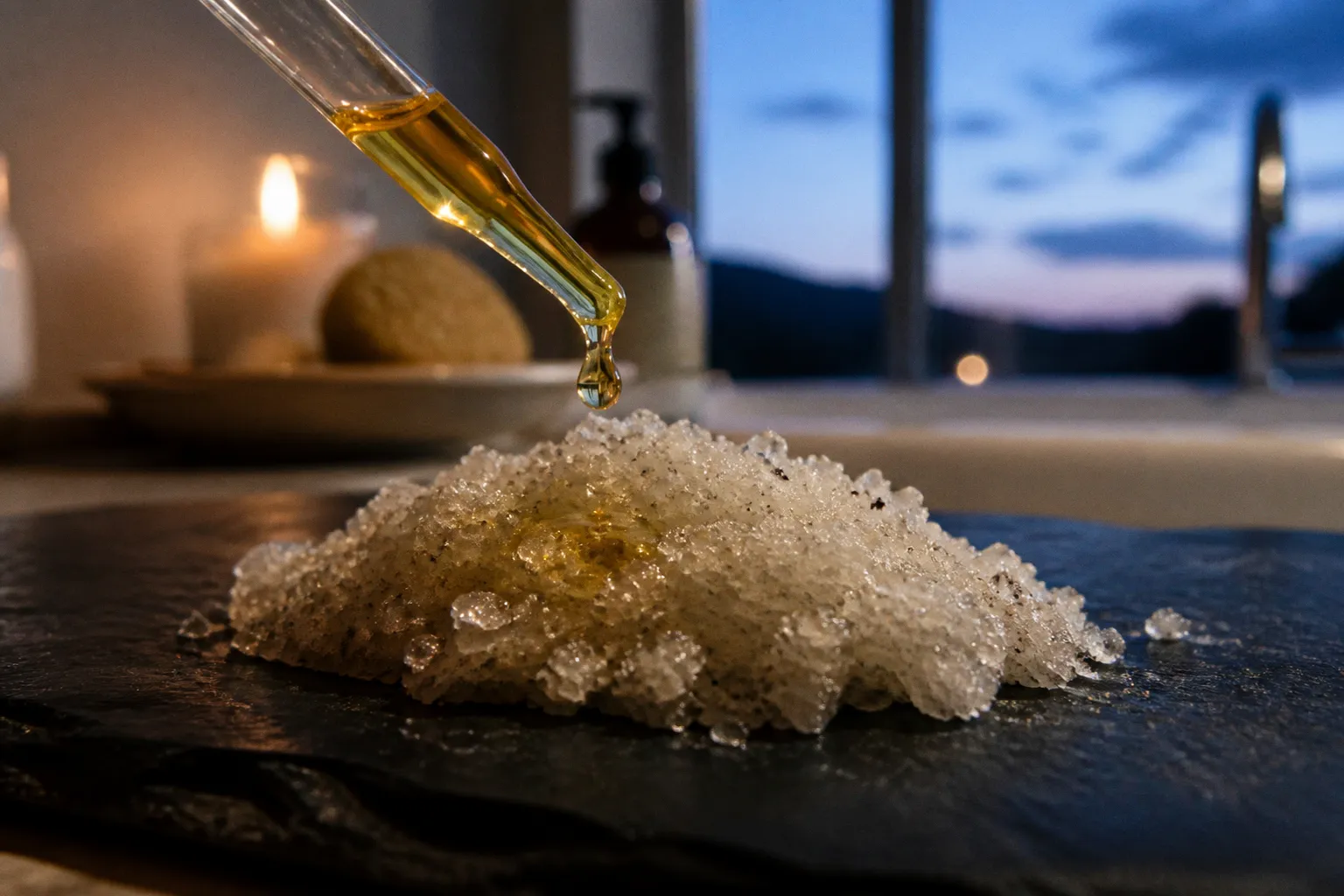
Skip the preparation and the same product that should smooth rough texture can leave the skin tight, red, and irritated instead.
Most scrub problems happen before the granule ever touches the body. The water is too hot. The skin is dry. The particle is too aggressive. A loofah gets added for no reason. Pressure turns a light pass into sanding. Then the scrub gets blamed for a mistake made during setup.
A useful pre body scrub preparation checklist is not complicated: soften the skin, choose a manageable granule, use clean hands, control pressure and time, check what else is already on the area, and have a proper moisturizer ready for the final step. The point is not to make exfoliation ceremonial. It is to make the mechanical process predictable.
The Grind Starts Before the Scrub
Before gathering anything, look at the skin you are about to exfoliate. The body is not one uniform surface. Elbows, heels, knees, thighs, the backs of the arms, and the chest can all respond differently to the same formula.
A premium scrub can still be the wrong tool for a particular area. Fine sugar suspended in a rich body butter may be comfortable on the legs but too much around a recently shaved bikini line. A salt scrub can feel effective on rough heels but sting on dry, cracked skin. Coffee grounds may seem soft because they are porous, yet their shape and size still matter when pressure increases.
Start with the condition of the skin, not the marketing language on the jar.
Do not exfoliate over:
- Fresh razor burn, cuts, or scratches.
- Sunburn or visibly inflamed skin.
- Areas that are peeling, cracked, or unusually tender.
- A rash, active irritation, or a breakout that becomes painful when touched.
- Skin that already feels hot, tight, or raw before you begin.
That is not a failure of the scrub. It is a timing problem. Physical exfoliation adds friction, and irritated skin has less tolerance for additional friction. Wait until the area feels calm and intact again.
Gather the rest of the setup before stepping into the shower:
- The scrub itself, with a granule suited to the area.
- Clean hands or a clean, soft applicator if the product requires one.
- Lukewarm water.
- A clean towel for patting, not rubbing.
- A fragrance-light moisturizer, body butter, or body oil for after rinsing.
The product should be within reach. Searching for it while water runs hot over the skin is how a controlled process turns into a rushed one.
The Science of Softening: Why Warm Water Is Your First Step
A dry scrub on unprepared skin is friction with nothing to give. The outermost layer of the skin is tougher and less pliable when it is dry. Add a coarse product and firm pressure, and you increase the chance of discomfort without necessarily improving the result.
Lukewarm water is the first step in how to prep skin for body scrub because it gives the surface time to soften. A short shower or bath is enough. The goal is not to soak until the skin is wrinkled or flushed. It is to let water loosen the surface so the granules can move across it with less drag.
Hot water is not a more efficient version of lukewarm water. It can leave the skin dry and uncomfortable before exfoliation starts, especially if the shower is long. If the barrier is already struggling, heat followed by abrasion is a poor combination.
Skip the hot. The best preparation makes the scrub gentler, not more dramatic.
Use a mild cleanser first if the skin needs it, then rinse thoroughly. There is no need to scrub twice by washing aggressively and then applying an exfoliator. Remove sweat, sunscreen, and body products, but do not turn cleansing into a second abrasion step.
Avoid household additives such as baking soda. They do not make a body scrub more precise. They can disrupt the skin’s normal surface environment and add another variable to a process that already depends on tolerance, water, particle size, and pressure. The purpose of prep is to create a controlled surface, not to make the skin more vulnerable before exfoliation.
The same principle applies to shaving. Combining a close shave and a vigorous scrub in one rushed session can be too much for some skin, particularly around the legs, underarms, and bikini area. If the skin is already prickly, red, or sensitive after shaving, postpone the scrub. Smoothness is not a reason to ignore irritation.
Selecting the Right Granule Size for Your Skin Type
A scrub’s feel in the jar tells you less than its behavior on wet skin. Particle size, shape, hardness, and density all affect how the product moves. A small, rounded granule generally gives you more control. A large, irregular, sharp-edged particle demands a lighter hand and a narrower use case.
Here is a practical way to think about the main categories:
| Granule type | How it behaves | More suitable for | Main concern |
|---|---|---|---|
| Fine sugar or fine salt | Small particles that spread easily in a creamy base | Legs, arms, and skin that prefers a gentler pass | Can still sting on broken or freshly shaved skin |
| Ground seeds or nut shells | Irregular particles with more noticeable edges | Normal, intact body skin when used lightly | Uneven edges may feel scratchy under pressure |
| Coffee grounds | Medium, porous particles with a distinct texture | Tougher areas such as thighs, buttocks, knees, and elbows | The texture can encourage overworking one area |
| Pumice or mineral crystals | Harder, more abrasive particles | Localized rough areas such as heels and feet | Too aggressive for broad use on reactive body skin |
This table is not a license to use a coarse scrub more forcefully. The opposite is true. The more assertive the granule, the less pressure and time it needs.
Fine particles are usually the safer starting point for dry, sensitive, or reactive skin. They can still improve the feel of rough areas without asking the skin to tolerate a heavy sanding motion. For keratosis pilaris — the small rough bumps often found on the backs of the upper arms or thighs — more abrasion is not automatically better. A rougher particle may make the surface feel temporarily smooth while leaving it irritated afterward.
Large, jagged particles are best reserved for small, thickened areas such as heels. Even there, they belong on intact skin and require a light touch. Do not carry a foot-scrub texture across the legs, chest, or arms simply because the packaging presents the product as a full-body formula.
When testing a new scrub, begin with a small area. That gives you useful information about sting, tightness, lingering redness, and how the product feels once the skin dries. A scrub that feels luxurious in the shower but leaves the area uncomfortable afterward is not delivering a premium result.
Read the base, not just the grain
The carrier matters. A scrub suspended in oils or body butter will move differently from a dry, loose salt blend. An oil-rich formula can reduce drag, but it can also make the shower floor slippery. A thick butter base may feel protective, yet it does not cancel out a sharp or oversized granule.
Look for the relationship between the abrasive and the formula:
- Fine granules in a rich base can suit broad areas where the goal is polished, comfortable skin.
- Salt-heavy formulas may feel particularly effective on rough zones but can sting if the skin is cracked or freshly shaved.
- Oil-based scrubs leave a conditioning film, but rinse carefully and clean the floor afterward.
- Dry, highly textured formulas require especially careful control of how much product and pressure you use.
The best scrub is not the one that feels roughest. It is the one that gives you enough movement to smooth the surface without making you negotiate with your skin for the next two days.
Timing and Technique: The 30-Second Rule for Gentle Renewal
Once the skin is softened and the granule is matched, the actual scrub should be brief. A useful working limit is about 30 seconds per area. Treat that as a ceiling, not a target you must fill.
Some zones need less time. If the skin starts to sting, feel hot, or look increasingly red, stop before the 30 seconds are up. Exfoliation is not a test of endurance. Staying longer does not prove that the product is working.
Use this sequence:
1. Apply to damp skin. Take a small amount and spread a thin, even layer over the area. Damp skin gives the granule a more controlled surface than completely dry skin.
2. Use clean hands. Hands let you feel how much pressure you are applying and where the particles are collecting. That feedback disappears when you scrub automatically with a large, rough tool.
3. Move in small circles. Circular movements help distribute the product instead of dragging the same edge in one direction. Keep the motion slow and light.
4. Leave sensitive zones alone. Do not treat the underarms, bikini line, nipples, or any area with thin or recently irritated skin as if it were a heel.
5. Keep the pressure low. The granule provides the exfoliating action. Your hand should guide it, not force it into the surface.
6. Stop when the area feels smooth enough. Do not keep working because the product is still visible. Rinse it away rather than trying to extract every possible bit of exfoliation from one pass.
Extra tools add friction. A loofah, washcloth, dry brush, and scrub granules all contribute to the mechanical load, so combining them makes pressure harder to judge. If you are using a body scrub, clean hands are usually the clearest way to control the application. If you prefer an applicator, choose one that is soft and use it as a replacement for hand application, not as an additional abrasive layer.
The old instinct is to press harder over rough patches. Resist it. Pressure can make the surface feel immediately polished, but that sensation is not proof that dead cells have been removed more effectively. It may simply mean the skin has been overstimulated.
Rinse thoroughly with lukewarm water. Granules left behind can continue to feel abrasive as you towel off or move through the day. Pat the body dry, leaving a small amount of moisture on the surface for the next product.
Navigating Contraindications: Retinoids and Chemical Sensitivity
The most important question in a pre body scrub preparation checklist is sometimes whether to scrub at all. Check what is already being used on the area.
Retinoids — including prescription tretinoin, over-the-counter retinol, and adapalene — can make skin more sensitive and more prone to irritation. Benzoyl peroxide can also increase sensitivity and irritation, particularly when the treated area is already dry or reactive. Neither belongs in the same mental category as a harmless cleanser when you are planning a physical exfoliation session.
The issue is not that every combination guarantees a damaged barrier. The issue is that adding scrub friction to skin already affected by an active treatment can increase the chance of dryness, stinging, redness, peeling, or breakouts.
Physical exfoliation is one part of a routine. It does not get a free pass simply because the product is labeled for the body.
If the area is visibly peeling, flaking, sore, or unusually tight, skip the scrub. Wait until the skin has settled rather than trying to smooth away the evidence of irritation. The same caution applies to strong AHA or BHA leave-on products, high-strength vitamin A formulas, and chemical peels used on the area.
A few scheduling principles keep the routine manageable:
- Do not scrub an area that is actively irritated by a retinoid, benzoyl peroxide, acid, or peel.
- Avoid stacking a scrub with several other exfoliating steps on the same day.
- If you use a retinoid or another strong active on the area, give the skin time to show how it tolerates that product before adding physical exfoliation.
- Keep the routine simple after exfoliation. A scrub is not the moment to introduce several new actives.
- If irritation persists, stop exfoliating and return to bland cleansing and moisturization until the skin is comfortable.
There is no prize for fitting every treatment into one schedule. If your body care routine includes a retinoid for bumps, benzoyl peroxide for body acne, or acids for texture, physical exfoliation may need to happen less often. In some cases, the active treatment already provides enough turnover or surface activity that a scrub adds more irritation than value.
This is where skin tolerance matters more than a calendar. A fixed routine can look disciplined and still be badly timed.
Post-Scrub Restoration: Locking in Hydration After Barrier Disruption
The scrub is not finished when the granules disappear. Rinsing removes the product; it does not decide how the skin will feel afterward. The next layer matters because freshly exfoliated skin can be more prone to tightness and stinging.
Pat dry instead of rubbing. Then apply a moisturizer while the skin is still slightly damp. A body butter is useful when the skin feels dry and needs a richer layer. A lightweight body oil can help seal in the water left on the surface, especially when applied over a lotion or cream rather than used as the only source of hydration.
Choose the texture according to the skin and the season:
- Body lotion works well for a light, quick layer across large areas.
- Body butter suits elbows, knees, shins, and other places that lose moisture easily.
- Body oil reduces the dry, tight feel and leaves a protective finish, but it should be used carefully around slippery floors and clothing.
- A lotion-and-oil combination can make sense for very dry skin: water-binding hydration first, a thin oil layer second.
Ingredient lists can help, but they are not a substitute for tolerance. Ceramides support the skin’s lipid structure. Glycerin and hyaluronic acid help attract and hold water in the upper layers. Squalane and lightweight plant oils can reduce moisture loss by forming a more occlusive finish. A rich formula is not automatically better if it contains a fragrance that irritates you.
For the first application after a scrub, avoid turning the moisturizer into another treatment step. Strong acids, retinoids, benzoyl peroxide, and other active products may sting more on recently exfoliated skin. Fragrance-heavy formulas and essential-oil blends can also be a poor match when the surface is feeling vulnerable.
A useful post-scrub product should make the skin feel quieter: less tight, less rough, and more comfortable. If it burns, stop and rinse if needed. Tingling is not a quality signal.
What to watch after exfoliating
The response over the next several hours tells you more than the smoothness you feel immediately after rinsing. Mild, short-lived pinkness can occur, but persistent discomfort is information.
Pay attention to:
- Tightness that continues rather than easing after moisturization.
- Redness that remains or becomes more pronounced.
- New stinging when applying otherwise familiar products.
- Flaking or peeling that appears later.
- Small irritated bumps in areas that were scrubbed too aggressively.
If any of these show up, reduce the frequency, move to a finer granule, shorten the pass, or stop physical exfoliation until the skin recovers. Do not respond to roughness by scrubbing harder. That creates the exact cycle you are trying to avoid: irritation makes the skin feel uneven, unevenness encourages more abrasion, and more abrasion prolongs irritation.
Build the Schedule Around Skin Tolerance
How often to exfoliate depends on the formula, the area, the rest of the routine, and the skin’s response. There is no universal schedule that makes every body better.
Normal, resilient skin may tolerate a scrub more regularly when the product is fine and the application is light. Dry, sensitive, or reactive skin generally needs more space between sessions. Skin treated with retinoids, benzoyl peroxide, acids, or other strong actives may need physical exfoliation reduced substantially or removed altogether.
Use this as a starting framework rather than a command:
| Skin profile | Sensible starting point | What to monitor |
|---|---|---|
| Normal and resilient | About once weekly, then adjust if the skin remains comfortable | No lingering tightness or next-day irritation |
| Dry or sensitive | Less often, with a fine granule and a short pass | Stinging, flaking, and persistent redness |
| Reactive or treatment-exposed | Only when the area is calm and the active routine allows it | Whether familiar products suddenly feel harsh |
| Sunburned, cracked, or actively irritated | Wait until the skin has healed and feels comfortable | Any return of tenderness or heat |
If you are new to body scrubs, start with one session and observe the result before increasing frequency. The skin’s response the next day is more useful than the immediate polished feeling in the shower.
Do not exfoliate daily. Daily friction can outpace recovery, especially when the scrub is coarse or the same areas are repeatedly targeted. Persistent sensitivity, a shiny tight surface, dryness, and reactive bumps are signs to pull back, not reasons to increase the intensity.
The Maintenance Loop
The complete body scrub preparation steps are simple enough to remember without turning the routine into a ceremony.
Soften the skin with lukewarm water. Cleanse without aggressive rubbing. Match the granule to the area and the skin’s tolerance. Apply to damp skin with clean hands. Use small circular movements and light pressure. Keep each zone brief. Rinse every particle away. Pat dry. Follow with a moisturizer, body butter, or a thin layer of body oil while the skin still holds some moisture.
Then leave the skin alone.
That final instruction is the one people skip. Once the surface feels smooth, there is a temptation to add an acid, a retinoid, a fragrance mist, another tool, or a second pass over the one rough patch that did not meet expectations. Resist the urge. A good exfoliation session creates a better surface for hydration; it does not require a second treatment to prove its value.
The best exfoliation prep checklist is therefore less about collecting more products and more about removing unnecessary friction from the process. Warm water instead of heat. A manageable granule instead of the roughest one. Hands instead of a pileup of tools. A short pass instead of persistent sanding. A body butter or oil chosen for comfort instead of an active formula chosen for excitement.
Run the cycle consistently and the scrub can do its actual job: loosen surface buildup, improve texture, and leave the skin feeling polished without making recovery the next project. Prep is not an accessory to exfoliation. It is what keeps exfoliation from becoming overwork.