Keratosis pilaris clearing stages with body scrubs
Keratosis pilaris rarely improves because the skin has been scrubbed harder. Those small, persistent bumps—often called strawberry skin—form when keratin accumulates around the hair follicles, most…
Keratosis pilaris rarely improves because the skin has been scrubbed harder. Those small, persistent bumps—often called strawberry skin—form when keratin accumulates around the hair follicles, most commonly on the upper arms, thighs, buttocks, and sometimes the cheeks. The surface may feel like fine sandpaper, while the surrounding skin shows follicular redness that becomes more noticeable after a hot shower or vigorous towel-drying.
The more reliable path is slower and less dramatic: loosen the buildup with measured exfoliation, then replenish the skin’s lipid profile before the surface has a chance to become tight and reactive. In my work with botanical body-care formulas, I look at this as a sequence rather than a single product question. The best scrub is not the roughest one. It is the formula you can use consistently without disturbing the barrier that keeps the skin comfortable.
The biology of keratin buildup: why aggressive scrubbing fails
Keratosis pilaris is not simply a layer of dead skin waiting to be polished away. The roughness sits around the follicle, where excess keratin forms small plugs. A gritty body scrub can smooth the very top of the skin for a short time, but it does not automatically resolve what is happening at the follicular opening.
This distinction changes the entire exfoliation strategy.
When a scrub is too abrasive, several things can happen at once:
- The grains create friction across already sensitive follicles.
- Repeated rubbing can produce tiny areas of barrier disruption.
- Protective lipids are stripped from the surface, leaving skin tight and more easily irritated.
- Redness becomes more pronounced, making the bumps appear worse even when the texture feels temporarily polished.
- The instinct to scrub again becomes stronger because the skin no longer feels smooth for long.
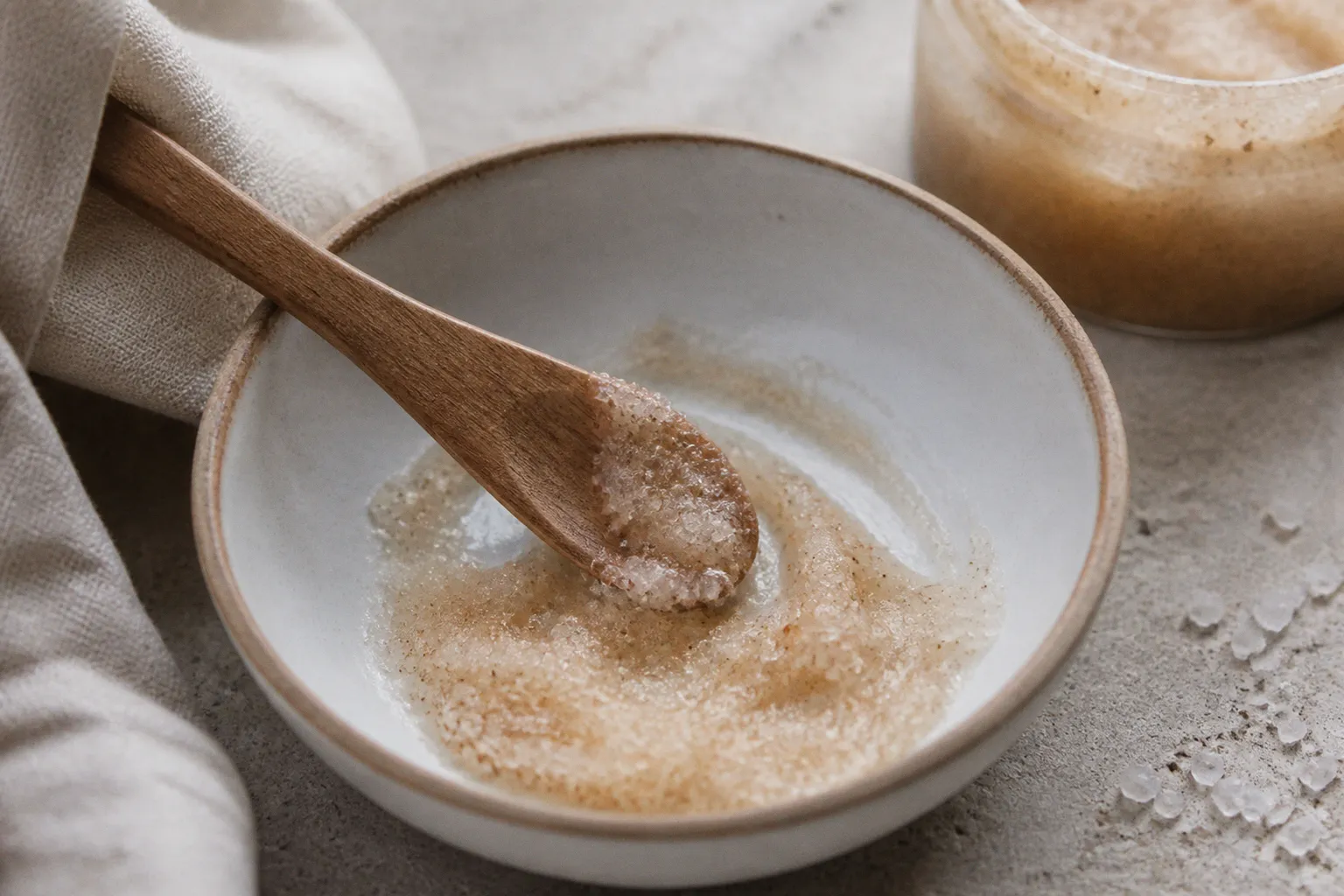
A sugar body scrub, for example, may leave a soft, rinsed finish because the crystals dissolve and the oil phase coats the skin. That sensory softness can be pleasant, but it should not be confused with permanent removal of keratosis pilaris. A coffee body scrub can offer a dry, powdery polish and a distinctive roasted olfactory note, yet the same rule applies: more pressure does not create a more intelligent treatment.
The skin’s response is usually a better guide than the immediate sensation in the shower. A useful exfoliating product leaves the surface supple and even, not hot, stinging, shiny, or squeaky. If the upper arms feel polished for an hour and then become itchy or rough by evening, the formula or frequency is asking too much of the barrier.
Keratosis pilaris responds to consistency, not punishment: loosen the buildup gently, then give the skin enough lipids and water-binding ingredients to recover.
The timeline is also naturally gradual. Keratosis pilaris cannot be permanently cured with a body scrub alone. It is a condition that is managed over time, and the visible pattern can fluctuate with dryness, weather, friction, shaving, and changes in routine. A realistic goal is softer texture and less noticeable follicular redness—not the promise of perfectly poreless skin after one application.
A keratosis pilaris body exfoliation routine: build it in layers
A practical routine has three functional stages: cleanse without stripping, exfoliate with restraint, and moisturize promptly. I find it useful to read a formula through its ingredient architecture: primary ingredients do the main treatment work, secondary ingredients shape the skin feel, and trace ingredients influence the experience without carrying the entire result.
1. Begin with a mild cleansing step
Hot water can make the skin feel temporarily relaxed, but it also increases the sensation of dryness for many people with rough, reactive body skin. Use warm water and keep the cleansing step simple. A foaming body scrub can be convenient because it combines cleansing and light physical exfoliation, but its surfactant system matters. If the skin feels tight immediately after rinsing, the formula is not a good foundation for a keratosis pilaris routine, regardless of how attractive the grain size looks.
The goal is a clean surface, not a stripped one. Fragrance, essential oils, and aromatic extracts can make a product feel beautifully crafted, but they should remain secondary to the comfort of the skin. For a reactive area, I prefer a lower olfactory intensity and a creamy rinse over an aggressively foaming base.
2. Choose the exfoliant according to the type of roughness
Physical exfoliation works at the surface. Chemical keratolytics work by loosening the bonds and buildup associated with rough, thickened skin. Neither approach needs to be maximal.
A chemical body exfoliant for keratosis pilaris may contain glycolic acid, lactic acid, salicylic acid, or urea. These ingredients do not all behave in the same way:
- Lactic acid is an alpha hydroxy acid with a softer, more cushiony sensory profile in many body formulas. It can be a thoughtful choice when the skin feels dry as well as rough.
- Glycolic acid has a smaller molecular structure and can feel more active or tingly, especially when the skin barrier is already compromised.
- Salicylic acid is oil-soluble and often selected for areas where follicular congestion is part of the texture.
- Urea supports hydration while helping soften thickened surface skin. Its sensory character is less immediately polished than a scrub, but it can be valuable in a routine centered on comfort.
- AHA combinations may be formulated at around 10% in targeted KP products, but a higher percentage does not make a home routine automatically better. The finished formula, pH, application area, and frequency all change the experience.
A physical scrub can sit beside a chemical exfoliant, but using both aggressively in the same session is where many routines lose their balance. If a leave-on acid product is already doing the keratolytic work, a very coarse sugar or salt scrub adds friction without necessarily adding useful benefit.
3. Keep physical buffing light and localized
The best body scrub for strawberry skin is usually one with a fine, even particle distribution suspended in a protective base. I pay attention to the viscosity here: a thin oil with coarse particles can drag across the skin, while a denser cream or balm gives the grains more slip and reduces the need for pressure.
Avoid scrubbing over inflamed, freshly shaved, scratched, or broken skin. Do not use the same vigorous motion on the upper arms that you might use on the heels. The upper arms and thighs are common KP areas, but they are not automatically tolerant of aggressive treatment.
A gentle application looks almost uneventful:
1. Wet the skin with warm water and spread a small amount of product over the affected area.
2. Use the fingertips rather than the palms to control pressure.
3. Move in short, light passes for a brief period instead of repeatedly circling the same patch.
4. Rinse thoroughly without rubbing the product away with a rough cloth.
5. Pat the skin until it is damp rather than completely dry.
6. Apply moisturizer immediately.
For many people, exfoliating two or three times per week is a sensible upper rhythm to begin with, not a command to follow indefinitely. If the skin is dry, sensitive, or already using a leave-on acid, start less often and allow the surface to show you whether the routine is tolerable.
Sugar scrub, foaming scrub, or chemical exfoliant?
The product category sets expectations. A sugar scrub is primarily a rinse-off physical exfoliant with a tactile polishing effect. A foaming body scrub adds cleansing, which can be useful in the shower but may feel less nourishing if the surfactant phase is strong. A leave-on lotion or treatment with acids or urea can address roughness without the same level of mechanical friction.
| Product type | Main action | Best role in a KP routine | Common limitation |
|---|---|---|---|
| Sugar body scrub | Gentle-to-moderate surface buffing as crystals dissolve | Occasional skin polishing when the formula has enough oil or emollient slip | Can encourage over-rubbing if the skin feels rough again quickly |
| Coffee body scrub | Physical exfoliation with a dry, textured grain and strong sensory profile | A short rinse-off polishing step on resilient, non-irritated skin | Does not replace a keratolytic treatment and can feel abrasive when pressed into the skin |
| Foaming body scrub | Cleansing plus physical exfoliation | A convenient shower option for light, regular exfoliation | May leave tightness if the cleanser removes too much surface oil |
| Chemical body exfoliant | Keratolytic action from acids or urea | A more targeted option for persistent follicular roughness | Overuse can cause stinging, irritation, discoloration, or barrier damage |
| Rich moisturizer or ointment | Hydration and lipid replenishment after exfoliation | The step that preserves comfort and supports routine consistency | Cannot compensate for an exfoliant that is consistently too harsh |
The table is not a ranking. It is a map. A person with rough but comfortable skin may enjoy a mild sugar scrub once or twice weekly. Someone with visible redness and a history of tightness may do better with a gentle chemical product used sparingly, followed by a rich moisturizer. A foaming scrub may be practical for the back of the arms, but it should not be treated as a complete KP treatment simply because it leaves the skin feeling freshly polished.
A well-made scrub often has a primary exfoliating component, secondary emollients, and trace botanical ingredients. The primary component might be sugar, finely milled powder, or a chemical keratolytic. The secondary phase could include sunflower, jojoba, oat, or other carrier oils chosen for their viscosity and skin feel. Trace ingredients—such as aromatic extracts—can give the product its olfactory notes and personality, but they should not distract from the essential question: does the skin remain calm after use?
The six-week transformation: what the timeline can actually look like
A KP body scrub treatment timeline is best understood as a progression in texture and tolerance rather than a dramatic before-and-after event. The skin may feel different before it looks different, and redness often lags behind surface smoothness.
Week 1: learning the skin’s response
During the first week, the most useful observation is not whether every bump has disappeared. Notice whether the skin feels less rough after bathing and whether the product leaves behind comfort instead of tightness.
A mild routine may produce an initial smoothing effect within one to two weeks. This can come from a combination of surface exfoliation, improved hydration, and the softening effect of emollients. It is an encouraging sign, but it is not proof that the follicular buildup has fully resolved.
If the skin stings when moisturizer is applied, feels unusually warm, or becomes itchy later in the day, pause the exfoliating product. Those sensations suggest that the barrier needs attention before the routine continues.
Weeks 2–3: texture begins to settle
With regular, restrained use, the surface may begin to feel more even. The roughness can become less uniform, with fewer areas that catch against clothing or a towel. This is the stage where many people make the mistake of increasing pressure because some bumps remain.
Resist that impulse. The skin does not necessarily need more abrasion; it may need more time. Continue at the same frequency if the skin is comfortable. If you are using a chemical exfoliant, follow the product’s instructions rather than layering multiple acids across the same area.
Hydration becomes particularly visible here. A moisturizer with humectants and a nourishing carrier phase can make the surface appear calmer because it reduces the dry contrast around each follicle. That does not mean the moisturizer has erased the keratin buildup. It means the skin is better supported while the exfoliating step does its slower work.
Weeks 3–6: bumps and redness may become less noticeable
Visible reduction in bump size and follicular redness commonly takes several weeks, with a three-to-six-week window being a realistic point at which to assess whether the routine is helping. Some areas may respond sooner; others may remain stubborn, especially when friction, shaving, or seasonal dryness continues to aggravate the follicles.
At this stage, compare the skin under similar conditions. A freshly moisturized arm will look different from a dry arm after a hot shower. Look for a general shift: fewer pronounced bumps, a more uniform feel, and less persistent redness. Avoid judging the routine by one day of flare or one unusually smooth evening.
The keratosis pilaris skin smoothing stages are not perfectly linear. A routine can be working overall while the skin still has occasional rough patches. Maintenance remains part of the process because the tendency toward keratin buildup does not disappear simply because the surface has improved.
After six weeks: refine rather than intensify
If the skin is smoother and calm, keep the lowest effective frequency. There is no prize for using an exfoliating scrub every day. If there has been no meaningful improvement, reconsider the structure of the routine rather than automatically choosing a stronger peel.
Look at the whole system:
- Is the physical scrub too coarse or being applied with too much pressure?
- Is a cleanser leaving the arms or thighs tight after rinsing?
- Is the chemical exfoliant being used alongside another acid or retinoid?
- Is moisturizer applied while the skin is still slightly damp?
- Are shaving, tight clothing, or repeated friction keeping the follicles inflamed?
- Has the routine been given several consistent weeks rather than scattered applications?
If the skin is increasingly red, painful, cracked, or intensely itchy, stop exfoliating and seek professional medical guidance. Persistent or severe changes deserve more than a cosmetic adjustment.
The first milestone is not perfectly bare skin. It is a quieter surface that can tolerate the routine you intend to keep.
Hydration after exfoliation: the step that protects the finish
Exfoliation changes the surface feel, but hydration determines whether that improvement remains comfortable. After rinsing, leave a light film of water on the skin and apply a rich moisturizer or ointment promptly. This helps reduce the dry, tight interval in which the skin can begin to lose comfort.
I think of the post-exfoliation formula in two parts. Humectants help attract and hold water at the surface; emollients soften the spaces between dry cells and improve slip; occlusive ingredients slow water loss. The carrier system determines how these elements arrive on the skin. A light lotion may be enough in warm weather, while a denser butter or ointment may suit rough upper arms during a dry season.
Body butters can be especially satisfying after a shower because their viscosity creates a protective cushion. Shea butter, mango butter, and plant oils each bring a different melt point and after-feel, so the formula should be spreadable rather than waxy or difficult to distribute. A beautiful butter that requires vigorous rubbing is poorly matched to already irritated skin.
Moisturizing two or three times a day may be recommended for very dry areas, particularly when the skin is struggling to remain comfortable. In everyday practice, the most valuable application is the one made immediately after bathing and exfoliation, followed by additional use when tightness returns.
Keep the aromatic profile gentle on areas prone to redness. Essential oils and fragrance can be part of an enjoyable body-care ritual, but sensory appeal is not the same as tolerance. If an exfoliating product already contains acids, adding a strongly fragranced leave-on oil may make it harder to identify the source of irritation.
Avoiding the over-exfoliation trap
Over-exfoliation often begins with a reasonable disappointment: the bumps are still present, so the user adds more pressure, more days, or a stronger acid. The skin may feel very smooth for a moment, then develop tightness, burning, increased redness, flaking, or a shiny, fragile appearance. These are not signs that the routine is finally working. They are signals to step back.
At-home high-concentration chemical peels carry a real risk of chemical burns, hyperpigmentation, scarring, and severe barrier irritation. They are not a sensible shortcut for ordinary strawberry skin management. A targeted product used according to its directions is a different proposition from combining a strong acid, a coarse scrub, and hot water in one session.
The warning signs of a routine that has gone too far include:
- Burning or stinging that persists after rinsing.
- Redness that lasts well beyond the shower.
- New flaking or cracking in areas that were previously comfortable.
- Increased sensitivity to moisturizer, clothing, or towel-drying.
- A cycle in which the skin feels polished immediately after scrubbing but rougher and itchier the next day.
- Darkening marks that appear after repeated irritation.
When these signs appear, remove the exfoliating steps temporarily and return to mild cleansing plus a bland, rich moisturizer. Give the skin time to settle before deciding whether to reintroduce a physical or chemical exfoliant. If the reaction is severe or does not improve, a dermatologist can help distinguish KP from other follicular or inflammatory conditions and suggest an appropriate treatment plan.
A botanical approach does not mean every plant-derived ingredient belongs in every routine. It means understanding the whole blend: the exfoliant, the carrier, the viscosity, the rinse profile, the fragrance load, and the way the formula behaves under warm water. A sugar crystal in a generous oil base has a different practical effect from the same grain in a thin cleanser. A lactic acid lotion with a supportive emollient phase has a different skin reality from a strong peel layered onto freshly scrubbed follicles.
A precise routine to follow
For a straightforward starting point, use this sequence:
1. Cleanse with warm water and a mild body wash. Avoid trying to remove every trace of natural oil from the affected area.
2. Exfoliate two or three times weekly at most to begin. Choose either a gentle scrub or a chemical keratolytic rather than stacking several aggressive steps.
3. Use minimal pressure. Let the product’s formulation do the work; the skin should not feel scraped or hot.
4. Rinse and pat dry. Keep a small amount of moisture on the surface.
5. Apply a rich moisturizer immediately. Look for a comfortable balance of humectants, emollients, and occlusive support.
6. Assess at one to two weeks for comfort and surface texture. Assess again around three to six weeks for a broader change in bump size and redness.
7. Reduce or pause exfoliation if the barrier becomes reactive. More frequent use is not a substitute for a well-matched formula.
The most effective keratosis pilaris body exfoliation routine steps are modest enough to repeat. A scrub can be part of that route, especially when its particle size, slip, and rinse feel respect the skin. But the durable result comes from the relationship between exfoliation and hydration: loosen what is sitting around the follicle, then protect the surface you have just softened.
The practical decision is simple. Choose the least abrasive product that addresses your texture, use it consistently for several weeks, and let the skin’s comfort set the pace. That is how strawberry skin gradually becomes smoother—not through harder polishing, but through a better-formulated routine and enough patience for the follicles to respond.