Body scrub before or after shaving: the correct order
Razor burn is rarely mysterious. It usually comes from a combination of friction, repeated strokes, a dull blade, and skin that was already irritated before shaving began.
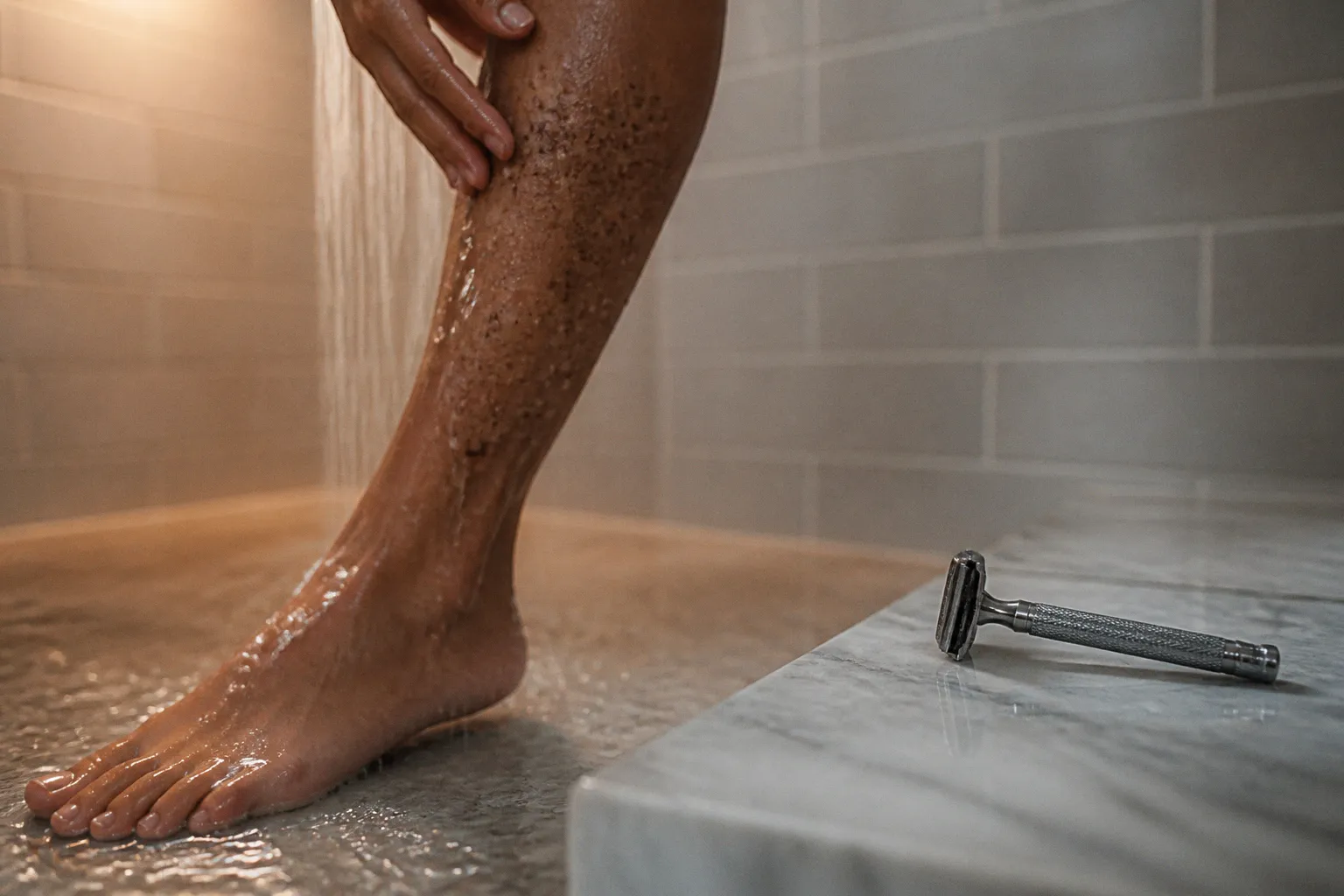
The order of your shower routine cannot eliminate every bump, but it can reduce the amount of work the razor has to do.
For most body areas, the better sequence is simple: exfoliate first, rinse thoroughly, then shave. Scrubbing after shaving is the part that causes trouble. Once the razor has passed over the skin, adding abrasive particles or strong acids can intensify stinging and redness instead of making the surface smoother.
Body scrubbing and shaving are not two unrelated tasks stacked into the same shower. They affect the same surface, and the first step changes how much friction the second step creates. That is why the question of body scrub before or after shaving has a practical answer: before shaving, with enough time between the shave and the next exfoliating session for the skin to settle.
The science of pre-shave exfoliation: why order matters
What exfoliation can and cannot do
The outermost layer of skin contains a mixture of shed cells, sebum, sweat, product residue, and other surface debris. It does not form a perfectly even layer. On some areas, particularly the legs, upper arms, thighs, and back, that uneven texture can make a razor drag or skip.
A gentle body scrub helps remove some of the cells that are already ready to shed. That can leave the surface more even and reduce the amount of resistance the blade meets. It does not “open” pores, and it does not reliably lift the hair above the skin. Hair follicles are not doors that warm water opens and cool water closes. The useful effect is more modest and more mechanical: the skin surface is cleaner and smoother, so the razor can move across it with less interference.
The shower itself also helps. Warm water softens surface oils and makes the hair more pliable, while shaving cream, gel, or oil adds slip between the blade and the skin. Exfoliation is only one part of that preparation. It should not be treated as permission to press harder or chase an extra-close result with repeated passes.
Sugar, fine salt, and finely milled plant powders can all provide physical exfoliation, but the texture matters. A product with smooth, small particles is easier to control than one containing sharp fragments or large crystals. The goal is to loosen surface buildup, not to polish the skin aggressively.
A useful pre-shave routine therefore has three separate jobs:
- warm and soften the area;
- remove loose surface debris with light pressure;
- create enough lubrication for the blade to glide.
When those jobs are done in that order, shaving is usually more comfortable than when a razor is used on dry, rough, or product-coated skin.
Pre-shave exfoliation is useful because it clears loose surface buildup; it does not change the structure of the pore or guarantee a closer shave.
Why shaving after body scrub is usually the better sequence
If the scrub is rinsed away before shaving, the blade meets a clean, lubricated surface. Any remaining roughness can then be addressed by the razor without adding a second abrasive step immediately afterward.
That distinction matters because shaving is already a form of friction. Even a careful shave can remove some surface cells and create tiny areas of irritation that are not visible in the mirror. The more passes you make, the more likely the skin is to feel hot, tight, or sensitive afterward. A pre-shave scrub should make the shave easier, not become another reason to keep going over the same area.
A post-shave scrub reverses the logic. Salt or sugar particles may catch on freshly irritated skin, and rubbing them over the area can increase discomfort. A chemical exfoliant can also sting when applied immediately after shaving, especially if the formula contains acids, fragrance, or a high level of alcohol.
This does not mean every person must exfoliate before every shave. Some people with very reactive skin do better with no physical scrub at all. But when exfoliation is part of the routine, exfoliating before shaving is generally the less irritating option.
Risks of scrubbing post-shave: protecting your skin barrier
Why freshly shaved skin needs a pause
The skin barrier is not a single visible coating. It is a functional arrangement of cells, lipids, and natural moisturizing factors that helps limit water loss and protects the surface from irritants. Shaving can temporarily disturb that barrier through friction and contact with the blade.
The signs are familiar: stinging when lotion is applied, tightness after rinsing, persistent redness, or a warm sensation across the shaved area. Scrubbing at that point adds more mechanical stress to a surface that is already recovering.
The most common mistake is to interpret post-shave roughness as a signal to exfoliate immediately. In reality, that roughness may be temporary dryness or irritation rather than a layer of dead skin that needs to be removed. More abrasion will not necessarily make it disappear. It may simply make the area more sensitive.
The risk is higher in areas where the skin is delicate, frequently rubbed, or prone to follicle irritation:
- underarms, where shaving, sweat, and deodorant can interact;
- the bikini and pubic area, where hair is often coarser and curls more tightly;
- the backs of the thighs, where clothing creates repeated friction;
- the chest and abdomen, particularly when the skin is dry or easily flushed;
- the face and neck, where dense hair and frequent shaving create repeated exposure to the blade.
These areas do not automatically require a complicated routine. They usually require less force, better lubrication, and a longer recovery interval.
What to do instead of immediate scrubbing
After shaving, rinse away the shaving product and pat the skin dry. Cool or lukewarm water may feel more comfortable than hot water, but it does not close pores. The soothing effect comes from reducing the sensation of heat and friction, not from changing the opening of the follicles.
Follow with a plain moisturizer, body butter, or lightweight body oil if your skin tolerates it. Choose a product that does not sting and avoid applying heavily fragranced formulas to freshly shaved sensitive areas. If the skin is already burning or visibly inflamed, keep the routine simple: gentle cleansing, bland moisturization, and time.
Wait at least 24 hours before exfoliating the same area again. Some people need closer to 48 hours, especially after a close shave, a first use of a new blade, or shaving an area that regularly develops bumps. The right interval is the one that allows the skin to feel calm rather than tight, raw, or tender before the next scrub.
Strategic timing for ingrown hair prevention
Ingrown hairs are not caused by one single mistake. They can be influenced by hair curl, the direction of growth, the closeness of the shave, friction from clothing, and the way dead skin accumulates around the follicle. Exfoliation may help reduce one part of that problem, but it cannot ensure that ingrown hairs will never occur.
How timing changes the benefit
Scrubbing before shaving can remove some loose surface cells and create a more even path for the blade. Waiting after shaving allows the skin to recover before you introduce another source of friction. When the area is calm again, gentle exfoliation may help prevent excess buildup from collecting around emerging hairs.
The timing is particularly important for people who shave against the direction of growth or try to remove every last trace of stubble. A very close shave can leave the cut end of a curly hair more likely to curve back toward the skin as it grows. Exfoliation cannot correct the hair’s natural shape, but a careful routine can reduce additional irritation around the follicle.
A practical rhythm looks like this:
1. Exfoliate before shaving, using light pressure and a mild product.
2. Rinse thoroughly and apply shaving cream, gel, or oil.
3. Shave with the direction of growth first.
4. Moisturize and leave the area alone after shaving.
5. Wait 24 to 48 hours before exfoliating that same area again.
6. Continue only while the skin remains comfortable; pause if it becomes dry, sore, or inflamed.
The exact calendar will vary. If you shave on Monday, a scrub on Thursday gives the skin more time than a scrub on Tuesday. If your skin is easily irritated, that longer interval may be the more sensible choice. A schedule helps you avoid piling one irritating step on top of another, but it does not train hair growth or alter the cycle of the follicle.
Exfoliation can support ingrown-hair prevention, but it is a supporting step—not a guarantee. The closeness of the shave and the skin’s tolerance matter just as much.
When an ingrown hair is already present
Do not scrub aggressively over a painful, swollen, or visibly inflamed bump. Avoid digging into the skin with a needle, pin, or tweezers in an attempt to find a trapped hair. That can create another wound and introduce bacteria.
Instead, stop shaving the area for a while and use warm, not hot, water to soften the skin. A gentle cleanser and a bland moisturizer are usually a better starting point than more friction. If the hair loop is clearly visible at the surface, it may release on its own as the swelling settles; do not force it out.
Seek medical advice if the area becomes increasingly painful, hot, swollen, or filled with pus, or if bumps keep returning despite changing your routine. Persistent folliculitis and recurrent ingrown hairs may need treatment beyond a body scrub.
Optimizing your routine: blade maintenance and frequency
How often should you exfoliate?
There is no universal requirement to use a scrub several times a week. Body skin can tolerate more than facial skin, but tolerance still varies by area and by product. A physically abrasive scrub used too often can leave the skin tight, flaky, or sensitive, even if the product feels pleasant in the shower.
For many people, one or two sessions a week are enough. Others may tolerate a third session on thicker, less reactive areas, such as the legs. That is a ceiling to approach cautiously, not a target that every routine needs to reach.
If you shave frequently, separate the two activities rather than trying to exfoliate every time. For example, you might scrub before one or two shaving sessions during the week and skip it before the others. The skin does not become less smooth because one scrub was missed. It can, however, become irritated when shaving and exfoliation are repeated without enough recovery time.
Reduce frequency or stop temporarily if you notice:
- persistent redness after the shower;
- tightness that returns soon after moisturizing;
- flaking or rough patches that feel more pronounced after scrubbing;
- stinging from products that normally feel comfortable;
- small abrasions or a burning sensation during the shave.
A body butter or oil can make dry skin feel softer, but it does not cancel out over-exfoliation. Moisture supports comfort; it does not repair a routine that is consistently too aggressive.
Blade maintenance is part of exfoliating before shaving
A scrub cannot compensate for a blade that drags. As a razor becomes dull, it may pull at the hair instead of cutting it cleanly. That encourages repeated strokes, extra pressure, and more friction in exactly the places where you are trying to prevent irritation.
Rinse the cartridge thoroughly during and after shaving, shake off excess water, and store it somewhere that allows it to dry. Do not leave it sitting in a puddle on the edge of the tub. Replace it when the stroke starts to tug, skip, or feel rough, or when the blades show signs of wear. The number of shaves a cartridge lasts depends on hair thickness, the size of the area, the product used for lubrication, and how it is stored.
A sharp blade still needs a light touch. Shaving is not a test of pressure. Use short strokes and let the lubricant do its job. If you have to press down to remove hair, the better response is usually to rinse, reapply product, change the angle, or replace the blade—not to push harder.
Shaving direction and number of passes
Start with the direction of hair growth. This may not produce the absolutely closest possible result, but it generally creates less pulling and friction than beginning against the grain. If a closer finish is important and the skin tolerates it, a second pass can be made across the grain or carefully against it. Stop when the skin begins to feel hot or tender.
Do not use the same pressure and direction on every body area. Hair on the lower legs may grow downward, while hair on the thighs, underarms, and bikini area can change direction over a relatively small patch of skin. Run your fingers over the area first if you are unsure. Mapping the growth direction is more useful than assuming that every section should be shaved the same way.
| Routine choice | Likely benefit | Main caution |
|---|---|---|
| Mild scrub before shaving | Smoother surface and less loose buildup under the blade | Use light pressure and rinse completely |
| Scrub immediately after shaving | No reliable extra smoothness and more friction on freshly shaved skin | More likely to sting or worsen redness |
| Shaving with the grain first | Usually less pulling and irritation | May leave a little more visible stubble |
| Repeated against-the-grain passes | Closer-feeling result | Higher risk of irritation and ingrown hairs |
| Fresh, well-rinsed blade | More consistent cutting with fewer corrective strokes | Still requires lubrication and a light touch |
| Thick shaving cream, gel, or compatible oil | Better slip between skin and blade | Reapply if the surface begins to dry |
Selecting the right exfoliant for sensitive skin
Physical scrubs: texture matters
A body scrub is not judged only by its ingredients. The shape, hardness, and size of the particles determine how the product feels on the skin. Large salt crystals, sharp shell fragments, and rough particles can create uneven pressure, particularly when used on thin or reactive skin.
Fine sugar is often more forgiving because the particles begin to dissolve as they mix with water. That does not make it impossible to overuse; the pressure of the hand still matters. Fine salt can work on thicker areas, but it may sting if the skin has tiny cuts or is already dry. Coffee-based scrubs vary widely. Finely milled particles are easier to control than coarse grounds, and the fragrance or essential oils in the formula may be more irritating than the exfoliating particles themselves.
Avoid using a coarse foot scrub as a pre-shave product on the legs, underarms, or bikini area. The skin in those areas does not need the same treatment as a thick callus on the heel.
Chemical exfoliants: gentler does not mean risk-free
A body product containing lactic acid, glycolic acid, or salicylic acid can loosen the bonds between surface cells without the same grainy friction as a physical scrub. That may suit someone who finds particles irritating. It can still sting after shaving, particularly when the skin barrier is compromised or the product is strongly fragranced.
Use chemical exfoliants on a different schedule from shaving at first. Apply them to calm, intact skin and follow the product’s directions. Do not combine a strong acid, a rough scrub, and a close shave in one routine simply because each step is marketed as smoothing.
For sensitive or reactive skin, the safer starting point is usually:
- a fragrance-free or low-fragrance formula;
- a small test area before broader use;
- one exfoliating method at a time;
- a longer interval between exfoliation and shaving;
- immediate suspension of the product if burning or persistent redness appears.
If you have eczema, psoriasis, active dermatitis, open cuts, or a recent sunburn, postpone exfoliation until the skin has recovered. A premium body butter or oil can make a routine feel more luxurious, but luxury does not change the basic rule: irritated skin needs less abrasion, not a more elaborate one.
Apply with your hands, not maximum force
Hands give you useful feedback. You can feel whether the product is sliding or catching, and you can stop when the skin begins to feel warm or sensitive. A brush, rough mitt, or exfoliating glove can make it easier to apply uneven pressure, especially on bony areas such as the shins and knees.
Use a small amount on wet skin and move in gentle circles without trying to create a dramatic polished feeling. That intensely “squeaky” finish is not proof that the scrub worked better. It may simply mean that too much surface oil has been removed.
The correct shower scrubs order of use
A sensible routine does not need to be complicated. The sequence below keeps the abrasive step away from freshly shaved skin and gives the razor enough lubrication to work without repeated corrections.
Step 1: Let the water soften the area
Spend a few minutes in a warm shower before applying the scrub. Avoid very hot water if your skin is dry, flushed, or prone to itching. Warmth can make the hair and surface oils easier to manage, but it does not open pores or raise the hair out of the follicle.
Step 2: Exfoliate lightly
Apply the scrub with your hands, one body area at a time. Use small circles and minimal pressure. There is no benefit in scrubbing until the skin turns red. A leg, arm, or underarm should feel clean and comfortable afterward, not raw.
If you are using an acid-based product rather than a physical scrub, follow its instructions instead of adding extra rubbing.
Step 3: Rinse everything away
Remove all particles and product residue before picking up the razor. Granules left on the skin can create uneven drag and make it harder to control the blade. Rinsing also gives you a chance to check whether the skin is already stinging. If it is, skip shaving that area until it settles.
Step 4: Add a proper shaving medium
Use shaving cream, gel, or a body oil that gives enough slip for your skin and razor. A thin layer that dries during the process is not enough. Reapply to any section that begins to feel dry rather than passing the blade over it unprotected.
Step 5: Shave with controlled strokes
Begin with the direction of hair growth, using short strokes and light pressure. Rinse the blade regularly so it does not become packed with hair and product. If you need another pass, reapply lubricant first.
Step 6: Rinse and pat dry
Cool or lukewarm water can feel soothing after shaving, but it does not close pores. Pat the area dry instead of rubbing it briskly with a towel.
Step 7: Moisturize and wait
Apply a body lotion, butter, balm, or oil that your skin already knows. Then wait at least 24 hours before exfoliating the same area. If there is lingering redness or tenderness, wait longer—closer to 48 hours or until the skin feels normal again.
The cleanest shave comes from reducing friction before the blade arrives and refusing to add more abrasion while the skin is recovering.
The bottom line
For most body areas, exfoliate before shaving, not immediately afterward. Use a fine, controlled exfoliant on wet skin, rinse it away completely, and follow with enough shaving cream, gel, or oil to keep the blade moving smoothly.
After shaving, give the area at least 24 hours before exfoliating again. Many people with sensitive skin will do better with a 48-hour pause. That interval is not a way to retrain hair growth; it is simply time for the surface to recover from the friction of the shave.
A well-maintained blade, fewer passes, shaving with the grain first, and a moderate exfoliation schedule usually matter more than an aggressive scrub. If bumps continue, examine the whole routine: blade condition, shaving direction, product fragrance, clothing friction, and how closely the hair is being removed.
The aim is not a complicated ritual or an artificially polished surface. It is a controlled sequence: soften, gently clear the surface, lubricate, shave, moisturize, and leave the skin alone long enough to recover. That is the reliable order for using body scrubs around shaving.