Body scrub vs exfoliating mitt for strawberry legs
Dark dots on the legs are usually not a simple dead-skin problem. They can result from clogged hair follicles, oxidized oil, shaving irritation, bacteria, or keratosis pilaris.
The visible color is produced when trapped material in a follicle oxidizes after exposure to air. Removing surface scale may improve texture, but it does not automatically correct the follicular process underneath.
Compare car rental deals in United Kingdom
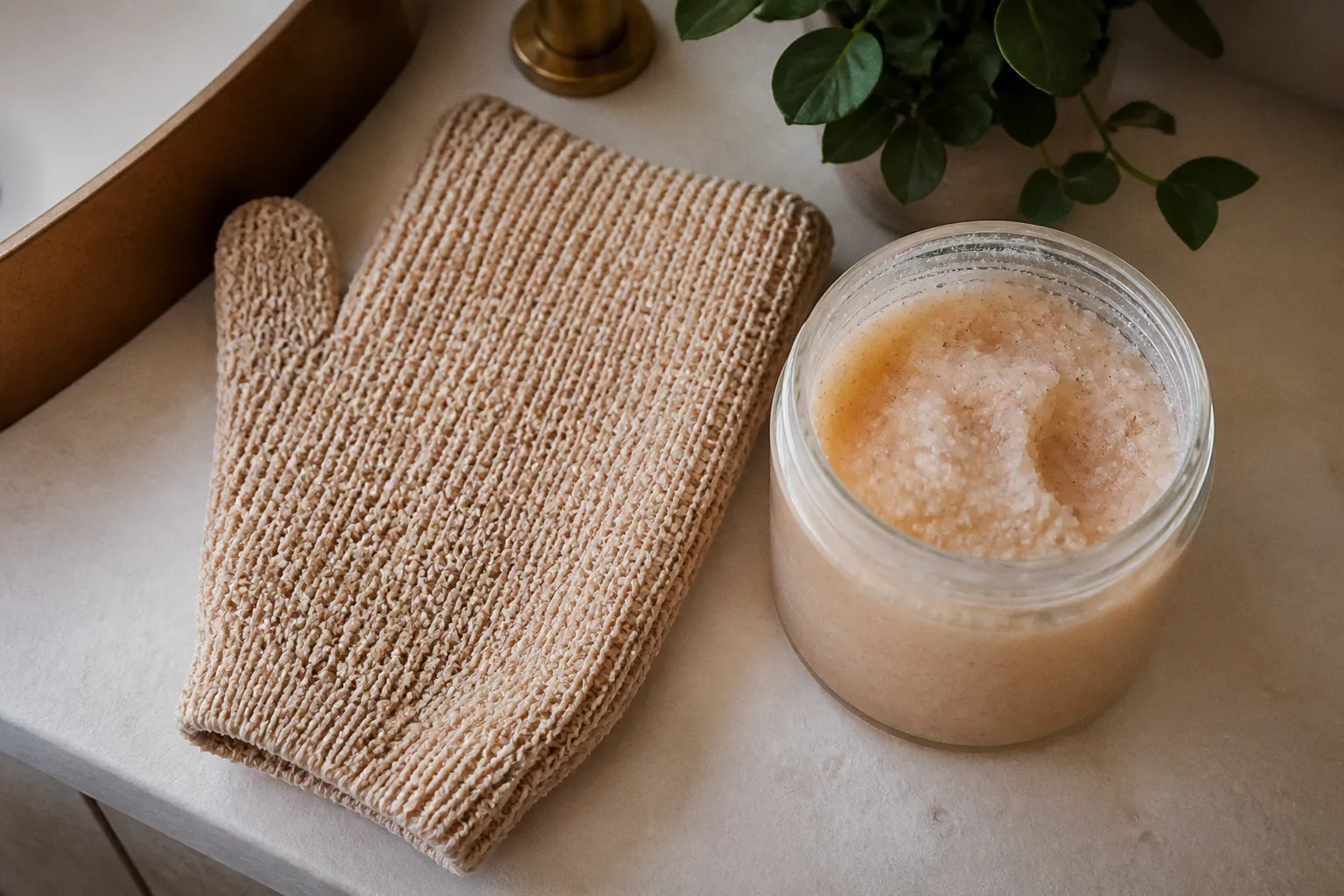
See available offersPartner link — DiscoverCars comparisonThis is the central distinction in the body scrub vs exfoliating mitt comparison. Both tools provide mechanical exfoliation. Neither is a universal treatment for strawberry legs. A mitt creates more friction. A scrub combines friction with an oil, cream, or foaming base. For skin prone to keratosis pilaris, redness, or post-shave irritation, the intensity of that friction matters more than the marketing language on the label.
The mechanics of strawberry legs: why pores darken
“Strawberry legs” is a visual description rather than a single diagnosis. The dots may be located at hair follicles, pores, or areas irritated by shaving. Several mechanisms can produce a similar appearance.
Follicular oxidation
A hair follicle can retain a mixture of dead skin cells, sebum, bacteria, and shaving debris. When this material is exposed to oxygen, it may darken. The pore itself has not necessarily changed size. The dark point is often the oxidized contents of the follicle.
A body scrub can remove some of the material sitting on the outer surface. An exfoliating mitt can remove more surface buildup because its fibers or textured weave generate higher friction. Neither method reliably removes every compacted plug inside the follicle.
Shaving irritation
Shaving creates several variables at once:
- Blade sharpness. A dull razor requires more passes and increases mechanical stress. A blade commonly remains usable for approximately five to seven shaves, although the actual lifespan depends on hair density, pressure, lubrication, and cleaning.
- Direction of shaving. Repeated passes against the grain can increase irritation for some users.
- Skin preparation. Dry shaving and insufficient lubrication increase drag.
- Post-shave friction. Tight clothing, vigorous towel drying, or immediate use of an abrasive scrub can compound irritation.
Physical exfoliation should occur before shaving, not immediately afterward. Freshly shaved skin has already experienced controlled surface abrasion. Adding a mitt or a granular scrub at that stage can increase redness and impair the barrier.
Keratosis pilaris
Keratosis pilaris, or KP, results from keratin accumulation around hair follicles. It is strongly associated with genetic tendency rather than inadequate cleansing. The condition affects approximately 50% to 80% of teenagers and around 40% of adults at some point.
KP can appear as rough, follicular bumps with red or brown discoloration. The skin often feels uneven even when it is clean. Scrubbing harder does not remove the underlying tendency to produce keratin plugs. It can instead disrupt the lipid structure that limits transepidermal water loss, or TEWL.
Strawberry legs describe an appearance. The correct exfoliation method depends on whether the main driver is surface scale, shaving irritation, follicular plugging, or keratosis pilaris.
Body scrub vs exfoliating mitt: how the mechanisms differ
A body scrub and an exfoliating mitt are both physical exfoliation tools, but they do not deliver the same dose of friction.
A mitt concentrates friction through a textured surface. Pressure, water content, contact time, and the number of passes determine the effective intensity. A sugar or salt scrub distributes particles across the skin and usually includes an emollient or surfactant base. The particles may dissolve, soften, or rinse away during use. A foaming body scrub may feel less oily but can provide less post-rinse occlusion than an anhydrous scrub based on oils or butters.
The composition of a scrub changes the after-effect. A formula containing sunflower, jojoba, or other emollient oils may reduce the dry feel that can follow washing. That does not make the exfoliation non-abrasive. Friction still acts on the stratum corneum.
Exfoliating glove vs body scrub
| Parameter | Exfoliating mitt | Body scrub |
|---|---|---|
| Main action | Mechanical friction from a textured fabric or fiber surface | Mechanical friction from particles suspended in a cream, oil, or cleansing base |
| Exfoliation intensity | Usually higher and easier to increase with pressure and repeated passes | Usually lower to moderate, depending on particle size, hardness, and formula |
| Control during use | Controlled by pressure, movement, and the number of passes | Controlled by particle load, pressure, contact time, and rinsing |
| Residue after rinsing | Usually minimal, unless used with a cleanser or oil | May leave emollient oils, humectants, or a film-forming base |
| Cost over time | Reusable and generally inexpensive over repeated use | Requires replacement after the product is used |
| Customization | Limited to pressure and frequency | Can be selected by particle type, oil phase, surfactant system, and texture |
| Main risk | Excess friction from vigorous or repeated passes | Abrasive particles, large crystals, fragrance, or repeated use on compromised skin |
| Relevance to KP | Can worsen redness if used aggressively | May improve surface smoothness but does not correct follicular keratin production |
The table does not establish a universal winner. It shows the trade-off. An exfoliating mitt offers stronger surface removal at a lower long-term cost. A body scrub offers more formula control and may combine exfoliation with emollient deposition. For reactive skin, either option can be excessive if used with pressure or used too often.
What the scrub base contributes
A body scrub is not defined only by its exfoliating particles. The vehicle affects how the product spreads, how much friction is generated, and how the skin feels after rinsing.
Common categories include:
- Sugar scrubs. Sugar crystals are water-soluble and generally become less abrasive as they dissolve. Particle size still matters. Large crystals can create localized pressure, especially on dry skin.
- Salt scrubs. Salt crystals can be more uncomfortable on shaved, cracked, or irritated skin. They may sting when the barrier is compromised.
- Coffee scrubs. Coffee particles provide mechanical texture. They do not establish a treatment for KP or follicular oxidation. Particle irregularity and pressure determine the abrasion.
- Foaming body scrubs. These use surfactants to cleanse while particles exfoliate. The rinse may remove more surface oil than an anhydrous scrub.
- Oil-based scrubs. These can reduce drag and leave an emollient layer after rinsing. A greasy finish is not the same as barrier repair, but the formula may reduce the immediate dry feel.
The comedogenic scale is often used to classify oils, but it should not be treated as a precise predictor for every body area. The rating depends on the testing system, concentration, vehicle, contact time, and individual skin response. A low-comedogenicity oil can still irritate a particular user. A higher-rated oil may not create visible follicular congestion when used briefly and rinsed away.
What the mitt contributes
The mitt has fewer formulation variables, but that makes technique more important. A rough textile can remove surface corneocytes efficiently. It can also produce micro-irritation when the user applies downward pressure or repeatedly works over the same area.
The highest-risk pattern is not one isolated pass. It is cumulative friction:
1. A dry or barely wet mitt is used with pressure.
2. The same area is scrubbed until it feels visibly smooth.
3. The skin is shaved immediately afterward.
4. A fragranced or acidic product is applied to the freshly irritated surface.
5. The process is repeated daily because the roughness returns.
The roughness often returns because the stratum corneum is continuously renewed. Increasing abrasion does not stop that biological process. It may only make the skin more reactive.
The barrier problem: why more exfoliation can worsen the appearance
The outer skin barrier is organized around corneocytes and intercellular lipids. Its function is not cosmetic. It limits water loss and reduces penetration of irritants. Excessive physical exfoliation can remove protective lipids and increase TEWL.
This creates a common feedback loop. The user sees roughness and dark follicles, scrubs more aggressively, develops dryness and redness, then interprets the altered texture as evidence that even more exfoliation is required. The result can be persistent irritation rather than smoother skin.
Signs that the mechanical method is too strong
Reduce or stop physical exfoliation when the skin develops:
- Persistent redness after rinsing.
- Burning or stinging during application of a bland moisturizer.
- Tightness that continues after the shower.
- Fine scaling or flaking.
- Increased sensitivity to shaving.
- Small abrasions or pinpoint bleeding.
- More prominent follicular redness.
- New irritation in areas that were previously unaffected.
These signs indicate barrier stress. They are not evidence that the product is “working deeper.”
A scrub can be too aggressive even when the particles feel small. A mitt can be too aggressive even when it is marketed for sensitive skin. The relevant variables are pressure, repetition, skin condition, and frequency.
Why KP-prone skin needs a different strategy
Keratosis pilaris is a keratinization problem. The goal is to loosen and dissolve compacted keratin with controlled chemical exfoliation and hydration, not to abrade every bump mechanically.
Lactic acid, glycolic acid, salicylic acid, and urea are commonly used for this purpose. They act through different mechanisms:
- Lactic acid is an alpha hydroxy acid with exfoliating and humectant properties.
- Glycolic acid has a smaller molecular structure and can produce a stronger exfoliating effect at comparable stated concentrations, depending on pH and formulation.
- Salicylic acid is oil-soluble and can be useful when follicular congestion and sebum are relevant.
- Urea hydrates the stratum corneum and can soften compacted keratin at suitable concentrations.
A treatment containing 10% glycolic acid was associated with a 62% reduction in KP over eight weeks in the research summarized for this topic. That figure should not be generalized to every product. Formula pH, application frequency, vehicle, skin tolerance, and baseline severity affect performance.
Chemical exfoliation is not automatically gentle. An acid product can cause irritation when combined with a mitt, a scrub, frequent shaving, or other active ingredients. The practical advantage is dose control. The formula can target keratin cohesion without requiring repeated high-friction passes over the skin.
If the problem is follicular keratin, a rougher tool is not a stronger treatment. It is only a stronger mechanical stimulus.
Mitt vs scrub for strawberry legs: choosing by skin condition
The decision between a body scrub or exfoliating mitt should begin with the condition of the skin, not with the promised finish.
A body scrub is the more controllable physical option when:
- The skin is intact and not inflamed.
- The user wants mild surface polishing rather than treatment for pronounced follicular plugs.
- The formula contains small, relatively uniform particles.
- The base includes emollients that reduce drag.
- The product can be rinsed without prolonged rubbing.
- Use is limited to one or two sessions per week initially.
A scrub is easier to modify through product selection. An oil-based sugar scrub and a foaming scrub will not behave identically. The first may reduce friction and leave a lipid-rich film. The second may cleanse more thoroughly but can feel drier after rinsing.
An exfoliating mitt may be appropriate when:
- The primary issue is superficial buildup.
- The user can apply minimal pressure.
- The mitt is used on wet, softened skin.
- The tool is not passed repeatedly over the same follicle.
- It is cleaned and dried between uses.
- The skin does not show active redness, rash, cuts, or post-shave sensitivity.
The mitt is not an efficient choice for every case. Strong surface removal can make the legs feel smooth immediately while increasing barrier disruption later. The short-term tactile result can therefore be misleading.
Avoid both physical methods temporarily when:
- The area has active razor burn.
- Follicles are painful, warm, or producing pus.
- There are open cuts or cracked skin.
- The user has an eczema flare or another inflamed dermatitis.
- An acid or retinoid has already caused irritation.
- The skin is unusually dry and stings with water or moisturizer.
Painful pustules, spreading redness, warmth, or persistent inflammation do not belong in a body-scrub comparison. Those findings may indicate folliculitis or another condition requiring clinical assessment.
A safer body exfoliation and shaving routine
A practical routine separates cleansing, exfoliation, shaving, and moisturization. It does not stack every abrasive or active step in one shower.
1. Soften the skin without prolonged hot water
Use warm water and a mild cleanser. Prolonged hot water can increase dryness and may make the skin more reactive. The objective is to remove sweat, sunscreen, and surface residue without aggressively degreasing the stratum corneum.
2. Exfoliate before shaving
If physical exfoliation is used, apply it before shaving. Use a brief, light pass. A body scrub should be spread rather than worked into the skin until the particles disappear. A mitt should glide over the surface with minimal pressure.
Do not scrub until the legs feel “polished.” That sensation often reflects removal of surface lipids and increased friction, not a corrected follicular process.
3. Shave with controlled pressure
Apply a suitable shaving medium and use as few passes as practical. Avoid pressing the razor into the skin. Rinse the blade frequently. Replace it when drag increases, the edge becomes dull, or repeated passes are required.
A new blade can still irritate skin if the user makes multiple passes over the same area. Blade sharpness is only one component of the shaving process.
4. Rinse and moisturize
Rinse without vigorous towel friction. Pat the skin dry and apply a moisturizer while the surface is still slightly damp. Ingredients that support barrier function include humectants, emollients, and occlusive agents. The exact formula depends on tolerance and the user’s preference for a lighter or more occlusive finish.
For dry or KP-prone skin, a moisturizer containing urea, lactic acid, or another suitable keratolytic may be more rational than increasing physical scrubbing. Introduce one active variable at a time.
5. Limit frequency
Physical exfoliation should not be performed daily. The available guidance places a maximum of approximately two to three exfoliation sessions per week, but sensitive or KP-prone skin may require less. Starting once weekly provides more information about tolerance than beginning with repeated use.
Wait for the skin response. If redness or stinging persists, frequency is already too high or the method is too abrasive.
How to combine physical and chemical exfoliation
Combining a body scrub or mitt with a chemical body exfoliant can be appropriate for some users, but simultaneous use increases the irritation load. The methods should be separated rather than layered.
A controlled weekly structure may look like this:
- One physical exfoliation session: Use either a scrub or a mitt, not both.
- Separate chemical exfoliation sessions: Apply a lactic acid, glycolic acid, salicylic acid, or urea product according to its instructions and the skin’s tolerance.
- Shaving on a non-irritated day: Avoid placing shaving immediately after an acid application if the skin is reactive.
- Moisturization between sessions: Support the barrier rather than attempting to maintain constant exfoliation.
This is not a universal schedule. It is a way to avoid applying multiple forms of stress at once.
A person with visible follicular bumps and roughness may see mild texture improvement in four to six weeks. Consistent smoothing can require four to twelve weeks. These timeframes are not guarantees. They indicate why daily scrubbing is a poor response to slow biological change.
What about coffee scrubs?
Coffee body scrubs are often selected for their particle texture and botanical positioning. The relevant question is not whether coffee is present. It is whether the particles are uniform, whether they create excessive friction, and how often the product is used.
Coffee particles cannot be assumed to dissolve during use. Pressure remains the main variable. A coffee scrub may remove surface scale, but it does not establish a treatment for KP, bacterial folliculitis, or the genetic tendency behind keratin buildup.
What about foaming body scrubs?
A foaming body scrub combines surfactant cleansing with physical particles. This can be useful for users who want to rinse away oil and residue in one step. It can also leave the skin drier than an oil-based scrub, depending on the surfactant system and the user’s baseline barrier condition.
The formula should be assessed by function:
- Does it rinse cleanly without repeated rubbing?
- Are the particles small and reasonably uniform?
- Does the skin feel tight afterward?
- Does redness persist beyond the shower?
- Is fragrance likely to be a problem for reactive skin?
The presence of botanical oils does not cancel the effect of surfactants or abrasive particles. Product evaluation requires the complete formula and the use pattern.
The limits of physical dead skin removal
Physical exfoliation is effective at removing some surface buildup. That is its appropriate scope. It should not be presented as a permanent solution for dark follicles or KP.
It cannot reliably:
- Change a genetic tendency toward keratin buildup.
- Permanently close pores.
- Prevent follicular oxidation in every case.
- Resolve bacterial folliculitis.
- Eliminate shaving irritation while shaving technique remains unchanged.
- Repair a damaged barrier through continued abrasion.
The strongest visible improvement may occur when surface scale is the dominant issue. If the dark points are caused by follicular contents, hair removal, inflammation, or keratin plugs, the result will be incomplete unless those variables are also addressed.
This is why a chemical body exfoliant can be more appropriate than either a scrub or mitt in a KP-focused routine. It works on keratin cohesion rather than relying on friction. It still requires conservative use.
A note on product expectations
A body scrub can improve immediate skin feel. A mitt can produce a more pronounced smoothness after one session. Those outcomes are measurable as surface texture, not proof that the follicles are clear.
The more persistent the dots, the less useful it is to judge a method by the first shower. Track the relevant variables instead:
- Follicular redness.
- Roughness between shaves.
- Number of ingrown hairs.
- Stinging after cleansing.
- Dryness and scaling.
- Whether the appearance improves or worsens after shaving.
- Whether the response persists between exfoliation sessions.
If the legs become smoother for several hours and more irritated the next day, the method is not well calibrated.
The practical verdict: scrub or mitt?
For uncomplicated surface buildup, a body scrub is generally the more adjustable physical option. The user can choose a sugar, salt, oil-based, or foaming formula and control the amount applied. This does not make every scrub mild. Particle size and pressure still determine the result.
An exfoliating mitt is more efficient at mechanical removal and costs less over repeated use. It also gives the user less protection against over-application. A rough weave, heavy pressure, and repeated passes can produce more barrier disruption than a well-formulated scrub.
For strawberry legs associated with KP, persistent follicular plugs, or recurring redness, neither tool should be the main treatment. A mild chemical exfoliant containing lactic acid, glycolic acid, salicylic acid, or urea is usually a more targeted route. Shaving technique and barrier care remain part of the result.
The choice can be summarized without turning it into a universal rule:
- Choose a body scrub for occasional, controlled surface exfoliation on intact skin.
- Choose a mitt only when stronger mechanical removal is needed and pressure can remain minimal.
- Choose a chemical exfoliant when the pattern suggests KP or persistent follicular keratin.
- Choose neither physical method during active irritation, razor burn, open skin, or suspected folliculitis.
Do
- Exfoliate a maximum of two to three times per week, and less often if the skin is reactive.
- Use physical exfoliation before shaving, never immediately afterward.
- Apply a mitt with light pressure and limited passes.
- Select scrub particles that are relatively uniform and not excessively sharp.
- Moisturize after rinsing to reduce water loss and support the barrier.
- Introduce chemical exfoliation gradually and avoid stacking it with aggressive physical friction.
- Replace a dull razor instead of compensating with more pressure.
- Allow four to twelve weeks for consistent texture changes before judging a routine.
Do not
- Do not scrub daily.
- Do not use both a mitt and a granular scrub in the same session.
- Do not treat KP as a hygiene failure.
- Do not interpret temporary smoothness as proof that follicular plugs are corrected.
- Do not use a mitt over razor burn, cuts, active dermatitis, or painful inflamed follicles.
- Do not claim that physical exfoliation can permanently eliminate strawberry legs.
- Do not continue a method that causes burning, persistent redness, scaling, or increased shaving sensitivity.
The answer to body scrub vs exfoliating mitt is therefore conditional. A scrub offers more formulation control. A mitt offers stronger friction. Neither replaces a targeted chemical exfoliant when keratin plugs are the main issue. The safest route is the one that removes only the amount of surface scale the skin can tolerate while preserving the barrier that keeps the legs from becoming more reactive.