Dry body oil vs body serum for daytime skin glow
A dry body oil and a body serum do not perform the same function. The difference is structural: a dry oil is an anhydrous lipid formula, while a body serum is usually water-based or gel-based and…
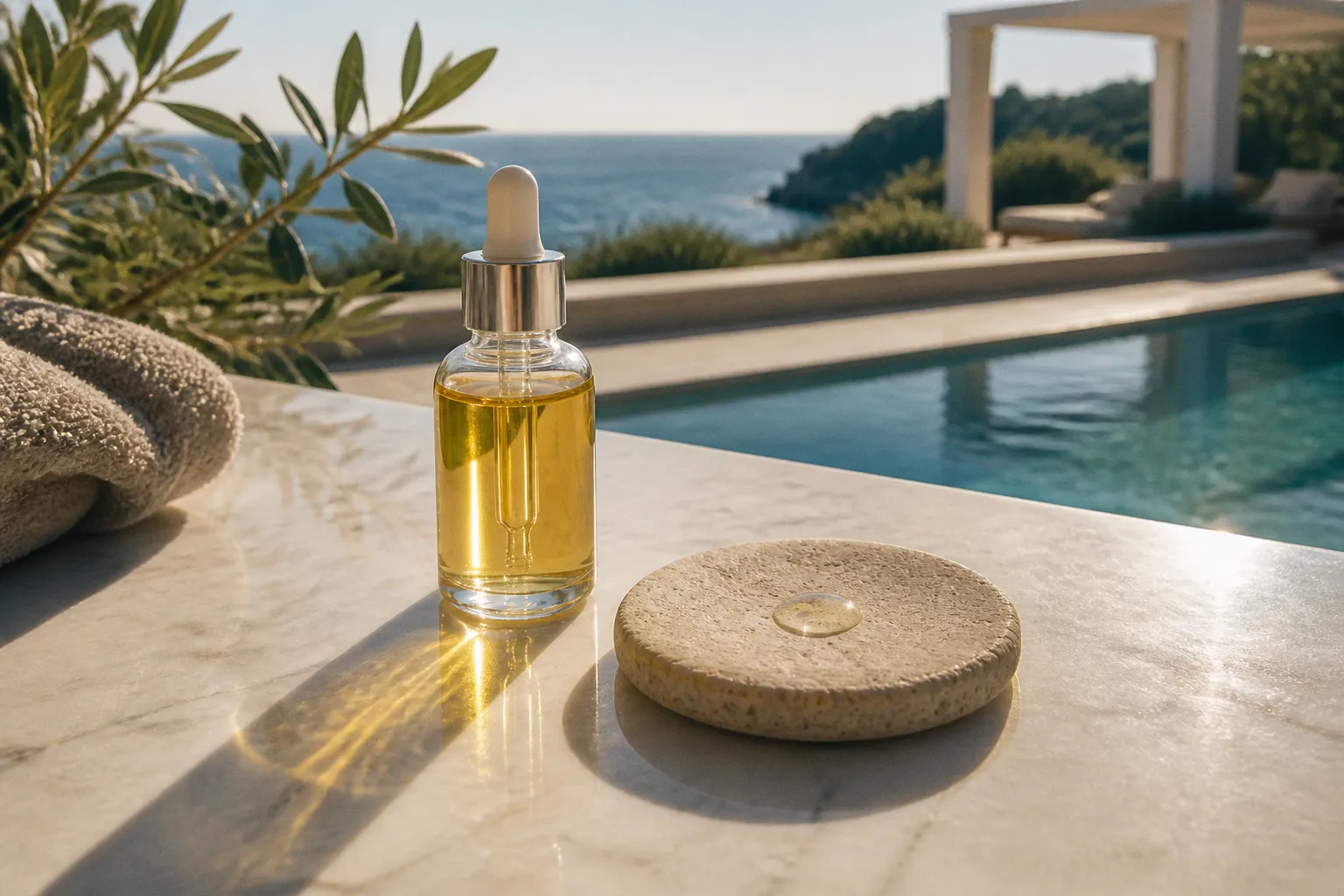
A dry body oil and a body serum do not perform the same function. The difference is structural: a dry oil is an anhydrous lipid formula, while a body serum is usually water-based or gel-based and carries humectants, acids, vitamins, peptides, or other active ingredients.
Compare car rental deals in United Kingdom
See available offersPartner link — DiscoverCars comparisonThat distinction determines the result. A serum can increase water content in the outer layers of the stratum corneum through humectants such as hyaluronic acid or aloe vera. A dry body oil can reduce water loss by spreading lipids across the skin surface. It also produces the immediate reflective sheen associated with a body glow oil. One formula attracts or distributes water. The other helps retain it.
For the question of dry body oil vs body serum for glow, the practical answer is not that one category is universally superior. The formulas solve different problems. A serum addresses hydration, surface texture, dullness, and selected pigment concerns. A dry oil supports the lipid barrier and changes the optical appearance of the skin almost immediately.
The science of absorption: water-based serums versus lipid-based oils
The word “absorption” is used loosely in body-care marketing. In formulation science, it does not mean that a product disappears into the skin or reaches an unlimited depth. It describes how a formula spreads, partitions between the skin surface and the stratum corneum, and loses its visible residue.
Body serums generally have low viscosity. Their continuous phase is water or a water-rich gel. This allows the product to spread with limited friction and carry water-soluble ingredients. Depending on the formula, these can include:
- Humectants, including glycerin, hyaluronic acid, and aloe-derived ingredients, which bind or attract water within the outer skin layers.
- Niacinamide, used in formulas targeting uneven tone, barrier function, and visible dullness.
- Alpha hydroxy acids, which alter corneocyte cohesion and can improve the appearance of rough surface texture when appropriately formulated.
- Peptides, used as signaling or conditioning ingredients, although their effect depends on the specific peptide, concentration, delivery system, and regular use.
- Vitamin C derivatives, which are selected for stability and cosmetic compatibility rather than simply for the presence of the vitamin name on the label.
A dry body oil has a different composition. It contains little to no water and is built from oils, esters, hydrocarbons, or a combination of these materials. Botanical oils may contribute fatty acids, unsaponifiables, and minor compounds. Cosmetic esters and lightweight emollients are often added to reduce drag and decrease the greasy residue associated with heavier oils.
The formula can contain high proportions of linoleic-acid-rich oils, squalane, jojoba oil, argan oil, rosehip oil, or grapeseed oil. These materials are not interchangeable. Their fatty-acid profiles, oxidation stability, spreadability, and afterfeel differ. The term “dry” refers primarily to the sensory and spreading behavior of the finished formula. It does not mean that the product contains no oil.
A dry oil is not a water-free moisturizer. It is an emollient and occlusive system that helps slow water loss from skin that already contains water.
The difference becomes more apparent after bathing. Water temporarily hydrates the outermost layer of the skin. Cleansing can also remove part of the surface lipid mixture, particularly when the cleanser is highly detergent or the water is hot. Applying a lipid formula while the skin remains slightly damp gives the oil water to help retain. Applying the same oil to fully dry, dehydrated skin may improve softness and surface slip, but it does not add water by itself.
Why some oils feel dry and others feel heavy
A rich oil leaves a continuous, perceptible film. A dry body oil is engineered to produce less of that effect. Several formulation decisions influence this outcome:
- Fatty-acid distribution. Oils rich in unsaturated fatty acids can feel fluid, but their behavior varies by source and processing.
- Squalane content. Squalane is a lightweight emollient with a low-tack skin feel and good oxidative stability.
- Cosmetic esters. Esters can reduce greasiness and improve spread, making the formula feel faster on the skin.
- Total oil load. A product labeled as a dry oil may still be relatively rich if the formula uses a high concentration of nonvolatile oils.
- Volatility. Some dry-oil formulas use volatile emollients that evaporate after application, leaving a thinner residual film. The ingredient list is required to determine whether this is the case.
This is why the label alone cannot establish the finish. “Botanical body oil” indicates an ingredient direction, not a predictable texture. A body oil made mostly from heavier oils will behave differently from a formula built around squalane, lightweight esters, and a smaller proportion of botanical oils.
What each formula can and cannot do for glow
“Glow” describes several different effects. A serum and an oil can both improve the appearance of dull skin, but through different mechanisms.
A body serum can create a more hydrated appearance. When the outer stratum corneum holds more water, its surface can appear smoother and less ashy. A well-formulated serum may also target uneven texture or dullness through active ingredients. This is a gradual skin-condition effect. It depends on regular use, formula design, tolerance, and the condition being addressed.
A dry body oil creates a surface effect. Lipids and emollients reduce rough optical irregularity, improve light reflection, and leave a controlled sheen. Some body glow oils also contain mineral pigments, mica, or other light-reflective particles. Those products create visible radiance independently of hydration. The finish is immediate, but it is primarily cosmetic.
The distinction matters when comparing a hydrating body oil vs serum. The oil can support softness and reduce the sensation of tightness. It cannot substitute for a water-based hydrating step when the skin is dehydrated. The serum can improve water availability in the outer skin layers. It may leave the surface looking hydrated, but it may not provide enough lipid coverage for persistent dryness or a reflective daytime finish.
| Parameter | Body serum | Dry body oil |
|---|---|---|
| Main phase | Water-based or gel-based | Anhydrous lipid or emollient-based |
| Primary function | Delivers humectants and active ingredients | Supplies emollients and reduces water loss |
| Best suited to | Dehydration, dullness, uneven texture, targeted concerns | Surface softness, barrier support, immediate sheen |
| Typical finish | Damp, smooth, or gel-like before absorption | Satin, luminous, or lightly glossy |
| Water content | Usually present | Little to none |
| Occlusive capacity | Variable and usually limited | Present, depending on the oil blend and film |
| Active ingredient range | Often broad and multi-active | More limited for water-soluble actives |
| Immediate glow | Moderate, formula-dependent | High when the finish is intentionally luminous |
| Main limitation | May not seal water into very dry skin | Does not add water hydration on its own |
A serum is therefore the more logical first step when the skin appears dehydrated, tight, or rough despite the use of oils. A dry oil is the more logical finishing step when the skin already has adequate water content and the desired result is a smooth surface with daytime luminosity.
Targeting skin texture with concentrated actives
The best body serum for glowing skin is not defined by the highest number of active ingredients. It is defined by a formula that matches the actual source of dullness.
Dull-looking body skin can result from dehydration, accumulated surface scale, friction, uneven pigmentation, or simple lack of surface emollience. These causes require different approaches. A humectant-heavy serum may improve dehydration. An acid-containing serum may address rough texture. Niacinamide may be selected for uneven tone and barrier support. None of these mechanisms is identical to the optical sheen produced by an oil.
Humectants: useful, but dependent on the surrounding formula
Humectants attract and bind water. They are useful when the skin barrier can retain at least part of that water. In a low-humidity environment, or when the barrier is significantly impaired, a humectant step without a suitable emollient or occlusive finish may feel insufficient. The serum can make the skin feel temporarily more hydrated while leaving the surface vulnerable to continued transepidermal water loss, or TEWL.
This does not make humectants ineffective. It means that hydration is a system rather than a single ingredient. Water, humectants, emollients, and occlusives perform related but separate tasks.
Exfoliating acids: texture control with a tolerance limit
Body serums containing alpha hydroxy acids are often used on areas with roughness, keratosis-pilaris-like texture, or uneven surface scale. Their performance depends on acid type, concentration, pH, application frequency, and the condition of the skin barrier.
An acid serum is not automatically compatible with a dry body oil containing fragrance or essential oils. Layering multiple potentially irritating products can increase discomfort, especially after shaving, on compromised skin, or in areas exposed to friction. The oil does not neutralize the acid. It only changes the film on the skin.
A controlled routine separates the goals:
1. Use an active serum on the areas where texture or tone is the target.
2. Allow the formula to settle according to the product instructions.
3. Apply a plain emollient or dry oil if the skin needs lipid support.
4. Reduce frequency when stinging, persistent redness, or scaling develops.
This is not a reason to avoid active body serums. It is a reason to treat them as treatment-oriented products rather than as interchangeable glow products.
Oils and comedogenic scale
The comedogenic scale is often presented as a definitive ranking of oils. It is not. Results vary with the test model, concentration, formulation, application site, and individual skin response. A raw ingredient’s comedogenic rating does not predict the exact behavior of a finished body oil.
Jojoba oil, for example, is structurally similar in some respects to components of human sebum and is used as an emollient. Rosehip and grapeseed oils are often selected for their lightweight profiles and fatty-acid composition. Coconut oil has a different sensory profile and can feel more occlusive. These distinctions are useful, but they do not justify universal claims that one oil will clog every person’s pores or that another cannot cause an issue.
For body use, the application area matters. The back, chest, and shoulders may be more prone to follicular congestion than the shins or forearms. A person comparing hydrating body oil vs serum for acne-prone body skin should favor a lighter, lower-residue formula and introduce it to a limited area first. The same formula may be well tolerated on the legs and poorly tolerated on the upper back.
The role of dry oils as barrier sealants
The skin barrier is not a single coating. It includes corneocytes embedded in an intercellular lipid matrix, with contributions from ceramides, cholesterol, and fatty acids. Cleansing, friction, low humidity, and repeated exposure to water can alter this structure and increase TEWL.
A body oil cannot rebuild the complete barrier architecture in the same way the skin does. It can provide an external lipid film that reduces water escape and improves flexibility at the surface. It also fills irregularities between dry corneocytes, which changes the way light reflects and reduces the visible contrast of flaking.
This explains the difference between softness and hydration:
- Hydration refers to water availability in the skin.
- Emollience refers to smoothing and softening through lipid or lipid-like materials.
- Occlusion refers to reducing water loss by forming a surface film.
- Radiance refers to the visible result of smoother light reflection or added reflective particles.
A dry body oil operates mainly through emollience and occlusion. Its glow is a surface phenomenon supported by reduced roughness and increased reflectance. It does not need to contain water to produce this effect.
When a dry oil is the correct finishing product
A lightweight body glow oil is appropriate when the skin is already comfortable but looks flat, rough, or ashy. It is also useful after a water-based lotion or serum when the routine needs a final lipid layer.
The ideal amount is the minimum needed to create an even film. Excess product does not increase the formula’s ability to attract water. It increases transfer to clothing, slipperiness, and the chance of a heavy finish. Application should be distributed over broad areas rather than concentrated in a few drops that remain visibly wet.
A dry oil is also more efficient when applied to slightly damp skin. The dampness is the water source. The oil functions as the sealant. This is a basic formulation principle, not a special property of a particular botanical oil.
Layering techniques for maximum daytime luminosity
For most body-care routines, the sequence follows the physical properties of the products:
1. Cleanse without excessive detergent exposure. Use water that is comfortable rather than very hot, especially when the skin is already dry or reactive.
2. Leave the skin slightly damp. Do not towel-dry until the surface is completely matte and tight.
3. Apply the body serum. Spread a thin layer over the areas requiring hydration or targeted actives.
4. Allow the serum to distribute. A long waiting period is not inherently necessary. The product should no longer be wet enough to move unevenly under the next layer.
5. Apply a dry body oil. Use enough to form a thin, continuous film. Concentrate on areas prone to visible dryness, such as the shins, elbows, and knees.
6. Adjust the finish. If the skin remains greasy, reduce the amount or choose a formula with lighter esters, squalane, or a more volatile emollient system.
This order places the water-based product first and the lipid-based product second. Reversing the sequence can limit the serum’s contact with the skin surface because the oil film changes wetting and spreading behavior. It does not make the serum useless, but it makes the application less predictable.
The serum supplies the water-management step. The dry oil supplies the surface-management step. Layering works because the functions are complementary, not because one product transforms into the other.
A simple daytime pairing
For ordinary daytime glow, a practical pairing is:
- a hydrating body serum with humectants for water support;
- a dry body oil with a light emollient profile for barrier sealing and sheen;
- sunscreen on exposed areas when the routine includes daytime exposure.
The sunscreen point is separate from the glow routine. A body oil is not a substitute for UV protection, even when it contains botanical oils or antioxidant ingredients. Antioxidant presence does not establish a product’s sun-protection factor.
If the serum contains exfoliating acids or other active ingredients, the routine requires more control. Use the active only where needed and do not assume that a larger amount will accelerate the result. The oil can reduce surface dryness, but it cannot remove the irritation potential of the active serum.
Matching the formula to the skin barrier
The correct choice depends on the dominant condition, not the marketing category.
When the skin is dehydrated but not persistently dry
Choose a body serum first. Look for a formula centered on humectants and compatible barrier-supporting ingredients. Apply it to damp skin. Add a dry oil if the skin loses comfort quickly or if a more luminous finish is required.
In this case, oil alone may improve the tactile result without resolving the underlying lack of water. The skin can feel smoother while continuing to look dull or tight.
When the skin is dry, flaky, or exposed to low humidity
A serum may still be useful, but it should not be the only step. The routine needs an occlusive or emollient layer. A dry body oil can provide that layer if its film is sufficient for the severity of dryness. Very dry skin may require a cream or balm with a stronger water-and-lipid structure, followed by oil only where additional sealing is needed.
This is the central limitation of the “dry oil for everything” approach. A water-free product can reduce TEWL, but it cannot compensate indefinitely for inadequate water-based hydration.
When the skin has rough texture
An active body serum may be more relevant than a plain oil. Alpha hydroxy acids can be selected for surface exfoliation, while other formulas may use urea or humectants for softening and water management. The product should be introduced gradually, especially on skin that has recently been shaved or exposed to friction.
A dry oil can improve the appearance of roughness by smoothing the surface. It does not provide the same texture-targeting mechanism as an exfoliating or keratolytic serum.
When the skin is prone to follicular congestion
Use lower-residue products and test them on a small area. Avoid treating the comedogenic scale as a universal prediction. A formula containing several botanical oils may still be well tolerated by one person and poorly tolerated by another, particularly on the back or chest.
A serum with a light gel texture may be easier to tolerate in congestion-prone areas. A dry oil can remain appropriate for the legs, arms, or other areas without the same follicular behavior. The site of application is part of the formulation decision.
When the goal is immediate visual radiance
A dry body oil is the direct option. Choose a formula based on the desired finish:
- Satin finish: usually associated with lighter emollient systems and limited surface residue.
- Gloss finish: produced by a more continuous lipid film.
- Shimmer finish: created by light-reflective particles rather than hydration alone.
- Natural-looking glow: generally comes from a thin, evenly distributed film without visible pooling.
A serum can improve the background condition of the skin, but it may not create the same immediate reflectance. For a daytime event or exposed limbs, the oil is the more direct cosmetic tool.
Dry body oil versus body serum: the decision in practice
A useful comparison does not ask which category wins in the abstract. It asks what the skin needs before the product is applied.
| Skin condition or objective | First choice | Why | Possible second step |
|---|---|---|---|
| Tight, dull skin after cleansing | Hydrating body serum | Adds water-management support through humectants | Dry oil to reduce TEWL |
| Flaking on shins or elbows | Serum plus emollient layer | Hydration and surface lipid support are both needed | Oil over cream or serum |
| Immediate body glow | Dry body oil | Produces a visible lipid sheen | Serum underneath if dehydration is present |
| Rough body texture | Active body serum | Targets surface turnover or texture more directly | Plain oil to reduce dryness |
| Lightweight daily maintenance | Dry oil or light serum | Depends on whether the issue is water or lipid loss | Layer only if the skin requires both |
| Follicular congestion on back or chest | Low-residue serum | Less surface oil may be easier to tolerate | Patch-test any oil before broader use |
| Low-humidity environment | Serum followed by an occlusive | Humectants need a sealing layer to limit water loss | Richer cream or balm if oil is insufficient |
This framework also clarifies the phrase “best body serum for glowing skin.” The best serum is not necessarily the one with the longest active list. It is the one that addresses dehydration, texture, or dullness without creating irritation that undermines the barrier. The best dry body oil is not necessarily the one with the most botanical ingredients. It is the one whose lipid and emollient system provides the required finish without excessive residue or poor tolerance.
The ingredient label is more useful than the front panel
A formula intended for daily body use should be assessed by its phase structure and finish, not by the number of plant names displayed on the package.
For dry oils, examine whether the ingredient list begins with heavier fixed oils, lightweight esters, squalane, or a mixture. Consider the placement of fragrance and essential oils if the skin is reactive. Botanical does not mean non-irritating, and natural origin does not establish oxidation stability.
For body serums, identify the main humectants and active ingredients. A serum containing several acids, vitamin derivatives, fragrance, and botanical extracts may have a more demanding tolerance profile than a simple humectant formula. More ingredients do not automatically produce more glow.
Packaging also affects oil quality. Unsaturated botanical oils are susceptible to oxidation. Opaque or otherwise protective packaging can reduce exposure to light, while a tight closure limits unnecessary air exchange. Odor and color changes can indicate degradation, although they are not the only quality markers. Storage conditions remain relevant even when the formula contains more stable materials such as squalane.
A strict do-and-don’t routine
Do
- Apply a body serum to slightly damp skin when the goal is water-based hydration.
- Use a dry oil as the final lipid step when the skin needs reduced TEWL or a luminous surface.
- Match active ingredients to the actual concern, such as humectants for dehydration or acids for rough texture.
- Use a thin, even layer rather than assuming more oil produces more nourishment.
- Assess the application area separately, because the back, chest, legs, and arms do not behave identically.
- Patch-test new formulas, particularly those containing fragrance, essential oils, acids, or multiple botanical extracts.
- Use sunscreen on exposed skin when the routine is part of daytime care.
Don’t
- Do not describe dry oil as hydrating in the same sense as a water-based serum. It primarily helps retain existing moisture.
- Do not apply an oil over heavily wet skin in excess. The result can be uneven spreading, transfer, and a slippery residue.
- Do not treat the comedogenic scale as a universal verdict. Finished-formula behavior is more complex than a single ingredient score.
- Do not layer several strong actives simply because the final step is an oil. Occlusion does not cancel irritation.
- Do not use a body glow oil as sun protection. Botanical oils and shimmer particles do not establish UV defense.
- Do not assume a fast-drying finish means the product has penetrated deeply. It may reflect efficient spreading, volatile emollients, or low surface residue.
- Do not expect oil alone to correct persistent dehydration in low humidity. Add a water-based step or use a cream-based barrier product when necessary.
Final position
The dry body oil vs body serum for glow comparison is a comparison of functions, not textures alone. A body serum is the treatment-oriented layer. It uses water, humectants, and selected actives to address hydration, texture, dullness, or uneven appearance. A dry body oil is the finishing-oriented layer. It provides emollience, reduces water loss, and creates a visible surface sheen.
For the most reliable daytime result, apply the serum first to damp skin and use the dry oil second when the barrier needs support or the finish needs more luminosity. If the skin is already comfortable and the only objective is immediate radiance, the oil can stand alone. If the skin is tight, flaky, or persistently dehydrated, oil alone is an incomplete routine.
The strict rule is simple: use the serum to manage water and active ingredients; use the dry oil to manage the lipid film and visible finish.