Beard conditioning options: balm, oil, or butter?
The distinction between beard oil, beard balm, and beard butter is primarily a formulation distinction. Oil has no structural hold. Balm contains beeswax and provides light-to-medium control.
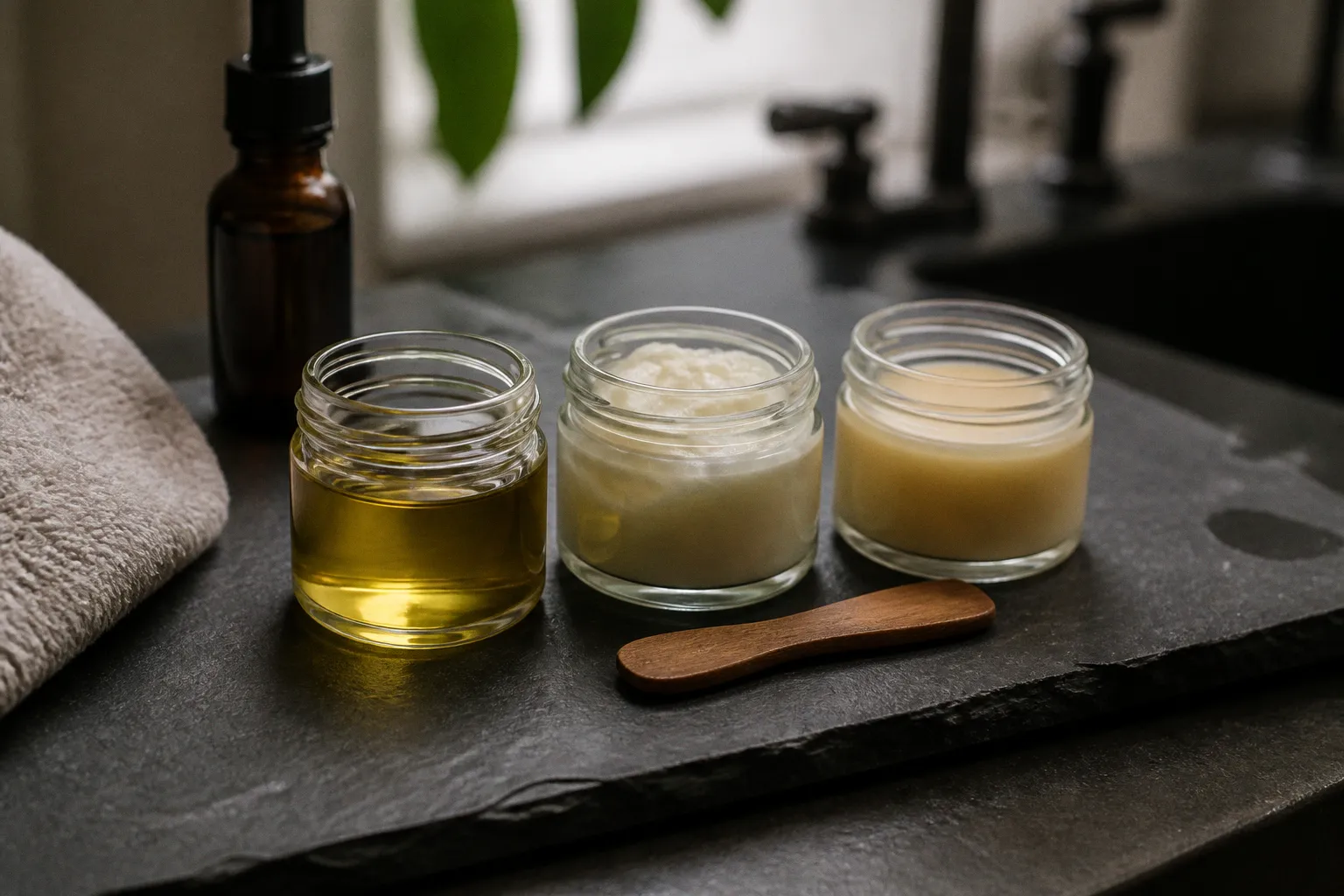
Butter uses plant butters for emollient conditioning but generally contains no wax, so its hold is minimal or absent.
Compare car rental deals in United Kingdom
See available offersPartner link — DiscoverCars comparisonThat difference determines the correct routine. A short beard with dry skin requires a different product profile from a beard longer than two inches that needs shaping. The question is not which product is universally best. It is which function is missing: dermal conditioning, hair softening, or mechanical control.
The science of skin hydration: why beard oil is the foundation
Beard hair does not replace the skin beneath it. It can obscure flaking, trap sebum, and make cleansing less consistent, but the underlying skin remains the primary source of itch, tightness, and visible dandruff. For that reason, beard oil is best understood as a skin-first product rather than a hair perfume.
A typical beard oil contains carrier oils selected for spreadability, oxidative stability, and fatty-acid composition. Common profiles include oils with higher proportions of oleic acid, linoleic acid, or other triglycerides. The exact blend affects slip, absorption rate, residue, and compatibility with the user’s skin condition.
The product does not add water to the skin. It reduces the rate at which water escapes by supplementing the surface lipid layer and improving the condition of the stratum corneum. This relates directly to transepidermal water loss, or TEWL. When the skin barrier is compromised, water leaves the epidermis more readily. The result can be tightness, scaling, and irritation.
Oil helps by:
- Replacing part of the depleted surface sebum under the beard.
- Reducing friction between skin, beard hair, and fingers during grooming.
- Softening short and medium-length beard hair through surface lubrication.
- Improving the feel of dry skin without the need for a wax-based film.
- Supporting a cleaner beard environment when used after appropriate washing and drying.
The most common application error is applying oil only to the visible beard hair. That leaves the skin underneath untreated. Beard oil should be distributed through the hair and worked down to the skin, particularly along the jawline, chin, and areas where flaking or itch is present.
A practical starting amount is three to six drops per application. The correct volume depends on beard density, length, hair porosity, and skin condition. More product is not equivalent to more hydration. Excess oil increases residue and can create a greasy surface without improving barrier function.
Apply oil after showering when the beard is clean and slightly damp, not wet. Water on the hair can dilute the product and interfere with even distribution. A small amount should be warmed between the palms, pressed through the beard, and then worked toward the skin with the fingertips. A comb or brush can distribute the remaining oil through the lengths.
Beard oil is the dermal conditioning step. If it never reaches the skin, the core function of the product has been missed.
Oil and skin type
Skin response depends on the carrier oils, not only on the product category. A beard oil with a high-oleic profile can feel richer and more persistent. A lighter formula may spread faster and leave less surface residue. Neither profile is automatically superior.
The comedogenic scale can provide a rough reference, but it is not a universal prediction of whether a product will clog pores. Testing conditions, concentration, cleansing habits, and individual sensitivity alter the result. A product’s position on a comedogenic scale should therefore be treated as an indication, not a guarantee.
For oily or acne-prone skin, the relevant variables are:
- Total application volume. Use the minimum amount that reaches the skin and hair.
- Cleansing frequency. Residual oil combined with sebum and environmental debris can increase congestion.
- Carrier-oil profile. Lighter-feeling oils may be easier to tolerate, but feel alone does not determine pore response.
- Fragrance load. Fragrance is not required for conditioning and may be unsuitable for reactive skin.
- Application area. Avoid spreading a beard product well beyond the beard onto unneeded facial skin.
Beard oil is usually the most direct starting point for a short beard, dry skin, or a user who has no styling requirement. It is also the most flexible product for a morning routine because it conditions without adding wax structure.
Mastering the hold: when beard balm is more useful than butter
Beard balm is an oil-and-butter product with a wax component, commonly beeswax. The wax changes the physical behavior of the formula. It increases viscosity, creates resistance during application, and leaves a film capable of organizing beard hairs into a controlled shape.
The hold is normally light to medium. Beard balm is not a substitute for a high-hold styling wax, and it should not be evaluated by the same standard. Its function is to condition while reducing flyaways and providing basic structure.
Beard balm becomes more useful when:
- The beard is two inches or longer and individual hairs no longer lie in one direction.
- The moustache or cheek line requires light shaping.
- Flyaways interfere with a clean outline.
- The beard needs daytime control but should not feel rigid.
- Oil alone leaves the hair soft but visually disorganized.
The wax ratio varies between formulas, and there is no standardized universal percentage that defines every commercial balm. Two products labeled balm can therefore behave differently. One may spread like a soft cream and provide minimal control. Another may require more warming between the fingers and create a more persistent film.
The difference between beard balm and butter is most visible during application. Balm becomes more workable as it warms. It should be taken in a small amount, emulsified between the fingertips, and pressed through the beard. The goal is not to coat the outer surface with a thick layer. The goal is to place enough material along the hair lengths to control movement.
A balm can be layered over beard oil. The oil addresses skin and softness. The balm adds structure. These products are not mutually exclusive replacements.
Beard balm versus beard butter
Beard butter may contain shea, mango, or kokum butter combined with carrier oils. It generally lacks beeswax or another strong structuring wax. As a result, it provides a dense emollient phase with minimal to zero hold.
The categories can be compared as follows:
| Parameter | Beard oil | Beard balm | Beard butter |
|---|---|---|---|
| Primary function | Skin and hair conditioning | Conditioning with light-to-medium styling control | Deep emollient conditioning |
| Typical structure | Liquid oil phase | Oils, plant butters, and beeswax | Plant butters and carrier oils |
| Hold | 0 | Light to medium | Minimal to 0 |
| Best use | Daily hydration support and softening | Flyaway control and basic shaping | Overnight conditioning and softening |
| Skin contact | Should reach the skin under the beard | Can reach skin, but is usually used mainly through the beard | Can be worked into beard and underlying skin |
| Best fit | Short to medium beard, dry or tight skin | Longer beard, styling needs, stray hairs | Coarse, dry, or brittle-feeling beard hair |
| Main application issue | Staying on hair and missing the skin | Applying too much wax and creating residue | Expecting hold from a wax-free formula |
The practical mistake is choosing based on the product name alone. A balm with a low wax content may perform closer to a rich butter. A butter with a dense formula may feel more occlusive than a lightweight balm. The ingredient list and physical behavior are more informative than the front label.
Deep conditioning mechanics: the role of plant butters
Plant butters are semi-solid lipid materials. Shea, mango, and kokum butter can increase the richness, persistence, and protective feel of a beard formula. They are useful when the hair feels coarse, porous, or rough after washing.
Beard hair is keratinized fiber. It is not living tissue and cannot be biologically repaired in the same way as skin. Conditioning products improve its surface behavior. They reduce friction, increase flexibility, and help damaged or rough fibers feel smoother. The effect is cosmetic and mechanical, not regenerative.
This distinction matters for claims about beard growth. Beard butter and beard oil can improve the condition of existing hair and the skin beneath it. They do not establish that new follicles will grow or that density will increase. A product described as a beard growth oil should be assessed for conditioning claims separately from growth claims.
Butter is particularly useful when the beard has one or more of these characteristics:
- A coarse texture that remains rough after oil application.
- Dry ends that catch on fingers or a comb.
- Increased friction during brushing.
- A beard that becomes brittle after frequent washing.
- A need for overnight emollient contact without daytime styling.
The heavier lipid phase can be useful at night because there is less concern about immediate styling performance. A small amount can be pressed into the beard after cleansing, with attention to the ends and the skin beneath the densest areas.
However, butter is not automatically superior for severe dryness. If the skin is inflamed, persistently flaky, painful, or affected by a diagnosed condition, adding more oil or butter may not address the cause. Product buildup can also complicate observation of the skin. A beard conditioner cannot replace assessment of persistent dermatitis or infection.
Butter, balm, and the problem of residue
Residue depends on more than the presence of butter. It is affected by particle size, melting behavior, oil selection, wax concentration, and the amount applied. A formula that feels dry on the hand may still accumulate if used daily without adequate cleansing.
For this reason, beard butter should be dispensed conservatively. Begin with a small quantity, emulsify it fully, and add more only if the lengths remain unconditioned. Dense products are difficult to remove when applied as a visible coating.
The same rule applies to balm. Excess beeswax does not create a more polished beard indefinitely. It can produce a stiff, coated feel and make later cleansing more difficult. Hold is useful only when it remains compatible with regular grooming and skin comfort.
Strategic layering: building a routine around beard length
A beard routine should be organized by function and time of day. Oil, balm, and butter can be combined because they perform different tasks. The correct sequence depends on whether the priority is skin conditioning, daytime control, or prolonged softening.
Short beard
For a short beard, beard oil is usually the most efficient option. The hair does not require substantial mechanical control, while the skin is still exposed to friction from shaving, trimming, cleansing, and early beard growth.
A basic routine:
1. Cleanse the face and beard with a product that does not leave the skin tight.
2. Pat dry and leave the beard slightly damp.
3. Apply three to six drops of beard oil, adjusting downward if the beard is sparse.
4. Work the oil through the hair and down to the skin.
5. Use a comb or fingers to distribute the remaining product.
Butter may be added at night if the hair feels rough despite oil use. Balm is usually unnecessary unless the short beard has specific flyaway or moustache-shaping requirements.
Medium beard
A medium beard often benefits from oil in the morning and targeted balm during the day. The oil supplies the conditioning base. The balm manages hairs that move outside the intended outline.
The sequence is straightforward:
- Use beard oil after the morning shower.
- Allow it to distribute through the beard rather than immediately covering the hair with a heavy product.
- Apply a small quantity of balm only where hold is required.
- Use a comb or brush to set the direction of growth.
- Reserve butter for evening conditioning if the ends remain dry.
This approach avoids using balm as a substitute for oil. Wax can make the beard feel controlled while leaving the underlying skin dry if the conditioning step is omitted.
Long beard
Longer beards create more separation between the skin and the ends of the hair. Oil remains relevant because the skin still requires conditioning, but the lengths may need a richer emollient product.
For a beard of two inches or more, balm becomes especially useful when shaping is part of the routine. Butter may be preferable overnight when the primary issue is softness rather than control.
A long-beard routine can therefore use:
- Oil in the morning for the skin and general softening.
- Balm during the day for outline, flyaway control, and light structure.
- Butter overnight for longer contact with dry or coarse lengths.
The quantity should remain proportional to the area being treated. Longer hair may require more product, but it should be added incrementally. Saturating the beard in one step increases residue and makes it harder to determine whether the formula is actually improving the hair.
The most functional routine is usually sequential: oil for the skin, balm for daytime structure, and butter for extended conditioning. Substitution is less useful than correct layering.
Beard conditioning options by primary need
| Primary need | First product to consider | Secondary option | Product to avoid overusing |
|---|---|---|---|
| Itchy skin under a short beard | Beard oil applied to the skin | Light beard butter at night | Heavy balm applied directly as the only conditioner |
| Softening coarse hair | Beard oil or beard butter | Balm for daytime control | Large amounts of wax |
| Flyaway management | Beard balm | Oil underneath for conditioning | Butter used as a styling product |
| Overnight conditioning | Beard butter | Beard oil for lighter texture | Strong-hold styling formulas |
| Moustache or beard shaping | Beard balm | Oil as a separate conditioning step | Oil alone when structure is required |
| Low-residue daily routine | Lightweight beard oil | Small amount of butter on dry ends | Layering all three at full amounts |
Common application errors that compromise beard condition
Most routine failures are application failures rather than category failures. The formula may be appropriate, but the sequence, quantity, or target area is incorrect.
1. Applying oil only to the beard surface
This is the most common mistake. The user creates shine on the hair while the skin underneath remains dry. Correct the technique by separating the beard with the fingertips and pressing the oil toward the skin.
2. Treating balm as a richer beard oil
Balm contains beeswax and has a different physical purpose. It should not be spread over the beard in the same quantity used for a liquid oil. Warm a small amount between the fingertips, then distribute it selectively.
3. Expecting butter to provide hold
Beard butter generally lacks beeswax and is not designed to maintain shape. It may reduce roughness and make the beard easier to comb, but it will not provide the light-to-medium hold associated with balm.
4. Using all three products at maximum volume
Layering is valid. Saturation is not. Start with oil, add balm only where structure is needed, and reserve butter for a separate conditioning window when possible. This keeps the formulation load measurable.
5. Ignoring cleansing
Oil, butter, wax, sebum, shed skin, and environmental particles can accumulate. A beard that feels dry is not necessarily under-conditioned; it may be coated with incompatible or excessive product. Cleansing should remove residue without producing prolonged tightness.
6. Applying product to a wet beard
A dripping-wet beard interferes with even distribution. Excess water can dilute the surface application and cause the product to remain on the outer hair. Slightly damp hair is more practical.
7. Confusing conditioning with growth treatment
Oil improves lubrication and softness. Butter improves emollient conditioning. Balm improves control. None of these functions, by themselves, establish increased follicle activity or new beard growth.
8. Choosing fragrance before function
Masculine scent profiles can be part of the grooming experience, but fragrance does not determine conditioning performance. First assess the oil phase, butter content, wax structure, and skin compatibility. Scent is a separate selection variable.
A strict do-and-don’t protocol
Do
- Do use beard oil as the foundation when the main problem is dry skin, tightness, or rough short hair.
- Do work oil down to the skin, not only across the visible hair.
- Do choose balm when the beard needs light-to-medium hold and control of flyaways.
- Do choose butter when the priority is deep emollient conditioning with minimal styling effect.
- Do layer products by function rather than treating them as interchangeable.
- Do begin with three to six drops of oil and adjust according to beard length and density.
- Do apply butter or balm in small amounts, warming the product before distribution.
- Do monitor residue, itch, and congestion after changing a formula.
- Do keep cleansing consistent so product buildup does not obscure the condition of the skin.
Don’t
- Don’t apply balm as if it were a liquid oil.
- Don’t expect butter to shape a beard when the formula contains no meaningful wax structure.
- Don’t assume a richer formula is automatically more effective.
- Don’t use a product only on the hair when the complaint is skin dryness.
- Don’t treat a beard growth claim as proof of follicular stimulation.
- Don’t rely on the comedogenic scale as an absolute prediction of pore congestion.
- Don’t add all three products at full quantity in the same application.
- Don’t hide persistent redness, pain, or scaling under progressively heavier conditioning products.
The answer to beard oil vs beard balm vs beard butter is therefore functional rather than categorical. Beard oil is the foundation for skin contact and daily softening. Beard balm is the control product for shape and flyaways. Beard butter is the richer conditioning option for coarse lengths and overnight use.
Select the missing function, then apply the smallest effective amount. That is the most reliable beard grooming routine across short, medium, and long growth stages.