Beard oil on damp or dry hair: the optimal timing
Your beard itches. The skin underneath flakes. You slap oil on dry hair in the morning and wonder why the product sits on top like a greased shelf instead of absorbing.
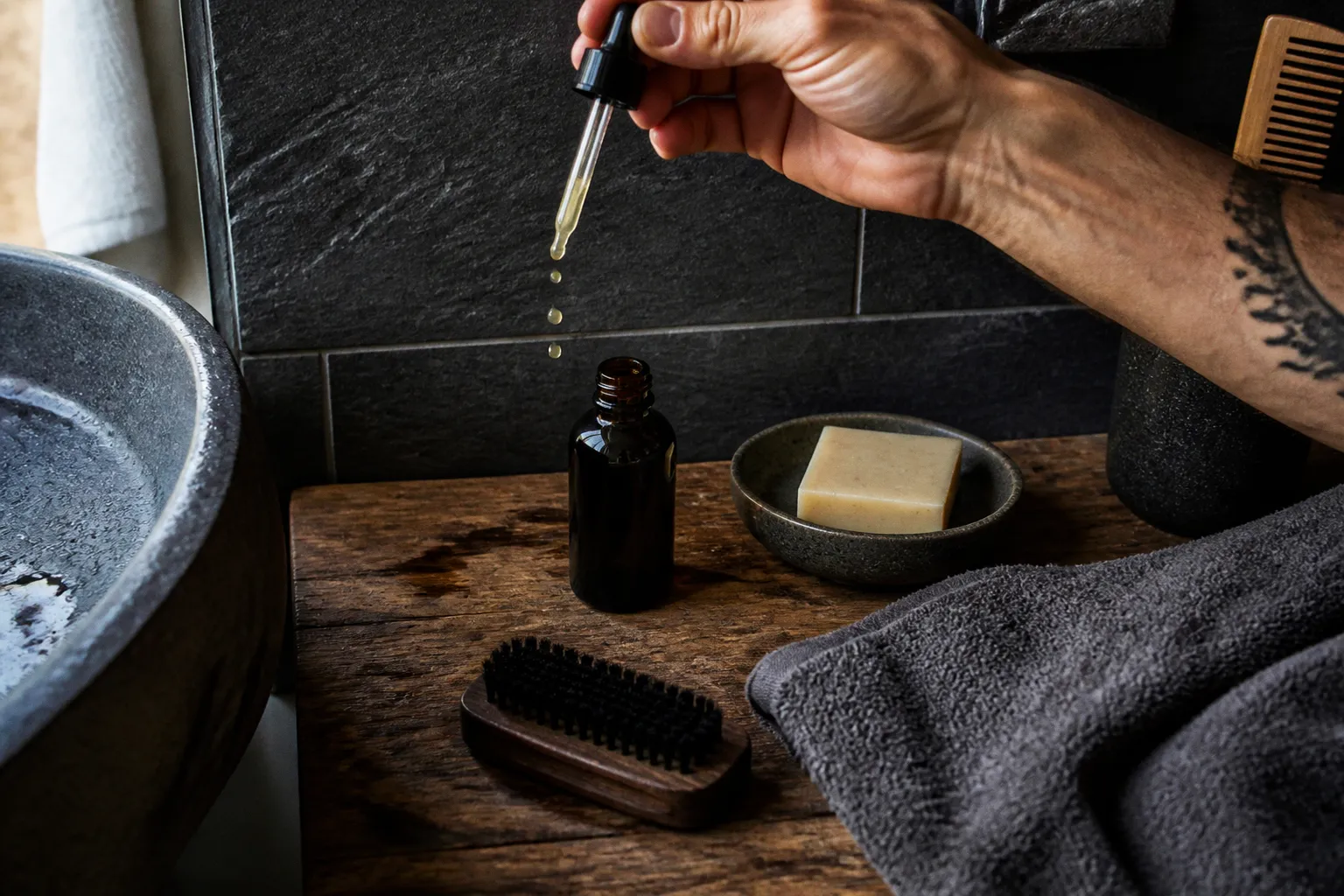
Beard Oil Timing: Why Damp Beats Wet and Dry Every Time
That friction between skin and hair is a mechanical failure, and the fix is not more oil — it is better timing. Beard oil goes on damp hair. Not soaking wet. Not bone dry. Towel-damp, warm, right after the shower. That is the window where the product actually performs the job you bought it to do.
Most men treat beard oil like a cologne — a finishing touch sprayed on whenever the bottle is convenient. That habit wastes half the bottle and leaves the underlying skin just as neglected as before. Oil is a sealant. Water is the hydrator. The sequence matters: hydrate first, then seal. Reverse them and the oil has no moisture to lock in, just dry hair cuticle and irritated follicles.
The Science of Moisture: Why Damp Hair Wins
Hair strands and the skin beneath your beard both absorb water in the shower. The cuticle swells open slightly. Pores soften. The whole apparatus under your jaw warms up and becomes porous. That warmth and that residual surface moisture are the delivery system for beard oil. When you apply oil to damp hair, the oil binds to the water already present and traps it against the skin and inside the follicle shaft. The water cannot evaporate quickly. The skin stays hydrated longer. The hair stays flexible instead of drying into a brittle wire brush.
The reverse problem is just as real. Dry hair has a closed cuticle that resists absorption. Oil applied to dry hair sits on the surface, slides off, or coats only the outermost layer of hair without reaching the skin underneath. You get shine without hydration. You get product smell without the actual job getting done. The same applies to soaking wet hair. Excess water dilutes the oil, repels the lipid molecules, and causes the mixture to drip off before it bonds to anything useful. The oil runs down your neck. Your towel catches it. The bottle empties for nothing.
| Beard State | What Happens to Oil | Result |
|---|---|---|
| Soaking wet (still dripping) | Water repels oil, dilutes it, product runs off | Wasted application, no seal |
| Towel-damp (8% moisture) | Oil binds to residual water, spreads evenly | Full hydration seal, even distribution |
| Bone dry | Cuticle closed, oil sits on surface | Surface shine only, skin stays dry |
The middle column — towel-damp — is the target. Most grooming professionals and beard care brands agree that this is the sweet spot for oil absorption and moisture retention.
The Pitfalls of Soaking Wet and Bone-Dry Application
Two mistakes dominate the field. The first is the post-shower rush. You finish your shower, step out, grab the towel, scrub the face and beard aggressively until everything feels "dry enough," and then reach for the oil. By that point you have stripped most of the surface moisture with the towel and the skin has already started cooling down. Pores are tightening. The beard is somewhere between damp and dry. The window is closing.
The second mistake is the evening application to dry hair. You sit on the couch at night, remember the beard, and dab a few drops onto the hair without wetting anything first. The oil coats the hair shaft, gives it some sheen, and does almost nothing for the skin underneath. You wake up with the same itch, the same flakes, the same rough texture along the jawline. The product is not broken. The timing is.
Damp hair carries oil into the follicle. Dry hair carries oil off your face.
There is also a third, less obvious failure mode: applying oil before the shower. Some men oil up in the morning, then hop in the shower an hour later. Hot water and steam strip the oil before it has bonded to anything. You leave the shower with stripped-down hair and no protective barrier. Save the oil for after the water shuts off.
Mastering the Post-Shower Application Window
The optimal moment is immediate. Not five minutes later. Not after you have dried your hair, brushed your teeth, and walked into the kitchen. Right after the shower, when the skin is still warm and the beard is towel-damp.
Here is the mechanical sequence:
1. Finish your shower. Shut the water off. Do not linger.
2. Pat the beard with a towel. Do not rub. Rubbing roughs up the cuticle and pulls at the skin. A firm press-and-lift motion removes dripping water while leaving the hair damp to the touch.
3. Dispense 3 to 6 drops of oil into the palm. The exact count depends on beard length and density, which we will get to below. For most medium-length beards, 4 drops is the starting point.
4. Warm the oil between both palms. Rub your hands together briskly for a few seconds. This thins the viscosity and prepares even distribution.
5. Work the oil into the skin first. Fingers reach down through the beard to the skin beneath. Massage in circular motions across the cheeks, jawline, and neck. This is where hydration is needed most.
6. Pull the remaining oil through the hair lengths. Run palms down the beard from root to tip, coating the outer shaft.
7. Comb or brush through with a boar-bristle brush or wooden comb. This distributes the oil evenly and trains the hair to lie in the desired direction.
That whole sequence takes about 90 seconds. The window for ideal absorption lasts roughly 5 to 10 minutes after the shower before the skin cools and the residual moisture evaporates. Stay inside that window and the product performs. Miss it and you are back to coating dry hair with expensive nothing.
Targeting the Skin: The Root-to-Tip Technique
The biggest mistake men make with beard oil is treating it as a hair product. It is not. It is a skin product that also conditions hair as a side effect. The skin underneath the beard is where itch, flaking, and irritation originate. That is the surface that needs the oil first.
Start at the roots. Press your fingers into the beard down to the skin. Work in small circles along the jawline from the ear toward the chin. Move to the cheeks. Then the upper lip area. Spend 30 seconds on the skin before you ever touch the outer hair. This drives the oil directly into the follicles and into the pores where dry skin and beard itch actually live.
After the skin is coated, drag the remaining oil from your palms through the hair lengths. Root to tip. Not side to side. This lays the cuticle flat and distributes the oil evenly across the shaft. The result is softer hair, less split-end fraying, and a beard that feels conditioned rather than coated.
Beard oil is a skin treatment. The hair is just along for the ride.
For longer beards, the root-to-tip pull also detangles gently. For shorter stubble, the skin massage is the entire point. Adjust the effort to the length you are working with.
Adjusting Dosage for Length and Climate
The 3-to-6-drop range is a starting point, not a law. Beard thickness, length, climate, and skin dryness all change the actual number you need. Density matters more than length when it comes to oil absorption. A thick, coarse beard drinks more oil than a fine, sparse one of the same length.
Here is how to calibrate:
- Stubble (under 1 cm): 2 to 3 drops. Focus on the skin. Hair does not need much coating at this stage.
- Short beard (1 to 3 cm): 3 to 4 drops. Skin massage plus a light pass through the hair.
- Medium beard (3 to 6 cm): 4 to 6 drops. Full root-to-tip coverage.
- Long beard (6 cm+): 6 to 10 drops. Longer hair soaks up more product, and the ends need extra sealing to prevent split-end fraying.
Climate changes the equation. Dry winter air, high-altitude environments, and arid indoor heating all pull moisture out of the skin faster. In those conditions, twice-daily application is reasonable — once after the morning shower and once at night as an overnight hydration routine. Humid climates and summer months often require only a single morning application. The beard should feel conditioned but not greasy. If it looks wet an hour after application, you have over-applied. If it feels dry or rough by mid-afternoon, you have under-applied or applied at the wrong time.
Skin type also matters. Men with naturally oily skin can hold longer between applications. Men with dry or sensitive skin often need the second nightly application as standard practice, especially during colder months when the skin barrier gets compromised.
Maintenance Schedule: Locking In the Habit
Beard oil is not a one-off treatment. It is a daily mechanical input, like oiling a chain or conditioning a leather strap. Skip it and the system breaks down — itch returns, flakes show up, the hair turns brittle. Run it consistently and the beard stays trainable, the skin stays calm, and the product actually delivers what the label promises.
A working maintenance schedule looks like this:
- Morning (primary application): Post-shower, towel-damp beard, 3 to 6 drops, skin-first technique. Comb through.
- Evening (secondary, optional): Dry beard, 1 to 2 drops, light pass through the hair lengths to seal overnight moisture loss. Skip this in humid climates or on days when the morning application is still holding by bedtime.
- Weekly reset: Wash the beard with a dedicated beard wash or mild soap to strip product buildup. Towel-dry, apply oil while damp, comb through. This clears clogged follicles and resets absorption.
Apply oil while the beard is damp. Massage the skin first. Adjust the drops to the beard and the season.
The mechanical principle stays constant regardless of brand, scent, or carrier oil blend. Damp hair. Warm skin. Skin-first massage. Even distribution. Daily consistency. That is the sequence. That is the maintenance routine. The product does the rest.