Aromatherapy bath setup: what to check before you soak
Most people treat essential oils like bubble bath concentrate — squeeze a few drops under the running tap, hop in, soak. The water looks fine for about thirty seconds. Then the oils coalesce.
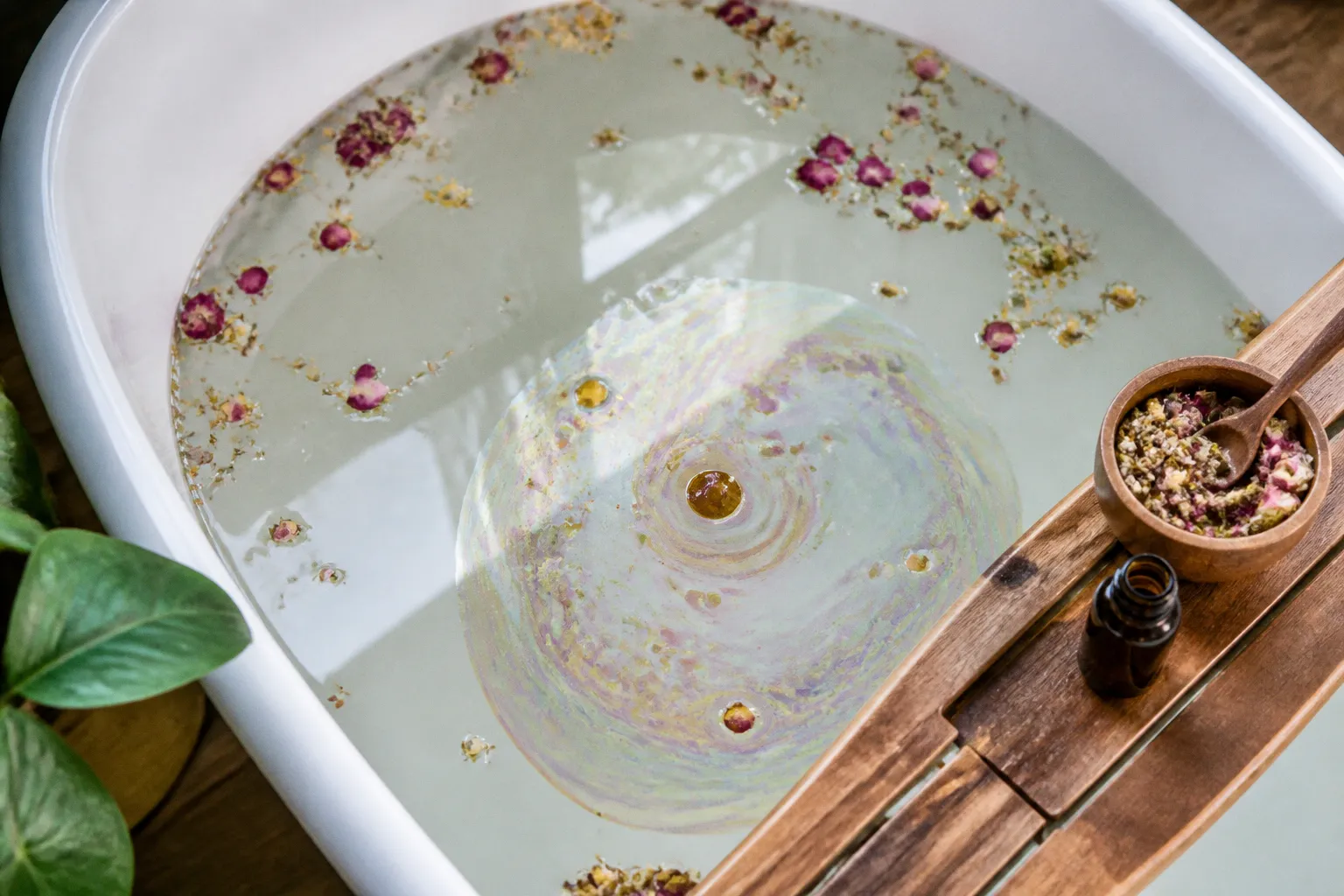
A thin, slick film rides the surface, slaps against your chest and thighs the moment you sink in, and the concentrated botanical extract makes direct contact with your skin undiluted. That's not aromatherapy. That's a chemical film burn waiting to happen.
Essential oils are hydrophobic. They do not bond with water molecules. Without a fatty carrier or proper dispersant to grab onto, the oil sits there in concentrated pockets until flesh or soap pulls it off the surface. Industry guidance is explicit on this point: blend the oil into a carrier first, then introduce that mixture to the bath. Skip the carrier, and you're soaking in a thin lacquer of raw botanical extract.
This aromatherapy bath preparation checklist walks you through the mechanical steps that make a soak safe — dilution ratios, phototoxicity windows, fire distance, and the right base ingredients to keep on the bench. No flowery ritual language. Just the setup that actually works.
The Dispersion Problem: Why Oil and Water Refuse to Mix
Here's the basic chemistry, stripped of jargon: water molecules are polar. Essential oil molecules are nonpolar. The two don't share an attraction strong enough to form a stable mixture. Drop lavender oil into a glass of water and watch what happens — the oil beads up, clings to the glass walls, and floats in a slick layer on top. A bathtub is just a larger version of that glass.
What that means for your skin: the moment you submerge, the concentrated oil film makes direct dermal contact. Lavender at 2% dilution in a carrier won't sting. Lavender at 100% concentration on damp, heat-opened pores absolutely will. The heat of the water dilates capillaries and softens the stratum corneum, which accelerates absorption of whatever sits on the surface. Undiluted oil plus hot water equals a faster path to irritation.
The fix is mechanical, not mystical. You need a third substance — a carrier — that shares enough molecular compatibility with both the oil and the water to bridge the gap. A fatty carrier oil (jojoba, sweet almond, fractionated coconut) bonds with the essential oil. A dispersant bonds with both. Either route keeps the botanical extract suspended in the water column instead of pooled on top.
Undiluted essential oil on bathwater is a film of concentrated extract waiting to hit your skin. The carrier isn't optional — it's the suspension mechanism.
Mastering the Dilution Ratio
The numbers aren't arbitrary. They're the boundary between therapeutic contact and dermal irritation. For a standard full-body adult soak, the working range is 5 to 20 drops of essential oil pre-blended into 1 tablespoon (15 ml) of carrier oil. For a general-purpose bath, 5 to 10 drops is the safer ceiling — enough volatile aromatic compounds to register on the nose, not enough to overload the skin.
If you're working with sensitive skin, a 1% dilution is the practical floor: roughly 1 to 2 drops of essential oil per 10 ml of carrier. That ratio comes straight out of topical formulation guidance. At 2% you get a stronger aromatic throw without crossing into sensitization territory for most adults. Above 2% and you're entering the range reserved for short-duration, targeted application — not a 30-minute soak.
Here's the prep in order:
1. Measure your carrier oil into a small glass or ceramic bowl — never plastic, since some essential oils degrade certain plastics over time.
2. Add the essential oil drops to the carrier. Cap at 10 drops for a standard soak unless you've worked with the specific oil before and know your skin's tolerance.
3. Stir briefly with a stainless steel or glass utensil. The goal is even distribution in the carrier, not emulsification — that comes when the mixture hits the water.
4. Pour the blend into the running bath as the tub fills. The agitation helps shear the oil into smaller droplets and distribute it through the water column.
5. Swirl the bath by hand once before you step in. If you see visible oil slicks or rainbow sheen on the surface, you've under-dispersed. Add more carrier or shorten the soak time.
One more mechanical note: don't add the essential oils to the carrier while the carrier is sitting in the bath. The carrier needs the agitation of the running water to disperse properly. A bowl of pre-blended oil poured into still water still pools.
Phototoxicity: The 24-Hour Window for Citrus Oils
This is the section most prep checklists skip, and it's the one that sends people to dermatologists with strange pigmentation patches. A subset of citrus essential oils — cold-pressed bergamot, lemon, lime, and grapefruit chief among them — contains furanocoumarins. These compounds are phototoxic. They react with UV radiation on the skin and trigger phytophotodermatitis, which looks like a chemical burn, a rash, or hyperpigmented streaks that can linger for months.
The fix is a hard avoidance window. After topical application of any phototoxic citrus oil — and that includes a bath where the oil contacted your skin — stay out of direct sunlight for 12 to 24 hours. That means no sunbathing, no midday errands with exposed shoulders, no rooftop lunch. Covered clothing counts. Sunscreen helps but doesn't fully neutralize the reaction because furanocoumarins absorb into deeper skin layers and continue reacting once UV hits.
If your soak is scheduled for a weekday evening, this is rarely a problem. If you're planning a Sunday morning soak before a noon beach walk, you've got a scheduling conflict. Move the bath to the night before, or swap the citrus for a non-phototoxic alternative: steam-distilled sweet orange, mandarin, tangerine, or any of the wood and herb oils that don't carry the furanocoumarin load. The cold-pressed versus steam-distilled distinction matters here — steam distillation strips most of the phototoxic compounds out, but cold-pressing preserves them.
Cold-pressed citrus oils plus sun exposure within 24 hours equals burn or pigmentation damage. Steam-distilled citrus is safer; non-citrus oils avoid the issue entirely.
Fire Safety and Ventilation: Candles vs. Concentrates
You're building a bath self-care ritual — and the standard kit includes a candle. Soy wax, essential oil candle, whatever's on the shelf. Here's the mechanical problem: essential oils are flammable. Concentrated botanical extracts have low flash points relative to the temperature of a burning wick. You don't want the open flame anywhere near the bottle, the dropper, the bowl of pre-blended carrier, or any surface with residual oil.
Set the candle first. Light it. Position it on a stable, heat-resistant surface — a ceramic dish or a stone coaster, not the edge of the tub, not a wooden bath caddy with fabric trim. Then prep your oil blend at a different station, ideally across the room. The volatile compounds coming off an open essential oil bottle can ignite if the bottle sits in the direct thermal plume of a flame.
Practical distances for safe essential oil bath preparation:
- Candle to oil bottle: at least an arm's length, ideally two.
- Candle to tub edge: minimum 30 cm (about 12 inches). Anything closer and radiant heat becomes a concern for the oil film on the water.
- Candle to towel stack: enough that a falling ember can't land on fabric.
Ventilation is the other half. The same volatile compounds that make the aromatic throw pleasant in a closed bathroom become a respiratory irritant in a sealed room with steam. Crack a window or run the bathroom extractor fan. Industry bodies have flagged this repeatedly: concentrated oils plus poor ventilation plus steam is a respiratory load, not a relaxing one. If you're using stronger oils — eucalyptus, peppermint, rosemary — the ventilation requirement hardens. Those compounds hit the airways harder when atomized by hot water.
Picking the Carrier That Actually Carries
This is where most DIY bath recipes fall apart. The internet is full of instructions to "add essential oils to Epsom salt" or "blend with milk" and call it dispersed. Neither works the way the recipe claims.
Epsom salt (magnesium sulfate) is water-soluble. It dissolves fully and pulls some water molecules into its crystal structure. But it has no fatty component, no molecular bridge to bond with a nonpolar essential oil. The oil and the salt solution coexist in the same water without mixing. The oil still floats. You've just added minerals to the bath and called it aromatherapy. Whole milk or cream fares slightly better because of the fat content, but it's unreliable — the fat globules are large, unevenly distributed, and tend to clump. You get partial dispersion and the same floating slick problem in milder form.
What actually works when gathering aromatherapy bath ingredients:
| Carrier option | Dispersion quality | Best for |
|---|---|---|
| Jojoba oil | Bonds cleanly with most essential oils; thin texture | General-purpose soaks, sensitive skin |
| Sweet almond oil | Light, spreads easily; affordable | Standard dilution, daily use |
| Fractionated coconut oil | Stays liquid, neutral scent | High-volume soaks, humid climates |
| Polysorbate 20 (solubilizer) | True emulsifier; clear dispersion | When you want zero surface film |
| Polysorbate 80 (solubilizer) | Stronger emulsifier for heavier oils | Resin-heavy oils like vetiver or myrrh |
Polysorbate deserves its own callout. It's a proper emulsifier — the same class of ingredient used in commercial bath products to keep fragrance oils suspended. If you want the bathwater to actually look uniform and not have a surface sheen, polysorbate 20 or 80 in roughly equal parts to your essential oil, pre-blended, will do what carrier oils alone can't. It's the option for people who want a clean water column and aren't precious about keeping the formulation strictly "natural."
For a more traditional approach, the carrier oil route is sufficient. The bath will have a faint surface sheen — that's the un-emulsified portion, and it's manageable if you've hit the right dilution. Step in slowly, avoid splashing, and rinse off with fresh water at the end of the soak to remove the residual film before it sits on your skin while you dry.
The Pre-Soak Checklist and Maintenance Schedule
Before you light anything, before you touch a bottle, run through this list. It takes 90 seconds and it's the difference between a clean setup and a skin reaction. This is the core of any aromatherapy bath preparation checklist — measure, position, ventilate, soak.
- Carrier oil measured out (1 tablespoon per bath, in a glass or ceramic vessel)
- Essential oil bottle closed and capped when not in use
- Total essential oil drops counted: 5–10 for a standard soak, max 20 for an experienced user
- Phototoxic citrus oils flagged if the soak is within 12–24 hours of sun exposure
- Candle positioned on a heat-resistant surface, minimum 30 cm from the tub
- Essential oil bottles and pre-blended carrier kept at least an arm's length from the candle
- Bathroom ventilation confirmed: window cracked or extractor fan running
- Towels, robe, and post-soak rinse water staged so you're not rushing near the candle while wet
If you can't tick every box, you're not ready to soak. Reset the setup.
Consistency is what separates a working ritual from a one-off experiment. Here's the cadence that keeps the bath safe and the aromatherapy effective without tipping into overuse:
- Frequency: 2 to 3 soaks per week is the practical ceiling for most adults. Daily baths with essential oils load the skin with repeated botanical exposure and raise sensitization risk over time. Two or three times a week gives the skin recovery windows.
- Oil rotation: Don't run the same oil every soak. Rotate across at least three profiles — a non-phototoxic citrus or bright note, a floral or herb note, and a resin or wood note. This prevents olfactory fatigue and reduces the chance of building a sensitivity to any single botanical.
- Skin check: After each soak, note how the skin feels over the next 24 hours. Redness, itching, or unexpected dryness on contact areas (inner arms, chest, behind the knees) is a signal to drop the dilution or change the oil. Sensitization builds gradually and announces itself quietly before it escalates.
- Candle maintenance: Trim the wick to roughly 5 mm before each lighting. A long wick throws more soot and pulls the flame closer to the melt pool edge, which is a thermal event you don't want near volatile oils. Replace the candle when the remaining wax is less than 1 cm deep — burning a soy candle to the bottom of the vessel risks the wick sitting in overheated metal or glass.
- Storage: Essential oil bottles belong in a cool, dark drawer. Heat and direct light degrade the volatile compounds that make the oil effective. A bathroom windowsill is the worst possible storage spot. A linen closet or bedroom dresser drawer is better.
Final Word
Preparing an aromatherapy bath isn't complicated, but it isn't forgiving. The chemistry doesn't negotiate: hydrophobic oils need a carrier, phototoxic oils need a sun window, flammable concentrates need distance from open flame. Treat the setup like the mechanical procedure it is — measure, blend, position, ventilate, soak — and the bath delivers what the marketing copy promises. Skip the prep and you'll learn the hard way why every serious formulator insists on the carrier-first protocol. Run the checklist every time. The value lives in the repetition.