Magnesium flakes vs Epsom salt for your bath ritual
Magnesium flakes and Epsom salt are not interchangeable bath ingredients. Magnesium flakes contain magnesium chloride, MgCl₂. Epsom salt contains magnesium sulfate, MgSO₄.
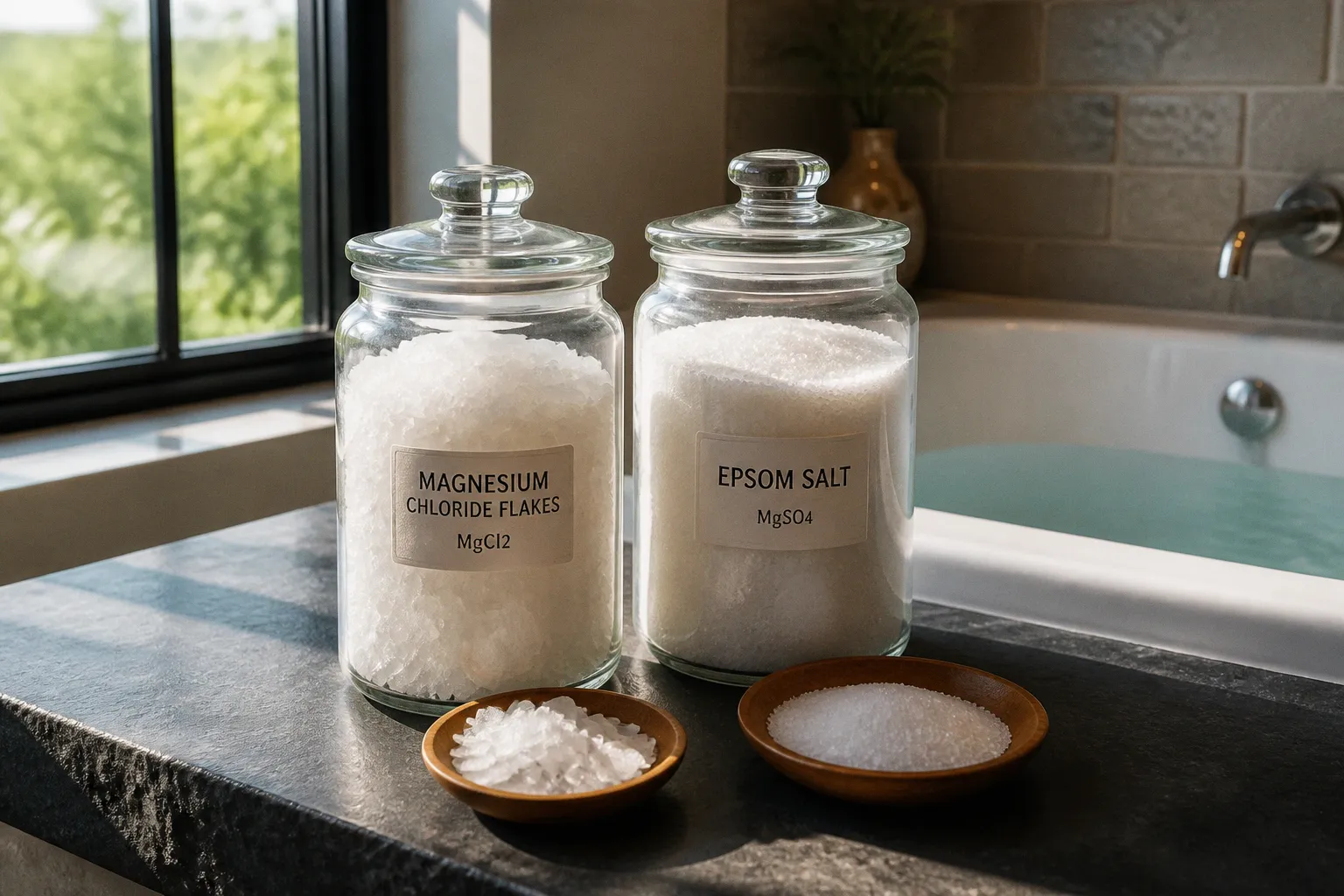
The difference affects elemental magnesium content, moisture behavior, mineral profile, sourcing, and post-bath skin feel.
Compare car rental deals in United Kingdom
See available offersPartner link — DiscoverCars comparisonFor magnesium flakes vs Epsom salt bath relaxation, the practical decision is not based on a single question of which product is stronger. It depends on the intended use: muscle comfort, skin tolerance, reduced tightness after soaking, ingredient traceability, or a broader mineral bath ritual.
Neither product should be treated as a proven replacement for oral magnesium supplementation. Evidence for meaningful systemic magnesium absorption through bath water remains unresolved. The strongest distinctions are chemical and sensory rather than clinical.
Chemical composition: magnesium chloride vs. magnesium sulfate
Magnesium flakes are formed from magnesium chloride. Epsom salt is magnesium sulfate, a compound containing magnesium, sulfur, and oxygen. Both dissolve in warm water, but they do not produce the same bath medium.
The elemental magnesium content also differs:
| Parameter | Magnesium flakes | Epsom salt |
|---|---|---|
| Primary compound | Magnesium chloride, MgCl₂ | Magnesium sulfate, MgSO₄ |
| Approximate elemental magnesium by weight | 12% | 10% |
| Typical physical form | Flakes or crystals | Crystals or granules |
| Moisture behavior on skin | Magnesium chloride binds moisture | Magnesium sulfate may leave a dry or tight feel |
| Common positioning | Sensitive-skin bath, hydration-focused soak | Budget-friendly muscle-soothing soak |
| Mineral complexity | Usually a relatively simple magnesium chloride source | Usually a relatively simple magnesium sulfate source |
| Main formulation distinction | Chloride salt | Sulfate salt |
The percentage of elemental magnesium is a chemical calculation, not a measure of how much magnesium reaches the bloodstream. A higher elemental percentage does not establish superior transdermal absorption. It only describes the proportion of elemental magnesium in the compound by weight.
Magnesium chloride contains approximately 12% elemental magnesium. Magnesium sulfate contains approximately 10%. This difference is real but modest. It should not be converted into a claim that magnesium flakes deliver a clinically meaningful dose through a bath.
The sulfate component also changes the way Epsom salt behaves in a ritual. After a prolonged soak, some users report a chalky, dry, or tight sensation. That response is not universal, and it depends on water temperature, soak duration, baseline skin condition, and whether the skin is rinsed and moisturized afterward. However, the possibility is relevant for skin that already has impaired barrier function.
Magnesium chloride is hygroscopic. It binds moisture from its environment and can contribute to a less dry skin feel after bathing. This does not make it a complete moisturizer. A mineral solution cannot replace an occlusive body butter or a well-formulated body oil. It can, however, produce a different after-feel from magnesium sulfate.
What the chemical difference means in practice
The distinction is most useful when applied to the skin barrier.
A bath temporarily increases water exposure to the stratum corneum. Warm water can soften surface corneocytes, but excessive heat and prolonged soaking can increase barrier disruption. Transepidermal water loss, or TEWL, may rise after bathing if the skin is not protected with a suitable emollient.
The salt itself does not determine the entire outcome. The complete set of variables includes:
- Water temperature. Hot water places more stress on the barrier than comfortably warm water.
- Soak duration. Longer exposure is not automatically more effective.
- Salt concentration. A more concentrated bath can increase the drying or stinging potential.
- Skin condition. Eczema-prone, cracked, freshly shaved, or irritated skin reacts differently from intact skin.
- After-bath care. A body butter or oil applied while the skin remains slightly damp reduces water loss more effectively than applying nothing.
For this reason, magnesium flakes may be preferable for a hydration-focused bath self-care ritual, while Epsom salt remains a reasonable option for a simple, inexpensive soak intended to support muscle comfort.
Magnesium chloride and Epsom salt differ chemically. The difference is not proof that either bath can correct a systemic magnesium deficiency.
Sourcing and purity: ancient seabeds, salt lakes, and manufactured Epsom salt
Magnesium flakes are commonly associated with natural mineral deposits. Some are harvested from ancient seabeds, including the Zechstein Sea region in Northern Europe. Others originate from salt lakes or other concentrated mineral sources.
Epsom salt is often manufactured from magnesium and sulfuric acid. The synthetic route is not inherently inferior. Purity depends on processing, quality control, contamination testing, and whether the final material is intended for cosmetic, agricultural, technical, or other use.
“Natural” does not function as a purity specification. A mineral extracted from an ancient seabed can contain additional salts or trace compounds. A manufactured magnesium sulfate product can be chemically consistent and highly pure. The label and technical documentation are more useful than the origin story alone.
How to assess a bath mineral product
A suitable bath product should identify the primary compound clearly. Look for:
1. The INCI or ingredient name. Magnesium chloride and magnesium sulfate should not be treated as interchangeable label terms.
2. A short ingredient list. Pure or near-pure mineral products are easier to evaluate than blends containing undisclosed fragrance components.
3. Fragrance disclosure. Essential oils, parfum, and botanical extracts can change skin tolerance.
4. Particle and moisture control. Magnesium chloride flakes can attract moisture and clump during storage.
5. Packaging integrity. A damp or partially dissolved product may have altered texture and dosing consistency.
6. Use designation. Cosmetic-grade and bath-grade labeling provides more relevant information than a generic industrial or agricultural designation.
7. Allergen communication. Fragrance oils and essential oils can contain sensitizing constituents even when the base mineral is simple.
The presence of trace minerals is not automatically a benefit. Dead Sea salts, for example, have a broader mineral profile. They contain magnesium chloride along with potassium chloride, calcium chloride, sodium chloride, and bromides. Some product descriptions refer to more than 21 trace minerals in Dead Sea mineral salts. That complexity may be relevant to a mineral bath, but it also makes the final composition less comparable to a single-salt magnesium chloride or magnesium sulfate product.
A single-compound product offers a clearer formulation profile. A multi-mineral blend offers a broader mineral profile but requires more attention to the label and skin response.
Skin feel and hydration: why one may leave skin softer
The most reliable consumer-level difference between magnesium flakes and Epsom salt is often the skin feel after the bath.
Magnesium chloride binds moisture. In a bath context, this can produce a less dry finish for some users. Epsom salt may leave the skin feeling tight, dry, or powdery, particularly after a long soak or when the water is hot.
This is not a universal clinical outcome. It is a formulation and barrier observation. The same salt can feel acceptable on intact body skin and uncomfortable on compromised skin.
The terms “hydrating” and “moisturizing” also require separation:
- Hydration refers to water content in the outer layer of the skin.
- Humectancy refers to attracting or binding water.
- Emollience refers to smoothing and filling gaps between corneocytes.
- Occlusion refers to reducing water loss by forming a barrier.
Magnesium chloride may bind moisture, but it is not an emollient in the same category as shea butter, squalane, or a triglyceride-rich body oil. Epsom salt is not a moisturizer simply because it is dissolved in water. Both products require appropriate aftercare if the goal is to limit TEWL.
The after-bath step controls much of the result
A mineral soak exposes the skin to water and dissolved salts. Once the bath ends, evaporation begins. If the skin barrier is already dry, evaporation can amplify tightness.
A more controlled routine is straightforward:
- Keep the water comfortably warm rather than very hot.
- Follow the product’s stated dilution instead of increasing the salt concentration arbitrarily.
- Avoid prolonged soaking when the skin is cracked, inflamed, or stinging.
- Pat the body dry rather than rubbing aggressively.
- Apply a fragrance-free body cream, body butter, or body oil while the skin is still slightly damp.
- Stop using the product if burning, persistent redness, or itching develops.
A body butter with shea butter supplies occlusive and emollient behavior that a mineral bath cannot provide. A body oil can reduce water loss, but oils vary in composition. Products high in oleic acid may feel heavier and can be less suitable for some acne-prone areas, while lighter formulations based on squalane or certain linoleic-rich oils may provide a different finish. The comedogenic scale is not a universal clinical test, so it should not be used as an absolute prediction of individual response.
For a whole-body bath, the main concern is usually irritation and barrier response rather than comedogenicity. For a bath oil applied to the chest, back, or shoulders, the formula becomes more relevant.
The science of transdermal absorption: what is established
Magnesium bath products are frequently marketed around transdermal absorption. The term describes the movement of a substance through the skin. The marketing claim is simple. The evidence is not.
A 2017 scientific review in Nutrients examined transdermal magnesium and reported that large-scale, rigorous human trials on systemic absorption remain unresolved. The exact percentage of topical magnesium that enters the bloodstream during a bath has not been established with sufficient certainty.
This leaves several claims unsupported:
- A bath cannot be described as delivering a quantified dose of magnesium to the bloodstream.
- Magnesium flakes cannot be presented as a verified substitute for oral magnesium.
- Epsom salt cannot be described as correcting a diagnosed magnesium deficiency through soaking.
- A longer soak cannot be assumed to produce greater systemic absorption.
- Higher salt concentration cannot be treated as medically superior.
The unresolved absorption question does not make bath salts useless. A bath can support a relaxation routine through warmth, reduced activity, and sensory cues. Mineral salts can contribute to the ritual structure. Muscle comfort may be perceived after warm water exposure. These outcomes do not require a claim of clinically meaningful magnesium delivery.
The distinction matters because the consumer benefit should be described accurately. A magnesium bath may be a relaxation and skin-care practice. It is not a validated replacement for medical treatment.
The evidence supports a bath ritual more confidently than it supports a measured transdermal magnesium dose.
Magnesium flakes and Epsom salt for muscle comfort
Epsom salt has a long-standing association with an epsom salt soak for muscles. The association is understandable because warm water can reduce the perception of stiffness and provide temporary comfort after physical activity.
The salt itself should not receive sole credit for the result. The likely contributors include:
- Heat exposure.
- Buoyancy and reduced load on joints.
- Temporary changes in muscle sensation.
- Reduced activity during the soak.
- Expectation and ritual consistency.
Magnesium flakes can be used for the same type of bath. Their magnesium chloride composition does not establish a superior muscle recovery effect. The more defensible distinction is that magnesium chloride may be better tolerated by users who find sulfate-based soaks drying.
For clinically significant pain, swelling, weakness, or persistent cramping, a bath is not an adequate diagnostic or treatment strategy. Those symptoms require evaluation in context.
Choosing the right mineral for the intended ritual
The “best salt for stress relief bath” depends on what the bath is expected to do. Stress relief is not a single biochemical endpoint. It can mean a quieter evening, reduced physical tension, a break from screen exposure, or preparation for sleep.
The mineral choice can be mapped to the primary constraint:
| Primary need | More suitable starting point | Reason |
|---|---|---|
| Low-cost general soak | Epsom salt | Widely available and usually inexpensive |
| Skin that feels dry after baths | Magnesium flakes | Magnesium chloride binds moisture and may produce a less tight after-feel |
| Sensitive or compromised skin | Either, with caution | Concentration, temperature, fragrance, and duration matter more than the mineral name |
| Broader mineral profile | Dead Sea mineral salts | Contains magnesium chloride and other mineral salts |
| Minimal ingredient complexity | Pure magnesium flakes or pure Epsom salt | Easier to assess than fragranced blends |
| Fragrance-based relaxation | A plain mineral base with separately assessed fragrance | Essential oils and parfum introduce additional irritation and sensitization variables |
| Medical magnesium deficiency | Neither as a replacement | Bath absorption is not established as a reliable treatment |
Magnesium flakes are the more logical starting point when post-bath dryness is the main complaint. Epsom salt is the more economical choice when the user wants a basic soak and does not experience tightness afterward.
Neither product has a universal advantage for stress relief. The ritual architecture often matters more:
- Use a consistent bathing time.
- Reduce unnecessary heat and noise.
- Select fragrance according to tolerance, not trend.
- Avoid mixing multiple essential oils without understanding their concentration.
- Keep the routine repeatable.
- Pair the bath with barrier-supportive aftercare.
An essential oil diffuser, scented candle, or bath bomb can be added, but each introduces a separate formulation question. Essential oils are concentrated volatile materials. They are not automatically safe because they are botanical. Bath bombs may contain sodium bicarbonate, citric acid, starches, dyes, fragrance, and surfactants. Their total irritation potential can exceed that of a plain mineral bath.
A soy wax candle provides ambient fragrance without direct skin contact, but the fragrance blend still affects indoor air quality and personal tolerance. For a skin-focused ritual, a plain mineral soak with a controlled after-bath emollient is easier to evaluate.
Avoid adding water to an anhydrous product
A pure body butter or oil base should not be diluted with bath water or modified by adding water inside the container. Once water enters an anhydrous formula, microbial risk changes. Without a suitable preservative system, the product may become unstable or contaminated.
The same principle applies to homemade bath blends. A dry salt mixture is not equivalent to a preserved emulsion. Adding fresh botanicals, milk, aloe juice, hydrosols, or water to a stored product creates a different formulation with different preservation requirements.
For a simple bath preparation, keep dry ingredients dry until use. If essential oils are included, they should be properly dispersed rather than floating as concentrated droplets on the water surface. Direct contact with undiluted essential oil can increase irritation risk.
A practical route for selecting between the two
A controlled comparison is more useful than switching products at random. The following process limits confounding variables:
1. Start with a plain product. Avoid comparing a fragranced magnesium flake blend with a fragrance-free Epsom salt product. The fragrance may be responsible for the skin response.
2. Use the label dilution. Do not increase the amount because a stronger bath seems more scientific. Concentration affects tolerance but does not prove greater absorption.
3. Keep water temperature similar. A hotter bath can create more dryness and redness, making the mineral comparison unreliable.
4. Keep the soak duration similar. Long exposure changes the barrier response.
5. Record the after-feel. Note tightness, itching, softness, residue, and redness after drying.
6. Apply the same aftercare. Use the same body butter or oil after each bath.
7. Change one variable at a time. If the salt, fragrance, bath bomb, candle, and body product all change together, the result cannot be attributed to one ingredient.
8. Stop at the first sign of persistent irritation. A relaxation ritual should not create a barrier problem that requires repair.
This process does not measure blood magnesium. It evaluates product tolerability and ritual usefulness. That is the part of the comparison that can be assessed at home without overstating the evidence.
When magnesium flakes are the better fit
Magnesium flakes are a rational choice when:
- The user prefers magnesium chloride over magnesium sulfate.
- Epsom salt leaves the skin feeling tight or chalky.
- The bath is part of a hydration-conscious body-care routine.
- A simple mineral product is preferred over a fragranced bath bomb.
- The user wants a mineral soak with a source associated with ancient seabeds or salt lakes.
- The product is stored in moisture-resistant packaging.
The word “gentler” should not be treated as an absolute. Magnesium chloride can sting compromised skin, particularly at a high concentration. A product may be gentler for one user and irritating for another.
When Epsom salt remains appropriate
Epsom salt remains appropriate when:
- Cost and availability are primary considerations.
- The user wants a basic soak for temporary muscle comfort.
- The skin tolerates magnesium sulfate without dryness.
- The product has a clear ingredient declaration.
- There is no need for a broader mineral profile.
- The bath is occasional rather than a high-frequency exposure.
Epsom salt is not an inferior product because it is often inexpensive or manufactured. A chemically consistent manufactured salt can be a sound choice. The relevant question is whether its composition matches the intended use and the skin’s response.
The strict do-and-don’t assessment
Do
- Do identify the compound: magnesium chloride for flakes, magnesium sulfate for Epsom salt.
- Do treat elemental magnesium percentages as chemical data, not absorption data.
- Do choose magnesium flakes when post-bath dryness is a recurring problem.
- Do use Epsom salt for a straightforward, low-cost soak if the skin tolerates it.
- Do keep water comfortably warm and follow the product label.
- Do moisturize promptly after bathing to limit TEWL.
- Do select fragrance-free products when the skin barrier is reactive.
- Do separate relaxation benefits from medical claims.
- Do consult a physician for diagnosed magnesium deficiency or persistent muscle symptoms.
Don’t
- Don’t claim that either salt reliably delivers a measured systemic dose through the skin.
- Don’t use a bath as a replacement for prescribed or medically indicated magnesium treatment.
- Don’t assume a higher salt concentration produces better results.
- Don’t add water, milk, aloe, or fresh botanicals to a stored anhydrous body-care product without a preservation system.
- Don’t apply undiluted essential oils directly to bath water or skin.
- Don’t judge purity from the word “natural” alone.
- Don’t confuse a broader mineral profile with proven superior skin or muscle benefits.
- Don’t continue a soak that causes burning, persistent itching, or redness.
Magnesium flakes and Epsom salt serve similar ritual functions but occupy different chemical categories. Magnesium chloride provides a slightly higher elemental magnesium percentage and may produce a less drying skin feel. Magnesium sulfate remains a practical and accessible option for a general bath, especially when the main goal is temporary muscle comfort.
The evidence supports choosing between them on composition, tolerance, sourcing, and aftercare. It does not support presenting either one as a quantified transdermal magnesium treatment. A well-designed bath ritual is therefore built on controlled variables: moderate heat, appropriate concentration, minimal unnecessary fragrance, and barrier-supportive care after the soak.