Soy candles or oil diffusers for bath relaxation?
The practical difference in a bath aromatherapy soy candle vs diffuser setup is not simply fragrance preference. It is a difference in delivery system, exposure pattern, maintenance, and safety profile.
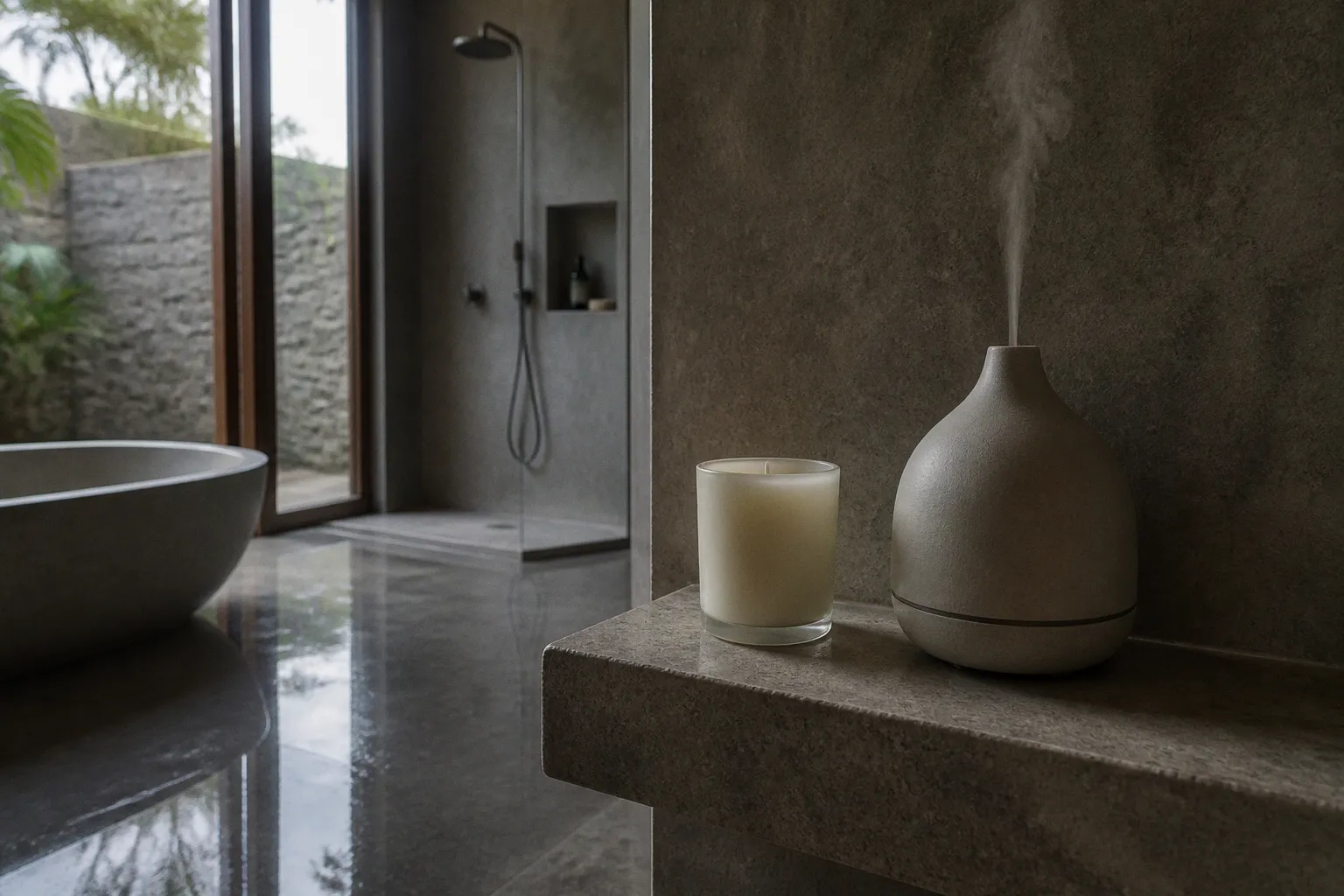
A soy wax candle produces fragrance through combustion and heat. It delivers scent rapidly and adds visible light, but it introduces an open flame and combustion particles into the room. An ultrasonic diffuser uses high-frequency vibrations to disperse a cool mist of water and essential oil. A reed diffuser releases fragrance through capillary action without flame, electricity, or active monitoring.
Compare car rental deals in United Kingdom
See available offersPartner link — DiscoverCars comparisonThere is no universal winner. The correct option depends on the duration of the ritual, bathroom ventilation, household pets, tolerance for open flames, and whether the priority is immediate scent intensity or continuous low-maintenance diffusion.
The sensory experience: warm light versus consistent mist
Candles and diffusers alter the bathroom environment through different physical mechanisms.
A soy candle melts wax around the wick. The liquid wax travels up the wick, vaporizes, and burns. Fragrance compounds are carried into the room by the heated air and convection generated by the flame. This produces a relatively fast scent release. The effect is strongest during the burn period and usually becomes noticeable soon after lighting.
An ultrasonic diffuser does not heat the oil. High-frequency vibrations break a mixture of water and essential oil into a fine cool mist. The mist disperses gradually and can maintain a more even ambient concentration while the reservoir contains water.
A reed diffuser operates at a lower output. Fragrance oil moves through porous reeds by capillary action and evaporates from the exposed surface. The release is continuous but passive. It does not produce the immediate scent throw associated with a burning candle or an active ultrasonic unit.
| Parameter | Soy wax candle | Ultrasonic diffuser | Reed diffuser |
|---|---|---|---|
| Fragrance release | Heat and combustion | Cool water-and-oil mist | Passive evaporation through reeds |
| Light output | Warm visible flame | None | None |
| Scent onset | Rapid | Gradual to moderate | Gradual |
| Operating mode | Requires active burning | Requires water, oil, and electricity | Continuous and passive |
| Monitoring | Required throughout burning | Lower, but reservoir and electrical placement matter | Minimal |
| Maintenance | Wick trimming and wax-pool management | Reservoir cleaning after use | Reed replacement or rotation |
| Typical use pattern | Short, intentional bath ritual | Controlled recurring diffusion | Background fragrance |
| Main safety issue | Open flame and combustion | Water, electricity, contamination | Oil exposure and placement |
The soy wax candle bath benefits are therefore specific. The candle is useful when the ritual is short and the visual environment matters. The flame creates a localized light source that changes the room without requiring a separate lamp or electrical diffuser. This is not an aromatherapy effect in itself. It is an environmental effect.
The diffuser has a different advantage: output continuity. An ultrasonic model can begin before the bath and continue through the entire routine without the rapid change in scent intensity that occurs as a candle burns down or is extinguished. A reed diffuser is even less demanding, but its output is less adjustable.
A candle is an active, high-output scent event. A diffuser is an ambient delivery system. Treating them as interchangeable creates poor safety decisions.
Scent intensity is not the same as therapeutic value
High scent throw does not establish a stronger physiological effect. It indicates that more fragrance has entered the surrounding air over a given period. The composition of the fragrance, concentration, ventilation, and individual sensitivity determine whether the result is acceptable.
Candles can contain fragrance oils, essential oils, or a combination. The label should be read as a formulation document, not as a mood claim. A product marketed as botanical may still contain a complex fragrance blend. A product containing essential oils may also contain compounds that are unsuitable around pets or irritating for sensitive occupants.
For a bath, the most reliable setup is usually one that keeps the scent at a tolerable level. A small bathroom can accumulate fragrance faster than an open living area. Closing the door may increase concentration, while an exhaust fan can remove both fragrance and humid air. The best way to scent a bath is not to maximize output. It is to match release rate to room volume and ventilation.
Combustion safety and air quality in a humid bathroom
Soy wax is not emission-free. It is a plant-derived wax, but the wick and fragrance still burn. Combustion generates gases and particulate matter. Particles from candle combustion can be as small as 0.1 microns, which means that the absence of visible smoke does not indicate the absence of airborne emissions.
Soy candles generally burn cleaner than traditional paraffin candles and reduce petroleum-derived byproducts such as benzene and toluene. That distinction is relevant, but it does not remove the core hazard: an open flame in a room containing water, textiles, cosmetics, and sometimes aerosol products.
A bathroom adds several operational problems:
- Humidity can affect the wick and flame behavior. A candle placed near steam, splashing water, or a strong exhaust stream may burn unevenly.
- Water can contaminate molten wax. A wet surface or splash may cause spattering when it reaches hot wax.
- The flame is easy to obscure. Steam, low lighting, and reflective tile can make a small flame less visible from across the room.
- Combustible items are common. Towels, bath mats, paper packaging, cotton accessories, and hair products should not be placed within the heat path.
- The candle requires supervision. A bath is not an appropriate time to leave a flame burning in an unoccupied room.
The container also matters. A stable vessel with a heat-resistant base is preferable to a thin decorative container of uncertain construction. The candle should stand on a dry, level surface away from the tub edge. Placing it directly on a wet ledge increases the chance of tipping and water contact.
A candle burn time of approximately 40–45 hours per refill unit is a product specification, not a recommendation to run it continuously. Each session should follow the manufacturer’s burn guidance. Wick trimming helps control soot and flame height, but trimming does not convert combustion into a risk-free process.
An ultrasonic diffuser removes the open flame, but it does not eliminate all hazards. The unit uses electricity near water. It should remain on a dry, stable surface, positioned so that the mist does not settle directly onto electrical outlets, switches, wooden shelves, or painted walls. The reservoir should not be overfilled. The power cable should not cross the floor where it can be pulled or exposed to standing water.
Reed diffusers avoid both flame and electricity. Their limitation is chemical access: the fragrance oil remains exposed in an open vessel. The container should not be placed where it can be knocked into the bath, accessed by children, or reached by animals.
Maintenance demands: wick trimming versus reservoir cleaning
Maintenance is part of the delivery system. Neglect changes performance and can create secondary safety problems.
Soy candle maintenance
A candle needs a controlled burn environment. The wick should be kept at the length recommended by the maker, because an excessively long wick can produce a taller flame, more soot, and faster wax consumption. The wax pool should remain free of wick fragments, matches, and other debris.
A recurring issue is uneven melting. If the candle is extinguished before the upper wax layer has melted sufficiently, a tunnel can form around the wick. This reduces usable wax and can destabilize later burns. The exact burn duration needed depends on vessel diameter and formulation, so generic timing rules are less reliable than the maker’s instructions.
The candle should be extinguished before the vessel becomes excessively hot or the wax level approaches the container base. The container should cool before it is moved or cleaned.
Ultrasonic diffuser maintenance
The reservoir is the critical component. Water and botanical oils create a moist environment that can support mold and bacterial growth if the unit is left dirty. Contaminated reservoirs may disperse biological material into indoor air along with the mist.
A practical maintenance cycle includes:
1. Emptying remaining water after the session. Standing water should not be left in the reservoir between uses.
2. Wiping the internal surfaces. Residual oil can form a film that attracts dust and changes subsequent scent output.
3. Cleaning according to the manufacturer’s material guidance. Abrasive tools and incompatible solvents can damage the reservoir or ultrasonic plate.
4. Drying before storage. A closed, damp unit is more likely to develop odor and microbial contamination.
5. Inspecting the mist outlet. Accumulated residue can reduce output or redirect condensation onto nearby surfaces.
The diffuser’s low-temperature operation reduces heat exposure but does not make maintenance optional. For frequent use, the cleaning burden is higher than many buyers expect.
Reed diffuser maintenance
Reed diffusers have the simplest hardware. The main variables are reed condition, oil level, and placement. Rotating the reeds can temporarily increase scent release, but it also increases the chance of oil transfer to nearby surfaces. Reeds should not be handled over porous stone, unfinished wood, painted furniture, or textiles.
A reed diffuser is not a substitute for ventilation. Continuous fragrance can become fatiguing in a small room even when the release rate is low.
Pet safety and essential oil toxicity
Pet exposure is a major distinction between bath aromatherapy setup options. Essential oils are concentrated mixtures of volatile compounds. Some compounds are metabolized differently by animals than by humans, and certain oils are toxic to pets, particularly cats.
Tea tree, eucalyptus, and concentrated citrus oils are specifically relevant. Their presence in a diffuser blend does not become harmless because the product is marketed as natural. The exposure route can include inhalation, contact with wet surfaces, grooming after contact, or ingestion following a spill.
The risk profile differs by device:
- A candle may contain essential oils or synthetic fragrance. Its primary immediate hazard is combustion, but spilled wax and fragrance residue can also create contact risks.
- An ultrasonic diffuser disperses oil into the air and may settle droplets onto nearby surfaces. This requires greater caution in households with cats, dogs, birds, or other sensitive animals.
- A reed diffuser creates a persistent open source of fragrance oil. A tipped container can produce direct liquid exposure, which is a different and potentially more concentrated event than normal ambient diffusion.
Households with pets should verify the complete oil composition before selecting an essential oil diffuser for the bathroom. If the composition is unavailable, the safety assessment is incomplete. A fragrance-free setup or a non-oil alternative may be more appropriate than assuming that a short operating period removes the concern.
The bathroom itself can also create a transfer route. A cat or dog may enter after the diffuser has stopped, contact a damp surface, or investigate a fallen reed. The unit should therefore be positioned away from floors, bath edges, and areas accessible to animals.
Matching the device to the room and routine
The choice becomes clearer when the ritual is defined by operating conditions rather than marketing language.
Choose a soy candle when:
- The bath is short and supervised from start to finish.
- Warm light is part of the desired room configuration.
- The bathroom has a stable, dry surface away from water and textiles.
- The user accepts combustion and does not need continuous fragrance.
- The household does not include occupants who are unusually sensitive to candle emissions.
- The fragrance formula and wick construction are disclosed clearly.
The candle is strongest as a controlled event. It should be lit shortly before or at the beginning of the bath, kept within direct view, and extinguished before the user leaves the room.
Choose an ultrasonic diffuser when:
- Flame-free operation is the primary requirement.
- The user wants adjustable, continuous scent during a longer routine.
- There is a dry location with safe electrical access.
- The reservoir can be emptied and cleaned consistently.
- The essential oil composition has been checked for household compatibility.
- The bathroom has enough ventilation to prevent excessive humidity and scent accumulation.
An ultrasonic diffuser is not the automatic choice for every bathroom. The combination of water, electricity, steam, and oil requires controlled placement. A unit on a narrow vanity beside the sink may be less suitable than a diffuser on a dry shelf outside the splash zone.
Choose a reed diffuser when:
- Background fragrance is preferred over an active ritual.
- Electricity and flame are both undesirable.
- The user can keep an open liquid vessel out of reach.
- The room does not require rapid scent adjustment.
- Low maintenance matters more than precise output control.
Reed diffusion is practical for a guest bathroom or a room that needs continuous, low-output fragrance. It is less suitable when the scent must be turned off immediately or when the space is accessible to children and pets.
Hardware costs for aromatherapy diffusers commonly fall in the range of $50 to $100, depending on the unit and its features. This cost should be considered alongside recurring oil purchases and cleaning time. A candle may require less initial equipment, but the ongoing expense depends on vessel size, burn frequency, and refill availability.
A direct comparison for common bath scenarios
| Bath scenario | More suitable option | Reason | Main control point |
|---|---|---|---|
| Ten- to twenty-minute supervised bath | Soy candle | Fast scent release and immediate light | Keep flame in direct view |
| Long bath with adjustable scent | Ultrasonic diffuser | Continuous cool-mist delivery | Clean reservoir and control oil dose |
| Guest bathroom with passive fragrance | Reed diffuser | No electricity or flame required | Prevent tipping and oil contact |
| Household with cats | Non-oil option or verified formula | Some essential oils are toxic to cats | Confirm composition before use |
| Small bathroom with weak ventilation | Lower-output reed diffuser or no added scent | Reduces accumulation of fragrance and humidity | Keep release rate low |
| User frequently forgets to extinguish flames | Ultrasonic or reed diffuser | Removes the open-flame failure mode | Apply electrical or spill controls |
| Bathroom with limited dry surfaces | Avoid ultrasonic device | Water and electricity cannot be safely separated | Select a different room or method |
The table does not establish a universal ranking. It identifies failure modes. In practice, the safer device is the one whose operating requirements the user can consistently meet.
The formulation details behind the label
A comparison based only on soy wax and essential oil is incomplete. The product base, fragrance load, wick, vessel, and instructions all affect performance.
Soy wax refers to the primary wax component. It does not describe the wick, fragrance, dye, stabilizers, or container. A soy candle may still produce soot if the wick is oversized, the flame is disturbed, or the formulation is poorly balanced. The phrase “clean-burning” should therefore be interpreted comparatively, not absolutely.
Diffuser oils also vary. Essential oil blends are chemically different from fragrance oils, and “natural” does not indicate low volatility, low irritation potential, or pet safety. The relevant questions concern the actual composition, the recommended application, and the device compatibility.
The same principle applies to bath salts and bath bombs used alongside a scent device. Volatile fragrance, steam, and warm water can increase the overall sensory load. If the bath product already contains a high fragrance concentration, adding a candle or diffuser may produce an unnecessarily dense environment. The objective is controlled exposure, not maximum ingredient count.
A measured setup usually contains one primary scent source. If a bath bomb, body oil, candle, and diffuser all release fragrance at once, it becomes difficult to identify the cause of irritation or headache. It also becomes difficult to adjust the environment without discarding several products.
“Natural” describes origin. It does not describe combustion behavior, microbial stability, volatility, or pet toxicity.
A strict operating standard
For a soy candle:
- Do: use a stable, dry, heat-resistant surface.
- Do: keep towels, paper, hair products, and other combustibles outside the heat path.
- Do: follow the maker’s wick and burn instructions.
- Do: extinguish the flame before leaving the bathroom.
- Do not: place the candle on the tub edge or beside standing water.
- Do not: assume soy wax is emission-free.
- Do not: move a hot vessel or add water to molten wax.
For an ultrasonic diffuser:
- Do: use the recommended water volume and oil quantity.
- Do: empty and clean the reservoir after use.
- Do: keep the unit away from splashes, outlets, and wet surfaces.
- Do: verify essential oil compatibility with pets and occupants.
- Do not: leave stagnant water in the reservoir.
- Do not: direct mist toward electrical equipment, unfinished wood, or painted walls.
- Do not: treat cool mist as proof that the device is risk-free.
For a reed diffuser:
- Do: place the vessel on a stable, non-porous surface.
- Do: keep it away from children and animals.
- Do: rotate reeds only when increased output is required.
- Do not: place it on stone, wood, or textiles that can absorb oil.
- Do not: assume passive diffusion is harmless after a spill.
- Do not: use an undisclosed oil blend in a household with sensitive pets.
The bath aromatherapy soy candle vs diffuser decision is therefore a systems decision. Soy candles provide rapid scent release and warm light with an open-flame burden. Ultrasonic diffusers provide adjustable, flame-free mist with a reservoir-cleaning burden. Reed diffusers provide continuous passive fragrance with a spill and exposure burden.
For a short, supervised bath, a correctly placed soy candle is the more direct tool. For repeatable, flame-free diffusion, an ultrasonic device is more controllable if it is cleaned and positioned correctly. For low-maintenance background scent, a reed diffuser is adequate when the open oil vessel can be secured.
The strongest setup is not the one with the highest scent output. It is the one whose chemistry, hardware, room conditions, and safety requirements remain under control.