Dry brushing vs body scrubs for dead skin removal
Dry brushing and body scrubs remove surface corneocytes through mechanical friction, but they do not create the same conditions for the skin barrier. Dry brushing acts on dry skin before showering with a brush.
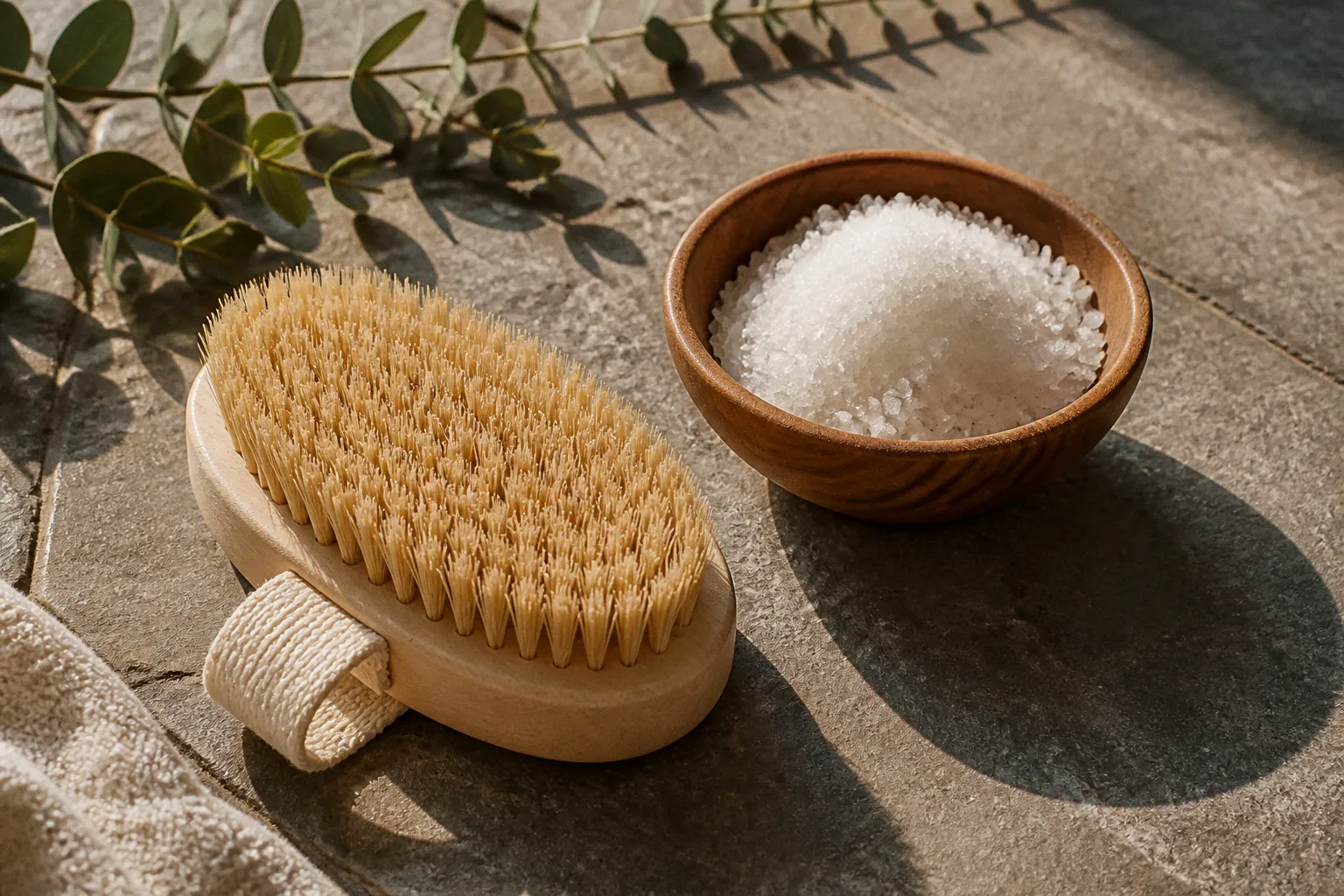
A body scrub acts on damp skin, usually after several minutes of warm water exposure, with particles suspended in oils, surfactants, or an emulsion.
Compare car rental deals in United Kingdom
See available offersPartner link — DiscoverCars comparisonThe practical difference is not simply strength. It is friction, water exposure, product composition, and what happens immediately afterward. A dry brush can provide controlled surface exfoliation without hot water stripping skin lipids. A shower scrub can soften compacted keratin and combine dead skin removal with emollient deposition. Either method can increase TEWL and produce stinging when used too often or with excessive pressure.
The comparison below is the useful starting point.
| Parameter | Dry brushing | Body scrub |
|---|---|---|
| Application surface | Dry skin | Damp or wet skin |
| Main tool | Natural, plant-based, synthetic, or boar bristles | Sugar, salt, coffee, coconut shell, or other particles in a base |
| Typical timing | Before showering | During a shower |
| Keratin softening | Minimal before application | Increased by warm water and soaking |
| Formula contribution | None unless followed by a product | Oils, butters, surfactants, humectants, and botanical extracts may support skin conditioning |
| Main mechanical variable | Brush stiffness and pressure | Particle size, particle shape, pressure, and formula slip |
| Main barrier risk | Abrasion from repeated strokes or stiff bristles | Abrasion combined with hot water, surfactants, or aggressive rubbing |
| Best use case | Light surface polishing with minimal product | Localized roughness, dry patches, and routine in-shower exfoliation |
| Immediate follow-up | Cream or body oil after showering | Cream or body oil after rinsing |
The mechanics of dry brushing: stimulation and surface renewal
Dry brushing uses a firm brush on dry skin in light, sweeping strokes. The bristles dislodge loose surface cells and create friction across the stratum corneum. The method does not use water, oil, or a cleansing base to change the skin surface during application.
That distinction matters. Water hydrates corneocytes and changes their mechanical behavior. Warm water also softens compacted keratin. Dry brushing takes place before this softening occurs, so the technique generally produces a more superficial form of exfoliation. It is not equivalent to applying a strong body peeling product, and there is no clinical basis for treating it as a cellulite-removal method.
The brush itself is the formulation in this method. Its physical properties determine the dose of friction:
- Bristle stiffness controls how much force reaches the outer skin layers.
- Bristle density changes the contact area and the amount of pressure required.
- Bristle length affects flexibility. Longer bristles usually bend more easily than short, rigid bristles.
- Stroke direction can be organized as light sweeps toward the torso, but direction does not transform the method into medical lymphatic drainage.
- Skin tension changes the amount of friction. Stretching the skin tightly can make the brush feel more aggressive.
- Application time determines cumulative exposure. Repeated passes over the same area increase irritation without necessarily improving dead skin removal.
Dry brushing benefits are therefore limited by technique. A short session with moderate pressure may remove loose surface flakes. A long session with a stiff brush can create persistent redness, stinging, or flaking. Those signs indicate barrier stress, not improved exfoliation.
The method also avoids one variable present in many shower routines: hot water exposure. Hot water can increase dryness by disrupting surface lipids and increasing water loss from the skin. Dry brushing before the shower does not prevent this damage if the subsequent shower is long and hot, but it separates the mechanical step from the water and cleanser step. That gives the user more control over the total irritation load.
A dry brush is not automatically gentle. “Dry” describes the application condition. It does not describe the pressure, bristle geometry, or biological effect.
Dry brushing is a friction method, not a detoxification method. Its measurable action is surface abrasion and temporary stimulation of local blood flow.
How to use a dry brush without escalating friction
A practical sequence is simple:
1. Use the brush on intact, dry skin before showering. The skin should not have cuts, abrasions, open lesions, active cold sores, warts, or signs of infection.
2. Begin with light pressure. The brush should move across the skin without scraping or producing pain.
3. Use one or two passes over each area. Repeated brushing of the same patch increases mechanical stress.
4. Avoid inflamed or compromised zones. Active eczema, psoriasis, and irritated keratotic areas are not suitable targets for dry brushing.
5. Shower with warm rather than hot water. The brush does not cancel out excessive water exposure.
6. Apply a moisturizer immediately after drying. A cream or body oil helps reduce the impact of water loss from the newly exfoliated surface.
The brush should also be cleaned and fully dried between uses. A damp, poorly ventilated brush can accumulate residue and microorganisms. This is a hygiene issue rather than an exfoliation benefit.
In-shower scrubbing: softened keratin and formula support
A body scrub combines exfoliating particles with a vehicle. The particles may include sugar, Dead Sea salt, coffee grounds, or crushed coconut shell. The vehicle may be an oil blend, an anhydrous butter base, a surfactant system, or an emulsion containing water.
This makes a body scrub more complex than a dry brush. The user is not applying friction alone. The skin is exposed to water, heat, cleansing agents, and the formula’s emollient or humectant components. Each variable affects the final result.
Warm water exposure for approximately 5 to 10 minutes can soften surface keratin before a wet exfoliation step. This may make rough patches easier to smooth, but it also makes the outer layer more vulnerable to excessive rubbing. Softer does not mean indestructible.
Particle type is only one part of scrub performance
The common particle categories behave differently:
- Sugar particles dissolve gradually in water. They can provide moderate exfoliation while the granules become less abrasive during use.
- Salt particles remain crystalline longer and can feel more abrasive, particularly on dry, cracked, or freshly shaved skin. Salt may also sting compromised areas.
- Coffee grounds provide irregular particles and a coarse texture. Their exfoliating action depends on grind size and the pressure used.
- Crushed coconut shells can be angular and rigid. Particle shape matters as much as particle size because sharp edges create concentrated friction.
- Synthetic or engineered particles, where used, may offer more consistent geometry than irregular natural powders. Consistency can make the product easier to dose, but it does not eliminate overuse.
A scrub’s texture is also modified by the base. An oil-rich formula can reduce drag through lubrication. A foaming body scrub introduces surfactants, which remove soil and some surface lipids while the particles provide mechanical action. An emulsified scrub may rinse more cleanly than a pure oil-and-sugar formula, but the rinse profile does not determine whether the product is suitable for daily use.
The formulation must be considered as a whole. A product can contain fine particles and still cause irritation if the user applies heavy pressure or uses it after prolonged hot-water exposure. Conversely, a coarse particle can be less aggressive when suspended in a highly lubricating base and used briefly. That does not make it appropriate for inflamed skin.
Pure oils, emulsions, and the preservation issue
Body scrubs frequently use oils or butters as the continuous phase. Shea butter, coconut oil, sunflower oil, olive oil, and other lipids may reduce friction and leave an occlusive film. Their fatty-acid profiles affect spreadability, rinse behavior, and skin feel.
Oleic acid-rich oils can feel fluid and spreading, but they are not universally tolerated by every skin type or body area. A product’s comedogenic scale rating should not be treated as a fixed clinical prediction. The response depends on concentration, the rest of the formula, application area, and individual susceptibility.
A pure anhydrous scrub does not contain meaningful free water. Its preservation requirements differ from those of a water-containing emulsion. Once water is added to a formula without an appropriate preservative system, microbial risk changes. This is a common formulation error in homemade body scrubs: adding water, aloe juice, hydrosols, or wet botanical material to a butter-and-sugar base without recalculating preservation and packaging.
A foaming body scrub can be useful when the goal includes cleansing, but surfactant exposure should be counted as part of the total barrier load. A body scrub used in a short, warm shower is not chemically equivalent to an oil scrub left on the skin and rinsed quickly.
Comparing body exfoliation techniques by skin problem
The correct method depends on the target. Dead skin removal is not one uniform task. Loose flaking, compact roughness, follicular bumps, and inflammatory lesions require different handling.
For loose surface flakes
Dry brushing may be sufficient when the problem is limited to light flaking on intact arms, legs, or the torso. The brush removes loose cells without requiring a scrub particle or a second cleansing product. The result depends heavily on pressure control.
A body scrub may provide more immediate smoothing because warm water softens the surface and the formula adds lubrication. This is useful when the skin feels rough rather than merely flaky. It is less useful when the roughness is caused by an active skin condition.
For very dry patches
An oil-based or butter-based scrub can temporarily improve surface texture by combining particle removal with lipid deposition. Shea butter and body oils may reduce the dry feel after rinsing, although the occlusive effect depends on how much product remains on the skin.
Dry brushing alone does not replace moisturization. It removes surface material but contributes no humectants, emollients, or occlusives. The follow-up product is therefore essential. Without it, the user may interpret post-shower tightness as a need for more brushing and create a cycle of escalating abrasion.
For keratosis pilaris and follicular roughness
Keratosis pilaris involves follicular keratinization. Mechanical exfoliation may temporarily reduce surface roughness, but aggressive brushing or scrubbing can increase redness and irritation around the follicles. Neither method should be presented as a cure for the condition.
Chemical body exfoliants containing alpha hydroxy acids or beta hydroxy acids may be used in separate routines, but combining them with vigorous dry brushing or a coarse shower scrub increases the total irritation load. Retinoids create the same concern. The relevant variable is not whether each individual product is tolerated in isolation. It is the cumulative exposure to mechanical and chemical exfoliation.
For follicular roughness, a lower-friction routine used consistently is generally more rational than daily abrasive treatment. If the area is inflamed, itchy, cracked, or stinging, mechanical exfoliation should stop until the skin barrier is stable.
For post-shaving texture
Abrasive particles and stiff bristles are poor choices immediately after shaving. Shaving already removes some surface corneocytes and creates microscopic disruptions in the outer layer. Salt, fragrance, acids, and high-friction particles can produce burning or prolonged redness.
The interval between shaving and exfoliation should be long enough for the skin to return to baseline. A bland moisturizer is more appropriate immediately after shaving than a scrub designed to create a polished surface.
Timing and barrier integrity
The question of dry brushing vs body scrub is partly a question of timing.
Dry brushing occurs before the shower. The user can control the brush exposure separately from cleanser and water exposure. Body scrubbing occurs during the shower, often after the skin has been wet for several minutes. The warm-water step changes the texture of the outer layer and can make the scrub feel more effective than it would on dry skin.
That sensation is not a reliable measure of biological benefit. A rougher feel, visible flakes, or temporary redness does not prove that the skin has been exfoliated to an optimal degree. It may indicate that the procedure has exceeded the skin’s tolerance.
Transepidermal water loss is a useful concept here. The stratum corneum limits water movement from the deeper skin layers to the environment. Mechanical abrasion, hot water, harsh surfactants, and low-humidity conditions can all increase barrier stress. When the barrier is impaired, the symptoms are familiar:
- Persistent redness rather than brief post-friction color.
- Stinging when moisturizer or water touches the skin.
- Flaking that continues after the routine.
- Tightness and increased sensitivity.
- Roughness that returns quickly despite more exfoliation.
- Itching or localized inflammation.
These signs are not an instruction to scrub more thoroughly. They are a reason to stop mechanical exfoliation and simplify the routine.
A reasonable starting frequency is once or twice per week. That range is not a universal prescription. It is a conservative entry point that allows the user to observe delayed irritation. Some body areas tolerate less. Areas with thin skin, frequent shaving, eczema history, or existing dryness require more restraint.
The correct exfoliation dose is the lowest dose that changes surface texture without producing delayed redness, stinging, or flaking.
The interaction with chemical exfoliants
AHA and BHA products are chemical exfoliants. Retinoids alter epidermal turnover and can increase sensitivity. When these products are used in the same routine as dry brushing or a body scrub, the skin receives multiple forms of stress.
The common error is to evaluate the schedule by product category rather than by cumulative action. A person may use an acid lotion on one evening, dry brush the next morning, apply a coffee scrub after shaving, and then use a retinoid body product. Each step may appear moderate alone. Together, they can compromise the barrier.
For a body exfoliation routine, separation is more useful than intensity:
- Use mechanical exfoliation on a day without a strong chemical exfoliant.
- Do not scrub over areas treated with irritating actives until the skin has demonstrated tolerance.
- Avoid increasing frequency because the first application produced only temporary smoothness.
- Reduce pressure before changing to a harsher particle or stiffer brush.
- Reassess the routine if moisturizers begin to sting.
Safety protocols: where neither method belongs
Mechanical exfoliation is unsuitable over cuts, scrapes, active infections, warts, cold sores, active eczema, and active psoriasis. Friction can worsen irritation and can spread infectious material across adjacent skin. This applies to both dry brushing and shower scrubbing.
The same restriction applies to areas with unexplained lesions, open cracks, or active dermatitis. A body scrub cannot correct a medical cause of scaling. It can obscure the progression of a condition by temporarily smoothing the surface while adding inflammation.
Do not dry brush:
- Over sunburned or peeling skin.
- Over open cuts or abrasions.
- Over active eczema or psoriasis.
- Over warts or cold sores.
- Over suspected infection.
- On skin that is already burning, stinging, or visibly inflamed.
- Immediately after procedures that disrupt the epidermal barrier.
Do not use a body scrub:
- On freshly shaved skin if it stings or feels raw.
- On cracked skin or fissures.
- Over active follicular inflammation.
- With heavy pressure simply because the product feels lubricated.
- In combination with an acid or retinoid when the skin is already irritated.
- Daily as a default routine.
- With particles that feel sharp or scratchy after the first pass.
The product’s botanical positioning does not change these rules. Coffee, sugar, sea salt, plant oils, and crushed shells are still physical materials. Natural origin is not a measurement of particle geometry, sterility, or barrier compatibility.
Post-exfoliation: restoring water and lipids
The post-exfoliation step determines whether the routine ends with controlled surface renewal or with avoidable dryness.
After dry brushing, shower with warm water, cleanse only where cleansing is needed, pat the skin dry, and apply a moisturizer while the skin retains some surface water. A cream supplies a more structured mixture of humectants, emollients, and occlusive components than a pure oil. A body oil can reduce water loss by forming a lipid film, but it does not hydrate dry skin in the same way a water-containing moisturizer does.
After a body scrub, rinse thoroughly according to the product type. Oil-and-sugar scrubs may leave a lipid layer. Foaming body scrubs may remove more of the formula during rinsing. Neither outcome removes the need to assess the skin’s response.
The choice between body butter and body oil can be made according to the condition of the skin:
- Body butter: More structured and occlusive. Useful when the skin feels rough, tight, or dry after bathing.
- Body oil: Spreads quickly and reduces water loss. Most effective when applied to slightly damp skin or layered over a cream.
- Emulsion lotion: Supplies water and lipids in a balanced vehicle. Often easier to distribute over large body areas.
- Fragrance-free cream: The more controlled option when the barrier is irritated or reactive.
Ingredients also matter. A formula containing occlusive lipids can reduce TEWL after exfoliation. Humectants such as glycerin can bind water within the outer layer, but they work best within a complete formula rather than as an isolated claim. Essential oils and fragrance compounds add sensory character but can increase irritation risk for reactive skin.
The moisturizer should be applied immediately after the shower or rinse. Delaying the step until the skin is fully dry reduces the amount of surface water available for the formula to help retain.
Dry brushing or shower scrub: selecting the lower-risk route
The decision can be made without assigning either method universal superiority.
Choose dry brushing when:
- The target is light surface flaking on intact skin.
- The user wants to avoid applying a scrub formula.
- The shower routine is already long or cleanser-heavy, and mechanical exfoliation can be kept brief before washing.
- The brush has flexible bristles and the user can maintain low pressure.
- The skin is not inflamed, cracked, or recently shaved.
Choose a body scrub when:
- The target is a localized dry patch or compact roughness.
- Warm water can soften the surface before brief exfoliation.
- The product base provides useful slip and leaves the skin less tight after rinsing.
- The user wants exfoliation and conditioning in one shower step.
- The formula’s particle geometry is tolerable and does not feel sharp.
Avoid both methods when:
- The skin barrier is already compromised.
- There is active eczema, psoriasis, infection, or an open lesion.
- The area has recently been shaved and remains sensitive.
- The routine already includes frequent acids, BHAs, AHAs, or retinoids.
- The user is relying on exfoliation to treat a condition that requires diagnosis.
For anyone comparing a dry brush with a specific scrub, the product label and the application method should be evaluated together. A foaming body scrub may behave differently from a sugar scrub suspended in shea butter. A small-grain sugar formula differs from a coarse salt or crushed-shell product. A soft synthetic brush differs from a rigid plant-fiber brush. Category names are not enough.
The operating rule
Dry brushing provides dry, tool-based surface exfoliation. Body scrubs provide wet, particle-based exfoliation with possible support from oils, butters, surfactants, and botanical extracts. Neither method permanently removes cellulite, detoxifies internal organs, or cures inflammatory skin conditions. The evidence does not support those claims.
For dead skin removal, the technically sound approach is controlled exposure:
- Do: start once or twice weekly.
- Do: use light pressure and short contact time.
- Do: soften skin with warm water before a shower scrub, not prolonged hot water.
- Do: choose a formula with adequate slip and particles that do not feel sharp.
- Do: moisturize immediately after exfoliation.
- Do: separate mechanical exfoliation from AHAs, BHAs, and retinoids until tolerance is clear.
- Don’t: brush or scrub inflamed, infected, cracked, or recently injured skin.
- Don’t: interpret redness, burning, or prolonged flaking as proof of effectiveness.
- Don’t: add water to an anhydrous scrub without a proper preservative system.
- Don’t: use natural origin as a substitute for evaluating particle shape and friction.
- Don’t: increase frequency when roughness returns. Reassess the barrier first.
The better method is the one that removes loose surface buildup while preserving barrier function. For most users, that means less pressure, fewer passes, moderate water temperature, and immediate moisturization. The skin should feel smoother after the routine, not progressively more reactive.