Whipped body butter vs lotion for dry skin repair
A typical body lotion contains 60% to 80% water. Traditional whipped body butter is often completely anhydrous, meaning it contains no water at all. The two products are therefore not interchangeable moisturizers with different textures.
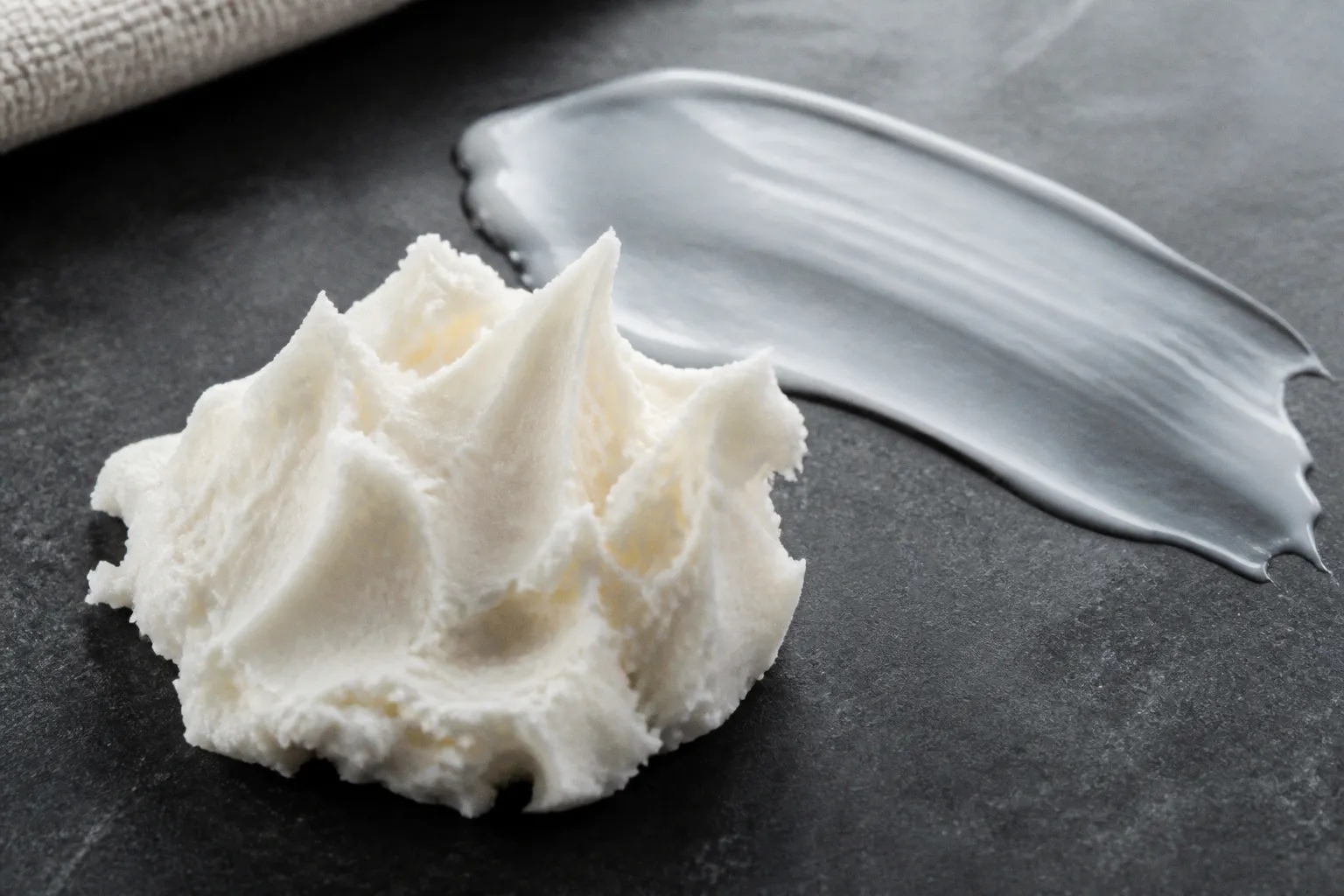
They are different delivery systems with different effects on transepidermal water loss, absorption speed, preservation, and skin feel.
Compare car rental deals in United Kingdom
See available offersPartner link — DiscoverCars comparisonFor dry skin, the choice between whipped body butter and hydrating body lotion depends on the condition of the skin surface, the need for immediate water delivery, and the amount of occlusion required. Lotion supplies a water-based emulsion with humectants and oils. Body butter forms a lipid-rich film that slows moisture loss. One replenishes the aqueous phase of the formula. The other mainly prevents existing water from escaping.
The chemistry of hydration: water-based emulsions versus anhydrous fats
A body lotion is an emulsion. It combines water and oil phases that would otherwise separate. An emulsifier stabilizes the mixture, while humectants such as glycerin attract and bind water within the upper layers of the stratum corneum. Oils and fatty alcohols contribute emollience. The final product is fluid enough to spread across a large body surface and absorb within approximately 1 to 2 minutes.
This structure makes lotion suitable for routine application over extensive areas. It distributes quickly. It leaves less residual lipid on the surface. It also allows the formula to carry ingredients that cannot be incorporated into a pure oil or butter base.
A traditional whipped body butter has a different architecture. The base usually consists of plant fats such as:
- Shea butter, which provides a semi-solid lipid structure and a high degree of occlusive coverage.
- Cocoa butter, which is firm at room temperature and contributes to the hardness of the product.
- Mango butter, which generally produces a lighter, less waxy structure than cocoa butter.
- Liquid plant oils, which adjust spreadability and reduce the drag created by solid fats.
- Antioxidants, such as tocopherol, which help slow oxidation of the oil phase.
Whipping introduces air into the fat system. It changes density and application behavior, but it does not convert the formula into an emulsion. A whipped body frosting can feel lighter during application than a compact butter while remaining chemically oil-dominant.
Body butter does not add water to the skin by default. It reduces water loss from skin that already contains moisture.
This distinction determines how the product should be applied. A dry, waterless skin surface may need an aqueous product or dampness from bathing before a butter can perform effectively. The butter supplies occlusion and emollience. It does not replace the water phase found in a lotion.
The role of humectants, emollients, and occlusives
The word “moisturizer” covers several mechanisms. A reliable formula often combines all three:
- Humectants attract water. Glycerin is a common example in body lotions.
- Emollients fill irregular spaces between corneocytes and improve surface smoothness. Plant oils, fatty alcohols, and esters can perform this function.
- Occlusives form a surface film that slows transepidermal water loss. Dense plant butters, petrolatum, mineral oil, waxes, and certain silicones can contribute to this effect.
Lotion can contain all three categories, but its high water content produces a fluid product with relatively low residue. Whipped body butter is usually strongest in the emollient and occlusive categories. It can soften rough skin and reduce evaporation, but its performance depends on moisture being present beneath the film.
The distinction is useful when evaluating claims such as “deep hydration.” A formula cannot be judged by texture alone. A thick product is not automatically more hydrating in every situation. A thin lotion is not automatically inadequate for dry skin. The ingredient system and application timing matter more than the visual density of the product.
Occlusive power and the skin barrier
Dry skin is commonly associated with increased water loss from the stratum corneum. When the surface barrier is compromised, water escapes more readily. The result can include scaling, tightness, roughness, and sensitivity to cleansing or environmental exposure.
A body butter addresses this problem primarily through occlusion. Its lipid phase forms a continuous or semi-continuous film over the skin. That film slows evaporation. It does not rebuild the skin barrier in a medically defined sense, and it does not permanently correct chronic inflammatory conditions. Its more precise role is to support barrier function by reducing surface water loss and improving flexibility in dry, rough areas.
The performance of a body butter depends on its ratio of solid to liquid lipids. A formula based mostly on cocoa butter can be firm and resistant to spread. A formula with more liquid oil can apply more easily but may provide less persistent surface coverage. Shea butter occupies an intermediate position. It can produce a dense balm-like structure while remaining workable at body temperature.
The fatty-acid profile also affects sensory and functional behavior. Oils high in oleic acid often feel more fluid and spreading. Oils with a greater proportion of saturated fatty acids tend to create a heavier, more stable film. These are formulation tendencies, not universal rules. Processing, crystallization, particle size, and the presence of waxes or esters also change the final product.
Shea, mango, and cocoa butter are not equivalent
The label “body butter” describes a product category, not a standardized formula. The base butter can change the application profile substantially.
| Formula base | Primary structural effect | Typical application profile | Best use in a routine |
|---|---|---|---|
| Shea butter | Semi-solid occlusive and emollient phase | Dense, moderate spread, persistent film | Dry limbs, elbows, knees, hands |
| Cocoa butter | Firmer solid lipid structure | More drag and a longer-lasting coating | Localized rough areas and overnight use |
| Mango butter | Softer, relatively lighter butter phase | Easier spread with less waxy resistance | Full-body application when a dense balm feels excessive |
| Butter plus liquid oils | Reduced hardness and improved slip | Faster distribution, potentially less residual film | Whipped body frosting and warm-weather use |
| Butter-based emulsion | Butter combined with water and emulsifiers | Creamier, more lotion-like behavior | Users who need water delivery with lipid support |
This table describes formulation behavior rather than a ranking. A mango butter product is not automatically superior to a shea body butter. The final result depends on the full ingredient list, not the front-label butter name.
A product can also be marketed as a body butter while containing a substantial water phase. In that case, the formula is an emulsion rather than a traditional anhydrous butter. It may contain humectants and preservatives and may absorb more quickly than a pure butter base. The category name cannot replace the ingredient analysis.
Whipped body cream versus lotion: absorption and daily use
Traditional body butter generally takes around 5 to 15 minutes to fully absorb. The range depends on the amount applied, the temperature of the skin, the lipid composition, and whether the formula contains fast-spreading oils or volatile ingredients.
A body lotion usually absorbs in approximately 1 to 2 minutes. That speed is practical for morning use, hot climates, office routines, and large body areas. It also reduces the likelihood that the user will apply too little because the product feels heavy or slow.
Absorption is not the same as efficacy. A product that disappears quickly may still leave a thin protective film. A product that remains visible may be providing stronger occlusion. The relevant question is whether the remaining film improves the condition of the skin without creating an unacceptable level of residue.
For a practical comparison:
- Choose lotion when the skin requires a water-containing formula, the application area is large, or rapid dressing is necessary.
- Choose whipped body butter when the skin is rough, visibly flaky, or exposed to repeated moisture loss.
- Use a butter-based emulsion when the goal is to combine water, humectants, and lipid occlusion in one product.
- Use both when the skin needs initial hydration followed by a stronger seal.
The most efficient application point is after bathing. Skin should be slightly damp, not actively wet. Applying body butter or lotion at this stage helps retain surface water and improves distribution. The product is then functioning as part of a moisture-retention sequence rather than being asked to create hydration on an entirely dry surface.
Amount controls the result
The same product can feel light or greasy depending on dose. A large amount of a high-fat formula creates a thicker film and extends the time before full absorption. A small amount may spread quickly but fail to cover rough areas consistently.
For full-body use, a lotion is easier to distribute because the water phase reduces viscosity. A whipped butter is more efficient when applied in thin layers. Concentrate on areas with higher roughness or repeated friction rather than applying a thick coating everywhere.
A useful application sequence is:
1. Cleanse with a product that does not leave the skin tight or visibly stripped.
2. Pat the body dry while retaining slight surface dampness.
3. Apply lotion if the skin needs humectants and water-based hydration.
4. Apply a thin layer of whipped body butter over the driest areas.
5. Allow the film to settle before dressing, especially when the butter contains a high proportion of cocoa butter or waxy materials.
This is not a requirement to layer two products every day. It is a way to separate the functions of hydration and occlusion when a single formula does not provide both.
Preservation standards and ingredient integrity
Water changes the microbiological requirements of a cosmetic formula. A water-based lotion can support bacterial or fungal growth if it is not protected by an effective preservative system. That is why lotions require preservation, whether the system uses conventional ingredients such as benzyl alcohol or a naturally positioned system such as radish root ferment.
An anhydrous body butter does not provide the same environment for microbial growth. Without water, bacteria have less available moisture to reproduce. This gives traditional waterless butters a preservation advantage, but it does not make them immune to contamination or degradation.
The main risks for anhydrous products are different:
- Water contamination from wet fingers, shower storage, or contact with damp skin.
- Oxidation of unsaturated oils, producing off-odors and changes in color.
- Heat exposure, which can destabilize the crystal structure of solid butters.
- Repeated temperature cycling, which can produce graininess or uneven texture.
- Poor packaging, which increases exposure to air and handling.
A whipped product also requires attention to packaging. Wide-mouth jars are common because the formula is too dense for a pump. They are practical but expose the product to repeated finger contact. A spatula or clean, dry hands reduce contamination. Storage away from direct heat helps preserve texture.
Preservation and “clean” positioning should not be confused. A waterless butter may contain no conventional preservative because its formula does not require the same antimicrobial system as a lotion. That does not make every waterless product safer, more stable, or more suitable for every skin type. Stability depends on the entire composition and packaging.
The ingredient list reveals the product category
The first ingredients provide a more accurate classification than the marketing name.
A lotion generally shows water near the beginning of the ingredient list, followed by humectants, emollients, emulsifiers, thickeners, and preservatives. A traditional body butter usually begins with plant butters and oils. If water appears near the beginning, the product is likely an emulsion, even if the package calls it a butter.
Look for the following formulation signals:
- Water, aqua, or hydrosols near the top: a water-based or water-dominant formula.
- Glycerin or other humectants: a formula designed to bind water.
- Glyceryl stearate, cetearyl alcohol, or similar emulsifying materials: structural support for an emulsion.
- Shea, cocoa, mango butter, or oils at the top: a lipid-dominant product.
- Benzyl alcohol, dehydroacetic acid, sorbates, or other preservative systems: evidence that the formula requires microbial protection.
- Tocopherol: commonly used as an antioxidant in oil-based formulas, although it is not equivalent to a broad-spectrum preservative.
No single ingredient determines the entire performance. A lotion may be highly occlusive if it contains a strong film-forming phase. A butter may feel relatively dry if it contains fast-spreading esters or a high proportion of liquid oils.
Strategic layering for deep skin moisturization
The most reliable approach to dry skin is often sequential rather than product-exclusive. A water-based lotion can provide the aqueous component and humectants. A body butter can then reduce transepidermal water loss by placing a lipid film over the surface.
This strategy is particularly relevant for skin that feels dry again shortly after applying lotion. The issue may not be that the lotion lacks hydration. Its film may simply be too light for the rate of water loss or the environmental conditions. Adding an occlusive layer can extend the effect.
The reverse sequence is less logical. Applying lotion over a thick layer of body butter can be difficult because the lipid film limits contact between the water-based product and the skin. If both products are used, apply the lotion first and the butter second.
Lotion supplies a water-containing emulsion. Body butter controls evaporation. Layering works when each product keeps its own function.
A practical pairing looks like this:
| Skin condition or routine | First step | Second step | Reason |
|---|---|---|---|
| Mild daily dryness | Lightweight lotion | None or a small amount of butter on elbows and knees | Limits residue while addressing localized roughness |
| Flaking after bathing | Hydrating lotion on damp skin | Whipped body butter over dry zones | Adds humectant support and stronger occlusion |
| Very rough heels or elbows | Lotion or damp skin preparation | Dense butter applied at night | Extends contact time and reduces water loss |
| Hot or humid climate | Fast-absorbing lotion | Butter only where needed | Prevents excessive surface residue |
| Cold, dry climate | Lotion over damp skin | Full-body or targeted body butter | Increases protection against environmental water loss |
| Sensitivity to heavy textures | Emulsion-style body butter | No additional layer initially | Combines water and lipid phases in one application |
This approach also prevents a common error: treating the heaviest product as the default solution for every dryness pattern. More occlusion is not always more useful. A dense formula can be difficult to spread, uncomfortable under clothing, or excessive on areas that are not significantly dry.
Body butter or lotion for dry skin: the decision point
The choice should be based on the dominant limitation in the routine.
If the skin lacks a water-based step, a lotion is the more direct starting point. Its water phase and humectants address hydration while its oil phase reduces some surface loss. If the skin receives lotion but remains rough, tight, or visibly flaky, a richer occlusive product may be necessary.
The following distinctions are more useful than judging texture by appearance:
- Dry but smooth skin often responds to regular lotion applied after bathing.
- Rough or scaling skin may need a richer emollient and stronger occlusion.
- Skin that becomes tight immediately after cleansing may require a gentler cleanser and a prompt moisturizing step.
- Skin exposed to frequent handwashing may benefit from repeated lotion application with targeted butter at night.
- Persistent inflammation, cracking, or severe itch should not be treated as a simple cosmetic hydration problem.
A body butter can support a dry-skin routine, but it does not permanently cure eczema or other chronic skin disorders. It also should not be used to conceal a reaction to fragrance, essential oils, preservatives, or botanical extracts. If application consistently produces burning, redness, or worsening itch, discontinuation is more appropriate than increasing the dose.
The current preference for whipped body frosting
Whipped body frosting remains popular because it changes the handling properties of a high-fat formula. Air incorporation produces a larger volume and a softer scoop. This can make a dense butter easier to distribute across the body.
The underlying chemistry remains important. A whipped product can collapse under heat, separate if the oil system is poorly balanced, or become grainy after repeated temperature changes. Its apparent lightness does not necessarily indicate low occlusive strength. The product may still contain a high concentration of solid and liquid lipids.
Consumers should distinguish between:
- Whipped anhydrous butter: no water, no emulsion, primarily lipids.
- Whipped body cream: may be an aerated emulsion containing water, emulsifiers, humectants, and preservatives.
- Body frosting: a marketing term that can describe either structure.
- Butter lotion: often an emulsion with a meaningful butter fraction, not a pure butter base.
The label terminology is therefore insufficient. Texture, ingredient order, and preservation requirements provide a more reliable classification.
For makers, adding water to a pure shea butter base without redesigning the formula is a fundamental error. Water requires emulsification, microbial control, compatible packaging, and stability testing. A mixture of butter and water that has been stirred by hand is not automatically a safe body cream. It may separate, develop uneven preservation, or support microbial growth.
A strict do-and-don’t guide
Do
- Apply lotion or body butter to slightly damp skin after bathing.
- Use lotion when humectants and a water phase are needed.
- Use whipped body butter when the primary requirement is occlusion and reduced TEWL.
- Read the ingredient list instead of relying on terms such as frosting, cream, or butter.
- Layer lotion first and butter second when both are required.
- Store anhydrous butter away from heat and direct light.
- Keep water out of wide-mouth jars and use clean, dry hands.
- Treat shea, mango, and cocoa butter as different structural materials, not interchangeable labels.
- Use targeted application on elbows, knees, heels, and other rough areas when full-body occlusion is unnecessary.
Don’t
- Do not assume that a thick butter adds water to dehydrated skin.
- Do not assume that every body butter is water-free.
- Do not apply a heavy butter over untreated wet skin and call the result hydration.
- Do not treat a water-containing homemade mixture as preserved simply because it contains plant ingredients.
- Do not interpret fast absorption as proof that a lotion is more effective.
- Do not interpret prolonged greasiness as proof of superior moisturization.
- Do not use cosmetic body butter as a treatment for persistent inflammatory skin disease.
- Do not ignore rancid odor, visible separation, or texture changes in an oil-based product.
The comparison between whipped body butter vs hydrating body lotion is not a contest between a superior and inferior product. Lotion is an aqueous emulsion designed for distribution, humectant support, and rapid daily use. Whipped body butter is usually a lipid-dominant system designed to reduce evaporation and reinforce the surface film.
For mild dryness, lotion may be sufficient. For rough, high-loss areas, body butter provides stronger occlusion. For more demanding conditions, the most technically sound routine is often lotion on slightly damp skin followed by a thin layer of butter where the barrier needs additional protection. The correct product is the one whose formulation matches the missing function: water delivery, emollience, or control of transepidermal water loss.