Melted whipped body butter: how to fix the texture
Melted whipped body butter often looks ruined before you touch it. The jar that once held a cloud-like body frosting may now contain a dense, glossy layer with a lower fill line and a completely different viscosity.
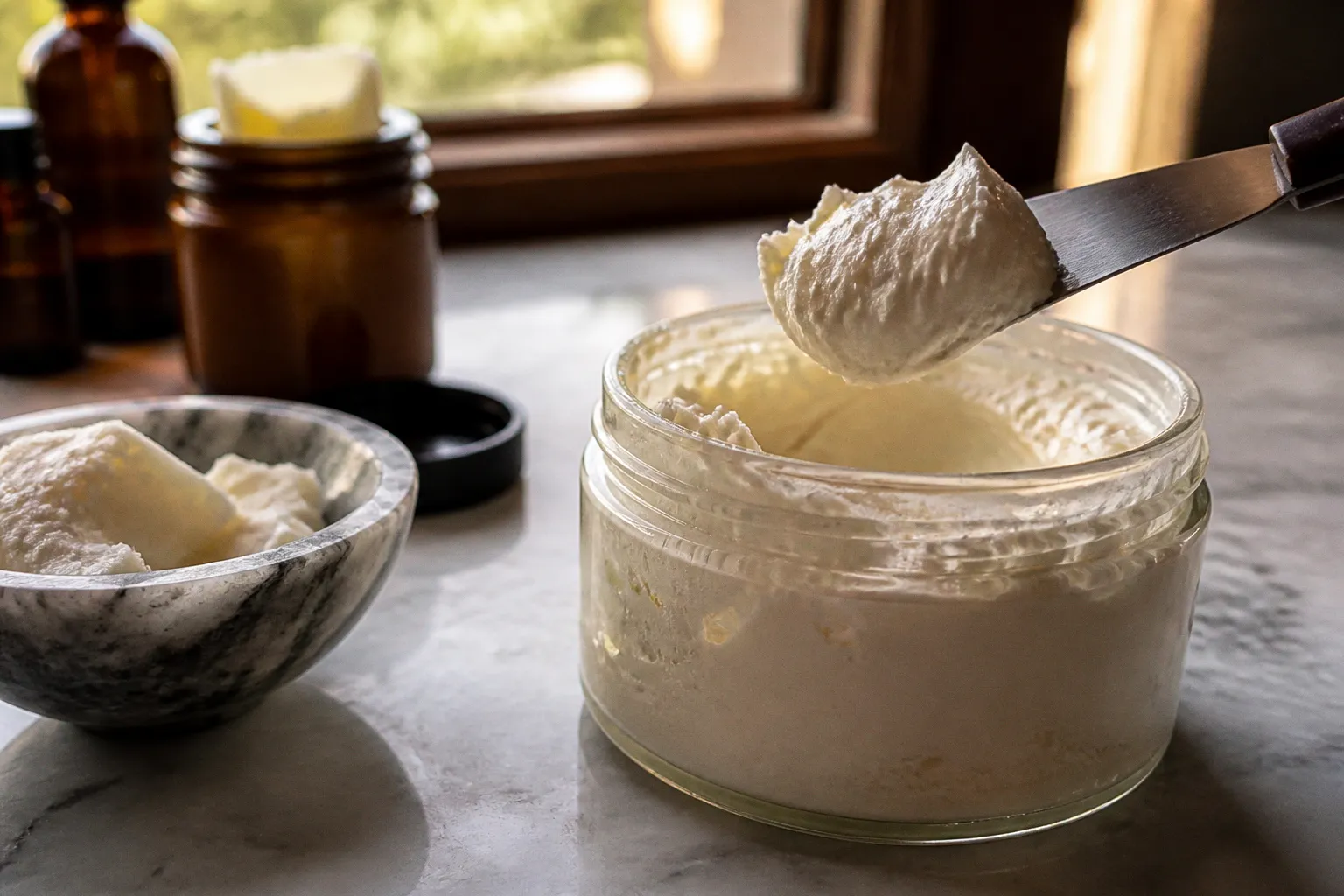
If it softened in a hot bathroom, sat in a delivery box, or travelled in a warm car, the first instinct is usually to discard it.
For a true anhydrous body butter made from plant oils and butters, that is usually unnecessary. Melting changes the structure and volume, not the moisturizing function of the lipid blend. The trapped air escapes as the butter liquefies, so the product becomes smaller-looking and heavier in texture even though the total amount has not disappeared.
The practical answer is melted whipped body butter restoration: fully liquefy the product, cool it quickly and evenly, then whip air back into the semi-solid base. The order matters. Slow cooling can create graininess, while whipping while the mixture is still too warm produces a soft, unstable frosting that collapses again.
The science of melting: why your butter lost its volume
Whipped body butter is not naturally fluffy in the way a baked frosting is fluffy. Its volume comes from air incorporated into a concentrated blend of solid butters and liquid carrier oils. During whipping, the semi-solid base holds thousands of small air pockets. Those pockets give the product its characteristic lift, pale appearance, and spoonable viscosity.
Heat disrupts that structure.
As the butter warms, the solid fat phase begins to soften. The air pockets merge and escape, and the material settles into a compact mass. Once enough of the butter has liquefied, the jar may appear only partly full. This can be alarming, but the apparent loss is mostly a change in volume. The total weight of the product remains unchanged unless some of it has actually spilled or adhered to the packaging.
A melted whipped body butter may therefore feel:
- denser and more oily on the skin;
- glossy rather than matte;
- less expansive when scooped;
- slower to absorb because the butter phase is no longer aerated;
- firmer or grainier after cooling, depending on how the fatty acids crystallize.
That last point is especially relevant. The final texture is not determined only by whether the product melted. It is also shaped by how it solidified afterward.
Natural body butters without water or chemical stabilizers begin to soften when the surrounding temperature rises above approximately 80°F, or 26.6°C. A parcel left in a warm delivery vehicle can cross that threshold easily, even if the product arrives in an otherwise undamaged container. Shea butter and cocoa butter have higher overall melting ranges than the ambient threshold at which a finished whipped blend may begin to soften, because the liquid oils in the formula lower the structure’s resistance to heat.
A jar that looks less full after melting has usually lost air, not product.
The texture loss is cosmetic and structural. In a properly formulated anhydrous butter, melting does not by itself remove the plant oils’ fatty acids, vitamins, or emollient value.
Why melting does not ruin your body butter
The word “melted” carries a sense of failure, particularly with botanical products that are often sold for their handmade character. But heat exposure and spoilage are not the same event.
For a waterless blend of shea butter, mango butter, cocoa butter, and carrier oils, melting is a phase change. The ingredients move from a semi-solid or solid arrangement into a liquid one. When the blend cools, the fats solidify again. The butter has lost its whipped architecture, but not automatically its function as an emollient.
This is why restoring melted shea body butter is primarily a texture project. The goal is not to rescue an inactive product. The goal is to rebuild the air-filled structure while encouraging the fat crystals to form with a smoother, more uniform pattern.
There are still sensible boundaries:
- If water, aloe, hydrosols, or another aqueous ingredient is present, you are dealing with an emulsion or cream rather than a simple body butter. Its preservation system and stability profile are different.
- If the product has visible mold, an unusual fermented odor, contamination, or a damaged container, re-whipping is not an appropriate remedy.
- If the butter has been exposed to prolonged, intense heat, the olfactory notes may shift even when the moisturizing properties remain.
- If fragrance or essential oils are present, repeated heating can soften or alter the aromatic profile.
A clean, waterless butter that has liquefied in transit is a different situation from a cream that has separated. The label language matters. “Whipped body butter,” “body frosting,” and “body balm” generally describe an oil-based product, but formulas vary. If the ingredient list includes water, the product should not be treated as a simple whipped butter.
The role of fatty acids in shea and cocoa butter stability
The behavior of a body butter comes from its lipid profile, not from one ingredient in isolation. Shea butter is a useful example because it contains fatty acids with different melting points. In typical high-quality unrefined shea butter, oleic acid makes up approximately 43–56%, while stearic acid accounts for roughly 31–45%.
Oleic acid contributes a softer, more fluid quality. Stearic acid provides more body and firmness. When these components cool at different rates, they may crystallize separately rather than forming one smooth network. That is the origin of the small, waxy or sandy sensation often called graininess.
Cocoa butter behaves differently. Its overall melting range is typically around 93–101°F, or 33.8–38.3°C, and it contributes a firmer, more structured feel to a formula. It can help a whipped body frosting hold its shape, but the complete formula still depends on the carrier oils, butter ratios, particle size, and cooling history.
Mango butter usually sits between a soft, cushiony butter and a more structured solid phase, depending on the grade and processing method. A blend high in liquid oils may melt and collapse more readily than a formula built around cocoa butter or a larger proportion of firm butters.
Here is the practical difference between the two common restoration approaches:
| Cooling approach | What it does | Likely texture result |
|---|---|---|
| Slow cooling at room temperature | Allows different fatty acids to solidify at their own pace | Greater chance of graininess or uneven firmness |
| Rapid cooling in a refrigerator | Encourages the blend to solidify more uniformly | Smoother base, ready for controlled re-whipping |
| Rapid cooling in a freezer | Quickly moves the product into a semi-solid state | Useful for badly melted butter, but requires close attention |
| Cooling in an ice bath | Pulls heat from the container without direct freezer exposure | Effective when you want more control over the solidification rate |
| Whipping while warm and liquid | Incorporates little lasting air | Soft, collapsed texture that may not hold |
| Re-whipping after partial solidification | Builds air into a stable fat network | Closest result to the original whipped texture |
The precise melting point of a finished commercial formula cannot be predicted from one butter alone. The ratio of liquid carrier oils to solid fats, the presence of waxes, and the manufacturing process all affect viscosity. That is why one body frosting may soften in a warm room while another remains scoopable at the same temperature.
How to fix melted body butter without making it grainy
The most reliable method is simple, but it requires patience between the heating and whipping stages. If the product is already fully liquid, do not try to whip it immediately. Liquid oil cannot hold the same volume as a semi-solid base.
1. Inspect the product before working with it
Look at the texture, scent, and container. If the butter merely melted and settled, it is a good candidate for restoration. If it smells rancid, has visible contamination, or contains water and appears separated, stop there and follow the manufacturer’s guidance.
A mild change in scent after heat exposure does not necessarily mean the product is spoiled, but delicate olfactory notes can become less distinct. Citrus top notes, in particular, tend to feel more fleeting than deeper notes such as vanilla, woods, or resinous materials.
2. Melt the entire batch evenly
Partial melting creates a poor base for re-whipping. The solid edges may contain a different crystal structure from the liquid center, and those zones can remain lumpy after cooling.
Place the jar or the product in a heat-safe vessel and warm it gently until the entire mixture is uniform. If using a microwave, use short intervals of approximately 10 seconds, stirring between each interval. The purpose is not to make the butter hot; it is to remove solid pockets without excessive heat.
A double boiler offers finer control. Keep the water warm rather than aggressively boiling, and avoid allowing water droplets or steam to enter the product. Anhydrous formulas contain no water phase, so accidental water introduction can change the preservation needs and shorten the product’s practical stability.
Once completely fluid, stir slowly to distribute the carrier oils and melted butters. Avoid vigorous agitation at this stage. You are creating an even lipid base, not incorporating air yet.
3. Cool it quickly and evenly
Transfer the melted butter to a clean, suitably sized mixing bowl. A wide, shallow vessel cools more evenly than a tall jar because the layer is thinner and more surface area is exposed.
Use one of these options:
- Refrigerate for approximately one to two hours, checking periodically.
- Place in the freezer for roughly 15–30 minutes when the product is very fluid and needs rapid cooling.
- Set the bowl over an ice bath, taking care that no water enters the butter.
The target is not a hard block. You want a semi-solid consistency: opaque or just beginning to turn opaque, firm enough to leave a ridge when stirred, but soft enough for a mixer to move through it.
Rapid cooling matters because it encourages the different fatty acids to solidify more simultaneously. That reduces the likelihood that one fraction forms coarse crystals while another remains soft and oily. Do not leave the butter unattended in the freezer for so long that it freezes into a solid mass around the edges and remains liquid in the center.
4. Re-whip the semi-solid base
Use an electric hand mixer or stand mixer. Begin at a low speed to break up the chilled mass, then increase gradually as the texture becomes smoother.
Whip until the mixture lightens in color and gains volume. The exact duration depends on the formula and the quantity, so watch the texture rather than following a rigid time. Scrape the sides of the bowl occasionally so the firm and soft portions return to the same mixing zone.
The restored product may not have exactly the original loft. Repeated melting and cooling can change the crystal network, and a formula with a high proportion of liquid oil may always produce a softer frosting after restoration. Still, a proper chill-and-whip process should return much of the airy, scoopable character.
5. Fill and allow the butter to settle
Spoon the whipped butter into its container without compressing it heavily. Excessive packing removes the air you have just incorporated.
Let it rest in a cool, stable environment before use. Once it has regained its structure, keep the jar away from radiators, sunny windows, hot shower steam, and warm vehicles. A bathroom shelf may be convenient, but it is often one of the least stable locations for a natural whipped product.
The crucial moment is not the whipping itself. It is the transition from fully liquid to semi-solid.
Why the freezer can help—and when it can work against you
Freezing is useful when a whipped body cream melted in the mail and arrives as a liquid pool. It rapidly removes heat and can limit the period in which the fatty acids crystallize separately. But cold is not a substitute for observation.
A shallow container may become semi-solid in the freezer within 15 minutes, while a full jar takes longer. The outer layer may harden before the center has cooled. If you begin whipping at that point, the mixer will break up cold edges and drag liquid from the middle into an uneven paste.
For the cleanest result, check the product every few minutes. Stir or scrape only if the edges are setting substantially faster than the center. Once the texture is uniformly semi-solid, remove it and begin whipping.
Do not attempt to whip a fully frozen block. Let it soften slightly at room temperature or allow the mixer to work at a low speed once the surface yields. Forcing a solid block through a high-speed mixer can strain the equipment and leave a coarse texture.
The refrigerator is slower but often more forgiving. It gives you a broader window between liquid and semi-solid, particularly when working with a small batch. The freezer is most useful when the product has been completely liquefied and needs a fast, controlled return to structure.
Restoring texture according to the formula
Not every butter responds in exactly the same way. The primary ingredients establish firmness; secondary ingredients influence slip and spread; trace ingredients shape the sensory finish and scent.
Primary ingredients: the structural phase
These are usually shea butter, cocoa butter, mango butter, kokum butter, or another solid botanical butter. They determine much of the product’s body, melting behavior, and post-cooling firmness.
A formula rich in shea butter may feel creamy and yielding, with a soft melt on contact with warm skin. Its oleic and stearic acid balance gives it both glide and structure, but it can also be more sensitive to crystallization differences after melting.
Cocoa butter generally brings more firmness and a slightly longer melt on the skin. Its characteristic aroma may remain noticeable in an unrefined formula, adding a warm, chocolate-like olfactory note. If the cocoa butter proportion is high, the restored butter may set firmer than it did before, especially after rapid cooling.
Mango butter often contributes a smooth, less aromatic finish. It can be helpful in blends where the formulator wants body without an assertive scent, although the final viscosity still depends on the carrier phase.
Secondary ingredients: the carrier phase
Liquid oils such as jojoba, sunflower, olive, sweet almond, apricot kernel, or fractionated coconut oil soften the butter network and change spreadability. They also determine how quickly the product disappears into the skin.
A high carrier-oil ratio may create a silky, fast-spreading body butter, but it also lowers heat resistance. After melting, that kind of product may need a longer refrigeration period before it can hold air again.
Jojoba is technically a liquid wax ester rather than a traditional triglyceride oil, and it can lend a smooth, elegant slip. Fractionated coconut oil is light and low in viscosity, while olive oil tends to create a richer, more enveloping finish. None of these carriers can restore volume on their own; they need a stable solid-fat network around them.
Trace ingredients: the sensory signature
Fragrance, essential oils, botanical extracts, vitamin E, and other minor components may represent a small portion of the formula, but they influence the experience. Heat may soften the distinction between olfactory notes, particularly in a delicate blend.
When re-melting a scented butter, use the lowest practical temperature and avoid prolonged holding at heat. The aim is to liquefy the structural ingredients, not to cook the aromatic phase. If you are formulating from scratch rather than restoring a finished product, add heat-sensitive aromatic materials after the base has cooled sufficiently, following the safety limits appropriate to each material.
The synergy of the blend is felt in use: the initial slip from the carrier oil, the cushion from the shea or mango butter, and the slower occlusive finish from a firmer butter. Texture restoration should preserve that progression rather than turning the product into a hard wax or a thin oil.
Preventing whipped body butter from melting in the first place
Restoration is useful, but prevention protects the texture you paid for and the formulator worked to build. A whipped butter is more vulnerable to heat than a compact balm because its aerated structure has more room to collapse.
For storage and shipping, choose conditions that keep the product below its softening threshold whenever possible. This does not mean placing every jar in a refrigerator. Excessive cold can make application unpleasantly hard, and repeated temperature cycling is not ideal for a whipped structure.
A stable, cool cupboard is usually better than a windowsill or a steamy bathroom. During warm-weather shipping, insulated packaging and cooling materials can reduce the chance that a parcel spends several hours above approximately 80°F. Once received, let the jar reach room temperature gradually if it has arrived very cold, then store it away from direct heat.
If your product routinely melts, the formula may need a different balance rather than a stronger marketing promise. A formulator might adjust:
- the proportion of firm butter to liquid carrier oil;
- the choice between shea, mango, cocoa, or kokum butter;
- the whipping temperature and duration;
- the cooling profile after whipping;
- the jar size and fill depth;
- the packaging used during warm-weather delivery.
The solution is not always to add more solid butter. Too much cocoa or kokum butter can create drag, waxiness, or a hard surface that melts unevenly on contact with skin. The best viscosity is a controlled compromise between thermal stability and sensory elegance.
What to expect after restoration
A successfully restored butter should be smooth, aerated, and easy to scoop. It may appear lighter in color than the melted version because air has been reintroduced. When applied, it should spread from a soft, dense cream into a thin lipid veil as body heat warms the butter.
Do not expect the jar to look as full as it did before the first melt unless new product is added. Whipping can recover volume, but it cannot always recreate the original distribution of air. The perceived fill level may change again as the butter settles during storage.
Repeated thermal cycles also deserve restraint. The exact effect on shelf life depends on the proprietary formula, packaging, contamination exposure, and the number and intensity of the cycles. There is no universal deduction to apply to every product. Keep the lid closed, use clean hands or a spatula, and follow the maker’s stated period-after-opening guidance.
If the restored butter develops graininess, it does not necessarily mean the ingredients have degraded. It usually indicates uneven crystallization. You can attempt the process again: melt the complete batch until uniform, cool it rapidly and evenly, then whip only once it reaches the right semi-solid stage. If the texture remains sandy after a second attempt, the formula’s crystal behavior may simply be resistant to a perfectly smooth reset.
The precise route back to a whipped texture
When a natural whipped body butter melts, treat it as a phase-change problem rather than a failed product. First confirm that it is a waterless butter with no signs of contamination. Then melt the entire batch gently and evenly, using short 10-second microwave intervals or controlled indirect heat. Cool it quickly in the refrigerator, freezer, or ice bath until it becomes uniformly semi-solid. Finally, re-whip with an electric mixer, scraping the bowl as needed, and return it to a cool, stable place.
The key is coordination between temperature and viscosity. Liquid butter cannot hold the air you want; a frozen block cannot accept it smoothly. The most responsive window is the cool, yielding stage where the lipid network has begun to reform but still gives way to the whisk.
That is where the original body frosting can return: not exactly by reversing time, but by giving the shea butter, cocoa butter, carrier oils, and air a better chance to work together again.