Body Butter Bases: Shea, Cocoa, or Mango for Your Skin?
Cocoa butter scores 3–4 on the comedogenic scale, while shea and mango butter generally fall between 0 and 2. That difference changes where each base belongs in a body-care formula. Cocoa butter is highly occlusive and structurally firm.
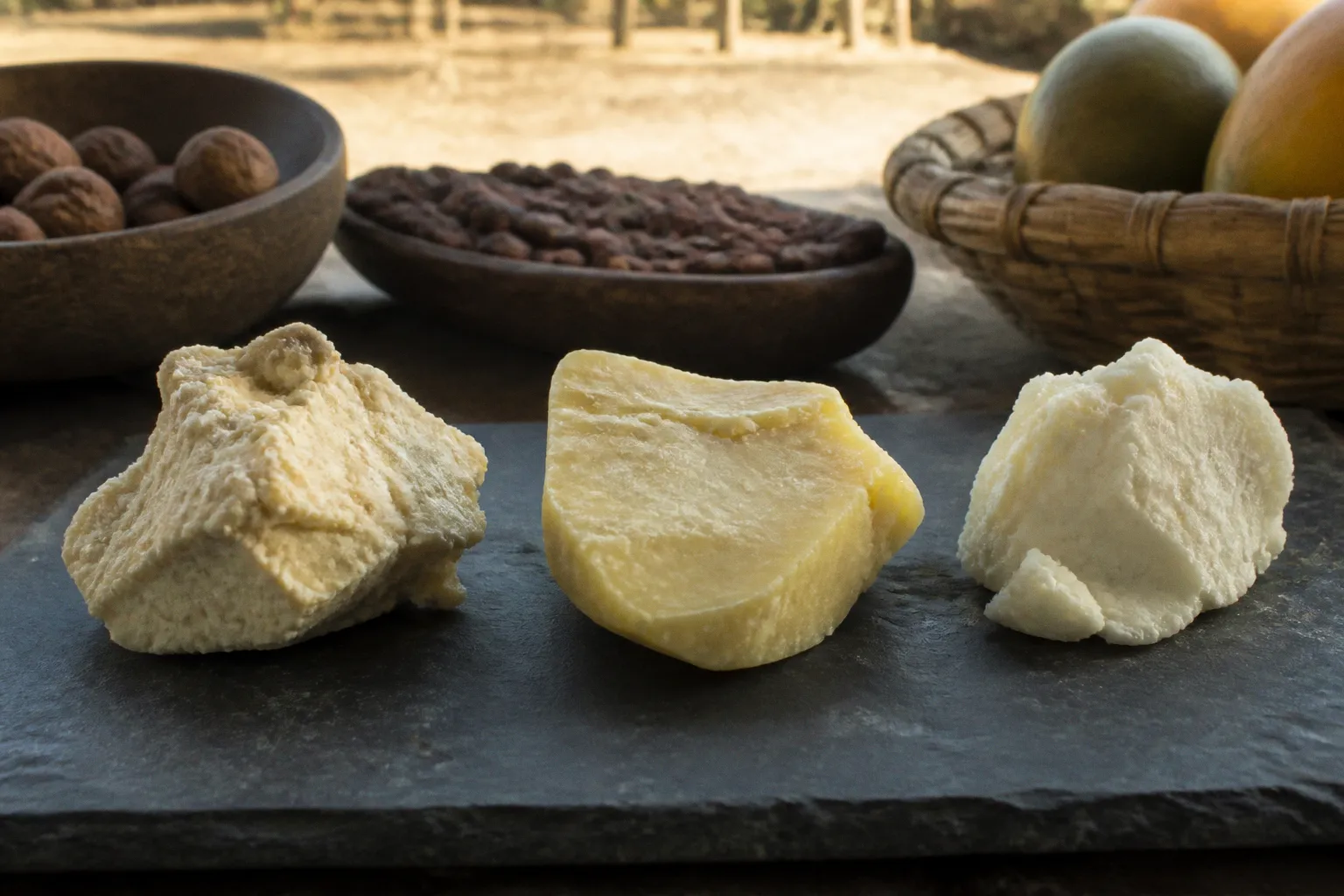
Shea butter provides occlusion with a higher unsaponifiable fraction. Mango butter has a lower-grease sensory profile and a fatty acid balance that supports faster absorption.
Compare car rental deals in United Kingdom
See available offersPartner link — DiscoverCars comparisonThe choice in a shea vs cocoa vs mango body butter comparison is therefore not a matter of which ingredient is universally best. It is a formulation decision. Skin surface, application area, climate, product format, and tolerance for residue all matter. A body frosting designed for heels should not use the same butter balance as a daily cream intended for the chest or upper back.
The science of occlusion: why the base changes performance
Body butters are primarily occlusive systems. They form a lipid layer over the stratum corneum and reduce the rate at which water leaves the skin. That water loss is known as transepidermal water loss, or TEWL.
A butter does not add water to the skin in the same way as an emulsion containing an aqueous phase. It slows evaporation. This distinction is central. A pure anhydrous body butter can reduce surface dryness when applied over slightly damp skin because it helps retain existing water. Applied to completely dry skin, it mainly provides lubrication and an occlusive film.
The physical behavior of that film depends on several variables:
- Melting point: Determines whether the butter remains firm in the jar or softens immediately on contact with skin.
- Fatty acid profile: Influences spreadability, slip, residue, and the physical structure of the product.
- Unsaponifiable fraction: Contains lipid-soluble compounds that remain after saponification and can contribute to the biological profile of the butter.
- Comedogenic rating: Provides a rough indication of pore-clogging potential, although it is not a universal clinical prediction for every person or body area.
- Oxidative stability: Affects shelf life and the development of rancid odor, especially when the butter is blended with liquid carrier oils.
- Whipped structure: Changes density and application volume without changing the underlying fatty acid composition.
Shea and cocoa butter both soften at body temperature. Shea butter has a melting point of approximately 31–38°C, while cocoa butter melts at about 34–38°C. Both can therefore be spread directly across the skin without a separate heating step. Mango butter is commonly used when the formulator wants a lighter, less waxy profile, but its exact behavior depends on processing and the rest of the formula.
Comedogenic ratings are a filter, not a verdict
The comedogenic scale runs from 0 to 5:
| Rating | General interpretation | Practical use |
|---|---|---|
| 0 | Low clogging potential | Often selected for sensitive or blemish-prone areas |
| 1–2 | Low to moderate potential | Usually suitable for many body-care formulas |
| 3–4 | Moderate to high potential | Better reserved for dry, thick, or less congestion-prone areas |
| 5 | High potential | Requires narrow, location-specific use |
This scale should not be treated as a direct measurement of how every finished product behaves. A butter is not used in isolation. Its concentration, particle structure, application frequency, occlusive strength, and combination with other oils all alter the final result.
Cocoa butter’s 3–4 rating makes it a poor default for acne-prone skin, especially when the formula is used on areas such as the upper back, chest, or shoulders. The same characteristic that makes it problematic in congestion-prone areas can be useful on heels, elbows, knees, and other regions with a visibly thickened or cracked surface.
Shea and mango butter, both rated around 0–2, provide more flexibility. That does not make every shea or mango product non-comedogenic. A finished body butter may also contain coconut oil, wheat germ oil, fragrance materials, or other components that change tolerance.
Occlusion is not a defect. It is a dosage problem. The right butter in the wrong body area still produces the wrong formula.
Shea butter: the broadest option for barrier-focused body care
Shea butter is the most versatile of the three bases for a rich body butter. It offers occlusion, a softening melt profile, and a relatively low comedogenic rating. It is also distinguished by a high unsaponifiable fraction of approximately 6–17%.
That fraction includes triterpenes, phytosterols, and vitamins A, E, and F. These components are part of the reason shea butter is used in formulas aimed at dry, compromised, or reactive skin. The ingredient is associated with skin-conditioning and anti-inflammatory activity, but the finished product still depends on concentration, processing, and the condition of the skin barrier.
Where shea butter performs well
Shea is a strong base for:
- Dry legs and arms with visible scaling.
- Skin exposed to cold, low-humidity air.
- Body creams designed for regular use.
- Barrier-support products that need more substance than a lotion.
- Sensitive skin formulas that avoid a high comedogenic load.
- Whipped body butter with a soft, scoopable texture.
Its melting range of 31–38°C allows shea butter to soften during application. In a well-structured whipped formula, this produces a dense but spreadable product. If the formula is not cooled correctly during crystallization, the butter can develop a grainy texture. That texture is a physical stability issue, not evidence that the ingredient has degraded.
Shea butter can be used in an anhydrous body frosting or in an emulsion. These are different product types. A pure whipped butter contains no water phase. A body cream contains water, emulsifiers, humectants, and a preservative system. The word “cream” is not a reliable indicator of composition.
Refined versus unrefined shea
Processing affects color, odor, and some minor constituents. Unrefined shea generally retains more of its characteristic unsaponifiable material, while refined grades provide a more neutral appearance and odor. Neither description alone determines whether the product is suitable for sensitive skin.
Fragrance is often the more relevant variable for reactive users. A product can use unrefined shea and remain poorly tolerated if it also contains a high fragrance load. Conversely, a refined shea formula can be well tolerated if the rest of the ingredient list is controlled.
For a daily body moisturizer, shea is usually the most balanced starting point when the target is dry skin without an intentionally heavy, wax-like finish.
Cocoa butter: maximum structure and targeted occlusion
Cocoa butter is harder and more structurally rigid than shea. It melts at approximately 34–38°C, which explains its behavior in a jar and on the skin. At room temperature, it can provide firmness and shape retention. During application, body heat softens the butter and allows it to form a persistent lipid film.
This is the main cocoa butter benefit for skin: high occlusive performance with physical structure. It is useful when the formula must remain dense and when the user wants a product for areas with substantial dryness.
The limitation is its comedogenic rating of 3–4. Cocoa butter is not the appropriate default for acne-prone skin. It may be suitable for heels, elbows, knees, and other dry body areas where pore congestion is less relevant, but it should be selected cautiously for the chest, shoulders, and upper back.
Cocoa butter is better as a targeted base
Cocoa butter makes sense when the product brief requires:
- A firm balm or body butter.
- Extended surface occlusion.
- A formula for thickened, rough areas.
- A lower-slip product with stronger structural integrity.
- A protective layer for heels, elbows, and knees.
It is less suitable when the brief requires:
- A fast-absorbing daily cream.
- A low-residue formula for acne-prone body skin.
- A light product for humid climates.
- A body butter intended for broad application across the chest and back.
Cocoa butter can also dominate the texture of a whipped product. A high proportion may produce a stiff or brittle frosting that collapses unevenly as it warms. The formula may look airy in the jar but spread as a dense film. That is not necessarily a stability failure. It is a consequence of the solid-fat network and the ratio of cocoa butter to liquid oils.
The unknown is often the exact concentration. A product marketed as cocoa body butter may contain cocoa butter as the primary base, or only as one component in a blend. The front label does not provide enough information to estimate the actual occlusive load. The ingredient list is more useful.
Mango butter: a lighter route to rich moisturization
Mango butter is frequently chosen when a formula needs body and softness without the heavier residue associated with cocoa butter. It has a comedogenic rating of approximately 0–2, which gives it broader use across different body areas.
Its fatty acid profile is relatively balanced:
- Stearic acid: approximately 40–45%.
- Oleic acid: approximately 38–42%.
Stearic acid contributes to structure and a more substantial texture. Oleic acid contributes to spreadability and a softer application profile. The result is a butter that can feel rich in the jar but less persistent on the skin than a cocoa-dominant formula.
This makes mango butter a practical base for daily body care, particularly when the user wants deep moisturization without a thick residual film. It is also a useful option for people who dislike the drag or rigidity of some cocoa butter products.
Mango butter versus shea butter skincare
The difference between mango and shea is not simply light versus heavy. Both can be used in rich products, and both have low comedogenic ratings. Their practical distinction lies in the balance between structure, spread, and minor lipid components.
Shea contains an unsaponifiable fraction of approximately 6–17%. Mango butter contains approximately 1–2%. This does not make one universally superior. It means the two ingredients bring different compositional profiles to a formula.
Mango butter may be the better starting point when:
- The body butter must absorb with less residue.
- The formula targets daily use rather than spot occlusion.
- The user dislikes strong surface greasiness.
- The product is intended for areas with a higher risk of congestion.
- The formula already contains heavier oils or waxes.
Shea may be preferable when:
- The skin is visibly dry or rough.
- The product must remain soft and cushion-like.
- Barrier support is the primary formulation objective.
- The user needs a richer product for repeated application.
- The formula contains fewer other unsaponifiable-rich ingredients.
Unrefined mango butter should not be expected to smell like sweet mango fruit. Its aroma is generally neutral to faintly earthy. A strong fruit scent usually comes from fragrance or flavor materials rather than from the butter itself.
Matching the butter to the skin and the body area
The phrase “best body butter base for dry skin” is incomplete without specifying where the product will be used. Dryness and congestion can exist at the same time. A person may have rough shins and acne-prone shoulders. One butter base does not need to serve both areas.
| Skin or body-care need | Most suitable starting point | Why | Main limitation |
|---|---|---|---|
| Rough heels and elbows | Cocoa butter | High occlusion and firm structure | Comedogenic rating of 3–4 |
| Dry legs and arms | Shea butter | Balanced richness and low rating of 0–2 | Can feel too substantial in humid conditions |
| Daily body moisturizer | Mango or shea butter | Lower congestion potential with useful spread | Mango may feel less persistent on very rough skin |
| Acne-prone shoulders or chest | Mango butter | Lower comedogenic rating and lighter finish | Avoid assuming the complete formula is non-comedogenic |
| Barrier-focused body butter | Shea butter | High unsaponifiable fraction and softening melt profile | Texture depends heavily on processing |
| Dense spot balm | Cocoa butter blended with lighter components | Maintains structure while reducing drag | Ratio must be controlled to avoid excessive stiffness |
A more precise selection method uses four variables:
1. Surface condition. Scaling and fissures require stronger occlusion than mild tightness.
2. Pore congestion. The upper back, chest, and shoulders need a different lipid strategy from the heels.
3. Application frequency. A product used once weekly can be more occlusive than one applied twice daily.
4. Climate and clothing. A dense butter behaves differently under humid conditions or beneath tight garments.
Body butter should usually be applied in a thin layer. Increasing the amount does not proportionally increase barrier support. It mainly increases residue, transfer to clothing, and the probability of discomfort.
The formulation error that changes everything
One of the most common mistakes in homemade whipped body butter is adding water to a pure butter-and-oil base without adding an appropriate preservative system.
Water changes the product category. It introduces an aqueous phase that can support microbial growth. A preservative is not optional simply because the product contains shea, cocoa, or mango butter. The butter itself does not protect an emulsion from contamination.
A stable water-containing body cream requires more than a preservative added at the end. It needs:
- A suitable emulsifier.
- Correct heating and cooling phases.
- Controlled pH.
- A preservative compatible with the formula.
- Adequate mixing and packaging.
- Stability and microbial testing appropriate to the product.
A pure anhydrous body butter has a different risk profile. Its main stability concerns are oxidation, contamination from wet fingers, and physical changes such as graininess or oil separation. Product life cannot be assigned universally because carrier oils alter oxidation rates. A mango butter formula with several unsaturated liquid oils will not age in the same way as a simpler, more saturated blend.
Packaging affects use. Wide-mouth jars expose the formula to repeated contact. A pump or squeeze tube can reduce direct contamination, although highly viscous anhydrous products may not dispense well through every pump. The package should match the viscosity rather than forcing the formula into a container designed for lotion.
If water enters a formula, preservation becomes a formulation requirement. Butter is not a preservative.
How to read a finished body butter
The butter named in the product title is not always the dominant ingredient. Ingredient lists are arranged by concentration through the portion of the formula governed by labeling rules, so the first several ingredients provide the most useful information.
For a product marketed as a shea, cocoa, or mango body butter, examine:
- The position of the named butter in the ingredient list. A butter listed near the end may be present for marketing rather than structural function.
- The presence of water. Water indicates an emulsion or another aqueous product and changes the preservation requirements.
- The oil blend. Coconut oil, wheat germ oil, and other carrier oils can change the finished product’s pore-clogging potential and oxidation profile.
- Fragrance materials. Essential oils and parfum affect tolerability independently of the butter base.
- Humectants. Glycerin and similar ingredients attract water but require an aqueous phase to function as intended.
- Texture modifiers. Waxes, fatty alcohols, and hydrogenated oils can make a mango formula feel heavier or a shea formula feel firmer.
- Packaging. A jar encourages repeated finger contact. That matters when the product is used after bathing with wet hands.
A whipped body butter also deserves a realistic interpretation. Whipping incorporates air and increases apparent volume. It does not make the lipid ingredients chemically lighter. A scoop of whipped product may spread more easily, but the underlying occlusive materials remain the same.
A practical decision for shea, cocoa, or mango
For most users comparing these three bases, the route is straightforward:
- Choose shea butter when the target is broad-use barrier support with a rich but workable texture.
- Choose cocoa butter when the target is concentrated occlusion for heels, elbows, knees, or other dry body zones.
- Choose mango butter when the target is daily moisturization with lower residue and a lower comedogenic profile.
- Use a blend when one butter alone produces the wrong structure. Cocoa can add firmness, shea can add a softer conditioning profile, and mango can reduce the perception of heaviness.
- Avoid judging the base independently of the complete formula. The carrier oils, waxes, fragrance, water content, and packaging all change the product’s behavior.
The most useful comparison is not shea versus cocoa versus mango in the abstract. It is the formula against the intended body area.
Final formulation rules
Do:
- Apply body butter to slightly damp skin to support water retention.
- Use cocoa butter for targeted dry areas rather than assuming it is suitable for acne-prone skin.
- Select shea for a low-comedogenic, barrier-focused base with a high unsaponifiable fraction.
- Select mango when spreadability and lower residue are priorities.
- Read the complete ingredient list, not only the product name.
- Treat a water-containing body cream as a preserved emulsion.
- Match the package to the viscosity and frequency of use.
Do not:
- Treat comedogenic ratings as universal clinical predictions.
- Describe cocoa butter as non-comedogenic.
- Assume a whipped texture means lower occlusivity.
- Add water to a butter-and-oil formula without an emulsifier and preservative system.
- Infer shelf life from the butter name alone.
- Assume unrefined mango butter has a sweet fruit aroma.
- Use the same heavy base on heels and acne-prone shoulders without adjusting the application area.
Shea is the most balanced general-purpose base. Cocoa is the most structurally occlusive and the most location-sensitive. Mango is the lighter daily option. The correct choice follows the skin surface, not the marketing label.